Calamus ornatus
Blume
Rotan kesup, Limuran
iNaturalist· cc-by-nc-nd
(c) Wakx, some rights reserved (CC BY-NC-ND)
wikimedia· cc-by
Wikimedia Commons - Quijano-Ravell AF, de Armas LF, Francke OF, Ponce-Saavedra J (2019) A new species of the genus Centruroides Marx (Scorpiones, Buthidae) from western Michoacán State, México using molecular and morphological evidence. ZooKeys 859: 31-48. https://doi.org/10.3897/zookeys.859.33069
Summary
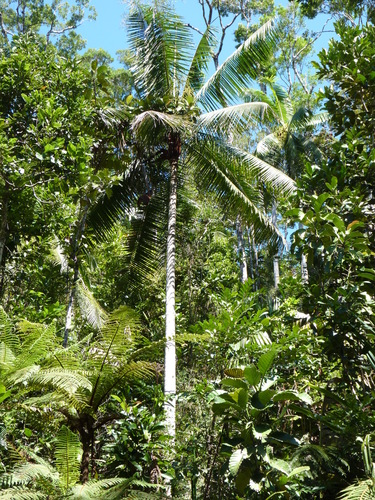
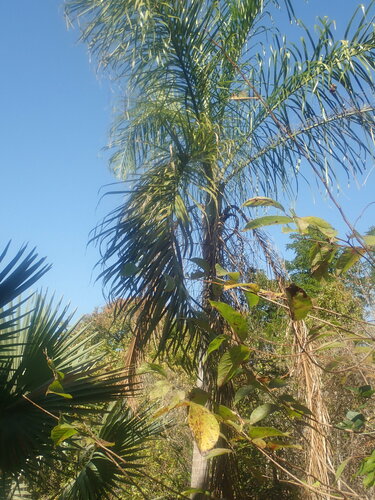
Source: WikipediaCalamus ornatus is a species of rattan palm native to peninsular Thailand, west and central Malaysia and the Philippines. It grows as a liana in wet tropical habitats.
Description
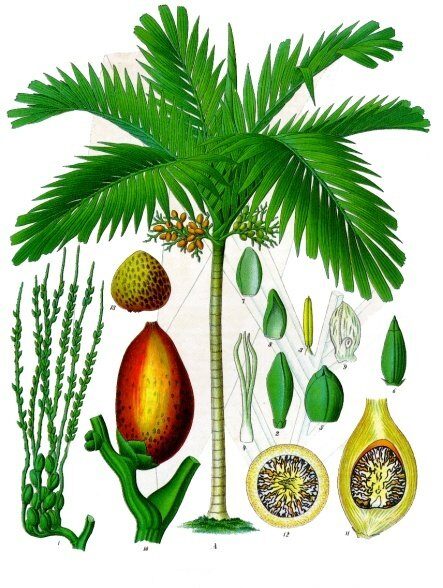
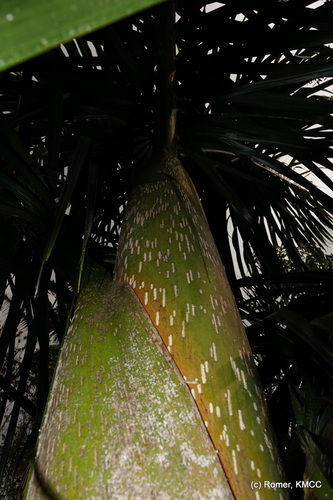
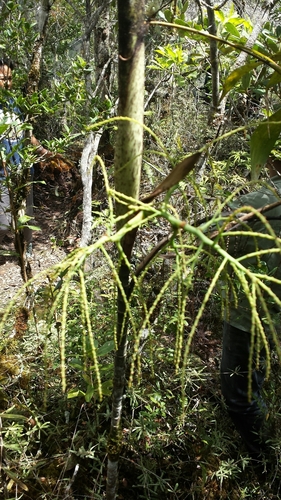
A climbing palm. There are spines along the stem. The stems are 8 cm thick. It can grow 70 m long. The leaves have leaflets along the stalk. These are large and dark green. The leaves are 4-5 m long. The leaflets are lance shaped, very large and equally spaced. The leaflets are 1m long and widely spaced. There is a whip like process on the stem. This can be 6 m long. The fruit are large and the seed is four sided. The fruit are red, scaly and 3.5 cm across. They have edible flesh.
Edible Uses
The buds are roasted and eaten. The fleshy portion of the fruit is eaten raw, plain, or made into sambal. Fresh stem sap provides drinking water. The palm heart and growing tips are consumed.
Traditional Uses
The bud is roasted and eaten. The fleshy portion of the fruit is eaten raw. The freshly cut stem gives good drinking water. Fruit eaten plain or made into a sambal in Brunei.
Medicinal Uses
The Semai people of Peninsular Malaysia consider it to be one of seven plant species whose leaves help in the avoidance of epidemic diseases. The water from the raw terminal bud is said to cure stomach-ache and diarrhoea. During childbirth, women in Sarawak may drink the extract of the roots to alleviate pain. The ash of the stem is believed to cure yaws.
Distribution
It is a tropical plant. They need a shady place and a well drained soil. They are most abundant at low and medium altitudes in virgin forests. They are found throughout the Philippines.
Where It Grows
Asia, Australia, Brunei, Indochina, Indonesia, Malaysia, Pacific, Philippines, Sarawak, SE Asia, Thailand,
Cultivation
Most species in this genus are more or less vigorous climbing plants in rainforests. Leaves of young plants are normally damaged if exposed to too much light, though leaves of older plants will usually tolerate full sun. In general, plants are likely to grow best with their roots in the shade but with enough gap in the canopy to encourage their stems to grow up towards the light. They are also likely to grow best in a humus-rich soil. Many of the species require fairly moist conditions for good growth, in fact several of them grow in wet soils or in areas with seasonal inundation - where we have the information it will be included under the plant’s habitat. Overhead shade should be manipulated at about 6-monthly intervals for the first 2 - 3 years of a young plant’s life to ensure they receive sufficient light to grow vigorously. About 40 - 50% light penetration is generally considered to be ideal for promoting stem growth. Little care is needed once the seedlings are established. It is important, however, to weed the area surrounding the seedlings occasionally until the plants are more than 2 metres tall. A dioecious species, both male and female forms need to be grown if fruit and seed are required.
Propagation
Seed - it has a fairly short viability and is best sown as soon as it is ripe.
Other Uses
The major use of the cane is for making furniture, and as core. Other uses include the making of walking sticks, handles for umbrellas, axes and parangs, and flooring. The stem, which is very long and robust, is traditionally employed as a cable stretched across rivers for moving ferry boats. The long and slender stems of Calamus species are put to various uses according to their size, length, flexibility, elasticity and toughness. The most slender canes are employed entire for binding purposes, and in making chairs, blinds, mats, wicker or basketwork, fishing implements, etc. Twisted together, they make very strong cables. The largest and more resistent canes are used entire as cables, the framework of wicker chairs etc. Usually, however, for many purposes the stems are split throughout their length into 2 - 4 or more strips from which the inner soft brittle and spongy portion is removed by means of a knife or same other instrument, so as to leave the external portion, which is hard, tough, flexible, elastic and has its outer surface very clean and smooth as if it had been varnished. Strips vary in width according to the use to which they are to be put. Those for delicate work, such as the network of furniture, small bags, hats, etc, are from 1 - 3mm wide; those employed as lashings in native housebuilding or in fastening the removable head of the Malay axe to its handle are from 5-6 mm wide. Collecting and preparing the stems is very simple. The stem is cut near the ground and detached from the trees by taking a strong hold of its base and thus pulling down the entire plant with its leaves. The most recent growth at the top of the plant is removed and then, handling it from the upper end, the stem is forcibly drawn in the opposite direction between two pieces of wood, thus removing the spiny coverings. It is then cut into lengths of about 5 metres, each piece is bent into two equal parts and the stems are fastened into bundles ready for market. The most valued stems are not thicker than a man's little finger and have a fine polished straw-yellow glassy surface. The plant is used in reforestation projects in the Philippines.
Production
It is fast growing.
Other Information
The fruit are sold in markets in Brunei.
Notes
There are 375-400 Calamus species. There are 175 species in tropical Asia.
Nutrition
| Part | Moisture | kJ | kcal | Protein | Vit A | Vit C | Iron | Zinc |
|---|---|---|---|---|---|---|---|---|
| Fruit | 79 | — | 79 | 0.6 | — | — | 1.7 | — |
| Shoots | — | — | — | — | — | — | — | — |
| Sap | — | — | — | — | — | — | — | — |
Synonyms
Also Known As
Limuran, Rotan dok, Wi jelayan
References (15)
- Alegado, A. M. & De Guzman, R. B., 2014, Indigenous food crops of the Aetas tribe in the Philippines and their traditional methods of food preparation. in Promotion of Underutilized Indigenous Food Resources for Food Security and Nutrition in Asia and Pacific. FAO. Bangkok p 160
- Balick, M.J. and Beck, H.T., (Ed.), 1990, Useful palms of the World. A Synoptic Bibliography. Colombia p 635
- Bircher, A. G. & Bircher, W. H., 2000, Encyclopedia of Fruit Trees and Edible Flowering Plants in Egypt and the Subtropics. AUC Press. p 72
- Burkill, I.H., 1966, A Dictionary of the Economic Products of the Malay Peninsula. Ministry of Agriculture and Cooperatives, Kuala Lumpur, Malaysia. Vol 1 (A-H) p 404
- Chai, P. P. K. (Ed), et al, 2000, A checklist of Flora, Fauna, Food and Medicinal Plants. Lanjak Entimau Wildlife Sanctuary, Sarawak. Forestry Malaysia & ITTO. p 162, 169
Show all 15 references Hide references
- Food Composition Tables for use in East Asia FAO http://www.fao.org/infoods/directory No. 994
- Johnson, D.V., 1998, Tropical palms. Non-wood Forest products 10. FAO Rome. p 66, 127
- Jones, D.L., 1994, Palms throughout the World. Smithtonian Institution, Washington. p 157
- Jones, D.L., 2000, Palms of Australia 3rd edition. Reed/New Holland. p 129
- Lacuna-Richman, C., 2006, The use of non-wood forest products by migrants in a new settlement: experiences of a Visayan community in Palawan, Philippines. Journal of Ethnobiology and Ethnomedicine. 2:36
- Milow, P., et al, 2013, Malaysian species of plants with edible fruits or seeds and their evaluation. International Journal of Fruit Science. 14:1, 1-27
- Monsalud, M.R., Tongacan, A.L., Lopez, F.R., & Lagrimas, M.Q., 1966, Edible Wild Plants in Philippine Forests. Philippine Journal of Science. p 522
- PROSEA (Plant Resources of South East Asia) handbook, Volume 6, 1993, Rattans.
- Riffle, R.L. & Craft, P., 2003, An Encyclopedia of Cultivated Palms. Timber Press. p 285
- Webbia 1:346. 1905