Acrostichum speciosum
Willd.
Mangrove fern, Wikakas fern
iNaturalist· cc-by-nc
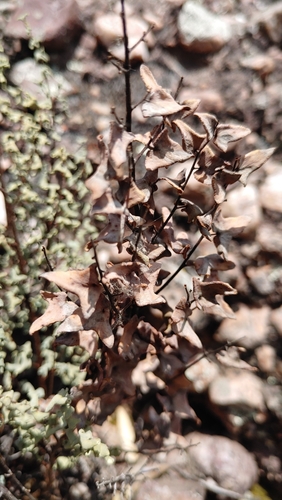
(c) Colin Trainor, some rights reserved (CC BY-NC), uploaded by Colin Trainor
iNaturalist· cc-by-sa
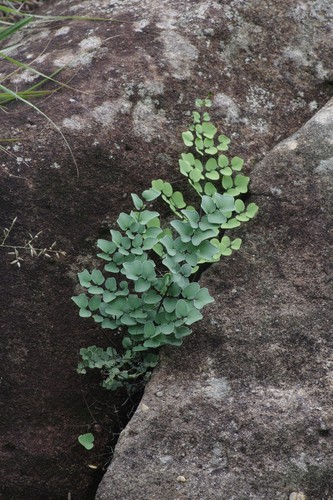
(c) Poyt448 Peter Woodard, some rights reserved (CC BY-SA)
iNaturalist· cc-by-nc
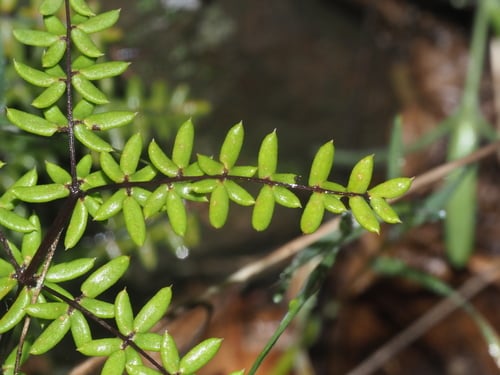
(c) Colin Trainor, some rights reserved (CC BY-NC), uploaded by Colin Trainor
Summary
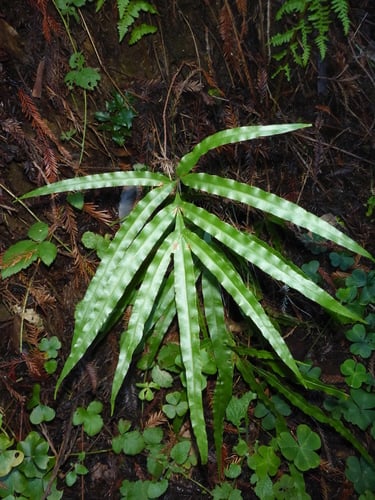
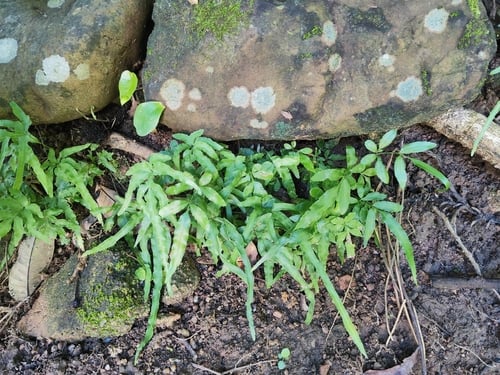
Source: WikipediaAcrostichum speciosum, the mangrove fern is a widespread plant found in Asia, Madagascar and Australia. A clumping plant to 1.5 metres tall with reddish/brown fertile fronds and pointed leaf tips. It is found as far south as New South Wales. It may be seen on coastal cliffs, but is usually seen in tidal flats, brackish swamps and with mangroves. The specific epithet speciosum refers to the attractive form of the plant. It first appeared in scientific literature in the year 1810, published in the Species Plantarum by Carl Ludwig Willdenow. It is now placed in the Parkerioideae subfamily of the family Pteridaceae.
Description
A coarse clumpy fern. It grows 1.5 m tall and has a creeping underground stem (rhizome) forming clumps. The stem is 5 cm across and 10 cm high. It is covered with brown scales. The leaves are erect fronds. The leaflets are on either side of the leaf stalk. The stalk of the frond is 50 cm long and 0.3-0.8 cm thick. The fronds are 1.5 m long. The leaflets are 20 cm long by 3.5 cm wide. They are somewhat thick and leathery. They are dull dark green. They taper to a narrow tip. The stalks for these leaflets are 1 cm long. The spores are produced on the upper fertile fronds. These are smaller than the sterile fronds. The spores cover the entire under surface as a dark brown mass. In Australia fertile fronds are produced in June.
Edible Uses
The root is processed to extract starch for eating, and the young curled shoots can be cooked and eaten as a vegetable.
Traditional Uses
The root is used for food. The starch is extracted and eaten. Also the young curled shoots can be cooked and eaten.
This uses section is brief — help expand it
Known Hazards
Very frost tender and plants are very difficult to transplant.
Distribution
A tropical plant. It grows in coastal flats and tidal areas. It is associated with mangroves. It can stand being flooded frequently by saltwater. This is the only fern found growing with mangroves. It occurs in Australia and Asia. It is very frost tender.
Where It Grows
Asia, Australia, China, Indochina, Indonesia, Malaysia, Pacific, Papua New Guinea, PNG, SE Asia, Solomon Islands, Thailand, Vietnam,
Cultivation
Plants are very difficult to transplant. Plants can be grown from young spores.
Other Information
It is used as food in Australia, but it is not known if it is used for food in Papua New Guinea.
Notes
There are 3 Acrostichum species. Also put in the family family Adiantaceae.
Synonyms
Also Known As
Pakis wikakas
References (28)
- Andrews, S.B., 1990, Ferns of Queensland. A handbook to the ferns and fern allies. Queensland DPI p 298
- Beasley, J., 2011, Plants of Tropical North Queensland - the compact guide. Footloose publications. p 20
- Brock, J., 1993, Native Plants of Northern Australia, Reed. p 80
- Cancilla, D., 2018, Ethnobotanical and Ethnozoological Values Desktop Assessment - Eliwana Project. p 44
- Chaffey, C.H., 1999, Australian Ferns. Growing them successfully. Kangaroo Press. p 72
Show all 28 references Hide references
- Cherikoff V. & Isaacs, J., The Bush Food Handbook. How to gather, grow, process and cook Australian Wild Foods. Ti Tree Press, Australia p 198
- Chin, W.Y., 1998, Ferns in the Tropics. Kangaroo. p 88
- Elliot, W.R., & Jones, D.L., 1982, Encyclopedia of Australian Plants suitable for cultivation. Vol 2. Lothian. p 144
- Flora of Solomon Islands
- Goudey, C.J., 1988, A Handbook of Ferns for Australia and New Zealand. Lothian. p 41
- Haslam, S., 2004, Noosa's Native Plants. Noosa Integrated Catchment Assn. Inc. p 123
- Hiddins, L., 1999, Explore Wild Australia with the Bush Tucker Man. Penguin Books/ABC Books. p 150
- Kenneally, K.E., Edinger, D. C., and Willing T., 1996, Broome and Beyond, Plants and People of the Dampier Peninsula, Kimberley, Western Australia. Department of Conservation and Land Management. p 50
- Lazarides, M. & Hince, B., 1993, Handbook of Economic Plants of Australia, CSIRO. p 8
- Leach, G.J., Osborne, P.L., 1985, Freshwater Plants of Papua New Guinea. UPNG Press, p 64
- Levitt, D., 1981, Plants and people. Aboriginal uses of plants on Groote Eylandt, Australian Institute of Aboriginal Studies, Canberra.
- Lim, T. K., 2015, Edible Medicinal and Non Medicinal Plants. Volume 9, Modified Stems, Roots, Bulbs. Springer p 3
- Lovelock, C., & Clarke, S., 1999, Field Guide to the Mangroves of Queensland. Australian Institute of Marine Science. p 24
- Low, T., 1991, Wild Food Plants of Australia. Australian Nature FieldGuide, Angus & Robertson. p 59
- Paczkowska, G. & Chapman, A.R., 2000, The Western Australian Flora. A Descriptive Catalogue. Western Australian Herbarium. p 26
- Pham-Hoang Ho, 1999, An Illustrated Flora of Vietnam. Nha Xuat Ban Tre. p 69
- Price, S.H. & J.L., Wild Food, Medicine and useful plants of the Wet tropics. Kwik Kopy, Cairns. p 3
- Melzer, R. & Plumb, J., 2011, Plants of Capricornia. Belgamba, Rockhampton. p 417
- Ryan, M. (Ed.), 2003, Wild Plants of Greater Brisbane. Queensland Museum. p 40
- Sukarya, D. G., (Ed.) 2013, 3,500 Plant Species of the Botanic Gardens of Indonesia. LIPI p 854
- Wheeler, J.R.(ed.), 1992, Flora of the Kimberley Region. CALM, Western Australian Herbarium, p 39
- Williams, K.A.W., 1999, Native Plants of Queensland Volume 4. Keith A.W. Williams North Ipswich, Australia. p 44
- www.eFloras.org Flora of China