Acrostichum aureum
L.
Golden Mangrove fern
iNaturalist· cc-by-nc
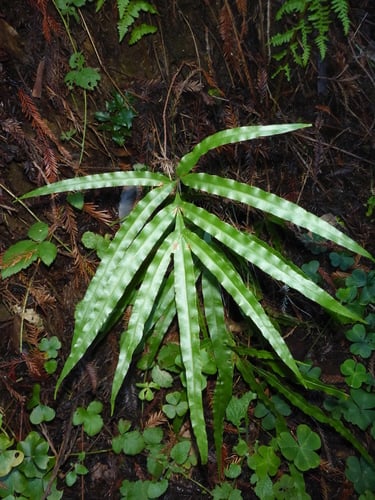
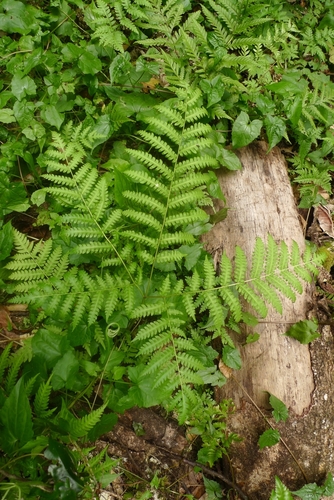
(c) John Starmer, some rights reserved (CC BY-NC), uploaded by John Starmer
iNaturalist· cc-by-nc
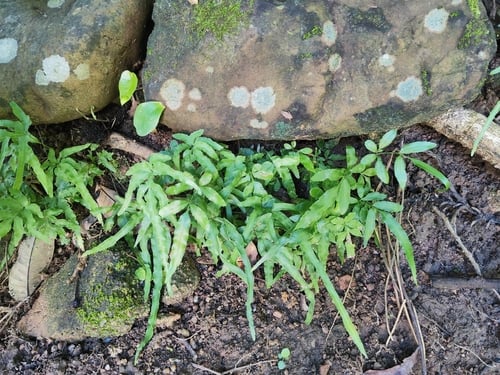
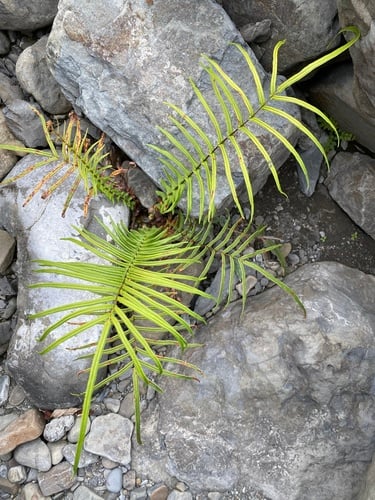
(c) wangleeping, some rights reserved (CC BY-NC), uploaded by wangleeping
iNaturalist· cc-by-nc
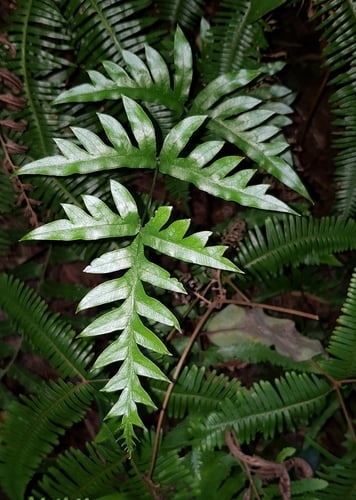
(c) Braden J. Judson, some rights reserved (CC BY-NC), uploaded by Braden J. Judson
Summary
Source: WikipediaAcrostichum aureum, the golden leather fern, is a large species of fern that grows in mangrove swamps and other wet locations. Other common names include swamp fern and mangrove fern.
Description
A fern with a short to medium creeping rhizome. The rhizome is up to 3 cm thick. It has large fleshy roots. The fronds are erect and up to 4 m long. The leaflets are large, thick and leathery. They are only divided once. They have blunt tips. They often have a yellowish colour. It grows in clumps or spreads out over the ground. Under the uppermost leaves there is often a mass of spores in a brown sugary mass.
Edible Uses
In Cambodia, where the fern is known as prâng' tük (prâng'="cycad", tük="aquatic", Khmer language), the young leaves are eaten in salads. In the Indian state of Goa, the fern crosiers (young fiddleheads) are cooked in a spicy coconut-based gravy known as tonak and consumed as a delicacy by the local people.
Traditional Uses
The young leaves (unfolded fronds) are eaten in salads. They are also cooked.
This uses section is brief — help expand it
Known Hazards
Although we have found no reports of toxicity for this species, a number of ferns contain carcinogens so some caution is advisable. Many ferns also contain thiaminase, an enzyme that robs the body of its vitamin B complex. In small quantities this enzyme will do no harm to people eating an adequate diet that is rich in vitamin B, though large quantities can cause severe health problems. The enzyme is destroyed by heat or thorough drying, so cooking the plant will remove the thiaminase.
Distribution
A tropical plant. Usually found in open swampy or mangrove situations. It cannot tolerate saltwater. It grows in Australia in the Northern Territory and Queensland. It is eaten in the Solomon Islands. It occurs throughout the tropics. It is very frost tender. It occurs in brackish pools and swamps and creeks near the beach. It can be on cliff-faces by the sea.
Where It Grows
Africa, American Samoa, Andamans, Asia, Australia, Bangladesh, Cambodia, Cameroon, Caroline Islands, Central Africa, China, Chuuk, East Africa, East Timor, Equatorial Guinea, Fiji, FSM, Gabon, Ghana, Guam, Guinea-Bissau, India, Indochina, Indonesia, Madagascar, Malaysia, Maldives, Micronesia, Mozambique, Niue, North America, Pacific, Papua New Guinea, PNG, Philippines, Rotuma, Samoa, SE Asia, Senegal, Sierra Leone, Solomon Islands, South America, Sri Lanka, Tahiti, Taiwan, Timor-Leste, Tonga, Turks & Caicos, USA, Vietnam, Wallis and Futuna, West Africa, Yap,
Cultivation
It is slow to re-establish if transplanted. Often transplanted plants die. The best option is to transplant young plants growing from spores. It can be grown from spores.
Other Uses
The ferns are dried, strung up on rods, and used instead of straw as thatch for the roof. The fronds can be combined with the leaves of Parinari laurinum.
Other Information
It is used as food in Australia, but it is not known if it is used for food in Papua New Guinea.
Notes
There are 3 Acrostichum species.
Synonyms
Also Known As
Akohorafanjava, Babasaga, Boresi, Boreti, Caca, Drababasavuga, Hagnaya, Hana meamea, Kalakeok, Kerakas, Khari bhaji, Kolovolo, Leather fern, Maakula hangali, Mayefungi, Marsh fern, Pakis laut, Paku larat, Paku laut, Palatava, Peye, Piai, Prang tuk, Sa'ato, Swamp fern, Vativati, Wihakas
References (40)
- Ambasta S.P. (Ed.), 2000, The Useful Plants of India. CSIR India. p 12
- Amoroso, V., et al, 2017, Indigenous edible ferns in southern Philippines: Utilization and conservation. China_Botanical Congress. p 3
- Amoroso, V. B., et al., 2017, Bringing back the Lost Value of Philippine EdibleFerns: Their Antioxidant, Proteins and Utilization. International Journal of Advanced research. 5(4), 757-770
- Andrews, S.B., 1990, Ferns of Queensland. A handbook to the ferns and fern allies. Queensland DPI p 298
- Burkill, H. M., 1985, The useful plants of west tropical Africa, Vol. 5. Kew.
Show all 40 references Hide references
- Burkill, I.H., 1966, A Dictionary of the Economic Products of the Malay Peninsula. Ministry of Agriculture and Cooperatives, Kuala Lumpur, Malaysia. Vol 1 (A-H) p 41
- Chaffey, C.H., 1999, Australian Ferns. Growing them successfully. Kangaroo Press. p 71
- Chin, W.Y., 1998, Ferns in the Tropics. Kangaroo. p 88
- Cribb, A.B. & J.W., 1976, Wild Food in Australia, Fontana. p 159
- Elliot, W.R., & Jones, D.L., 1982, Encyclopedia of Australian Plants suitable for cultivation. Vol 2. Lothian. p 143
- Flora and Livestock in Coastal Karnataka. 2007, Report. EMPRI p 60
- Franklin, J., Keppel, G., & Whistler, W., 2008, The vegetation and flora of Lakeba, Nayau and Aiwa Islands, Central Lau Group, Fiji. Micronesica 40(1/2): 169–225, 2008
- French, B.R., 2010, Food Plants of Solomon Islands. A Compendium. Food Plants International Inc. p 117
- Goudey, C.J., 1988, A Handbook of Ferns for Australia and New Zealand. Lothian. p 41
- Grubben, G. J. H. and Denton, O. A. (eds), 2004, Plant Resources of Tropical Africa 2. Vegetables. PROTA, Wageningen, Netherlands. p 559
- Jansen, A. A. J., et al, (Eds), 1990, Food and Nutrition in Fiji. Volume One. p 52
- Jones, D.L. & Clemesha, S.C., 1976, Australian Ferns & Fern Allies. Reed. p 99
- Leach, G.J., Osborne, P.L., 1985, Freshwater Plants of Papua New Guinea. UPNG Press, p 63
- Low, T., 1991, Wild Food Plants of Australia. Australian Nature FieldGuide, Angus & Robertson. p 59
- Low, T., 1992, Bush Tucker. Australia’s Wild Food Harvest. Angus & Robertson. p 110
- Macmillan, H.F. (Revised Barlow, H.S., et al), 1991, Tropical Planting and Gardening. Sixth edition. Malayan Nature Society. Kuala Lumpur. p 356
- Maghirang, R. G., et al, 2018. Ethnobotanical Studies of Some Plants Commonly Used as Vegetables in Selected Provinces of the Philippines. Journal of Nature Studies. 17(2), 30-43.
- NYBG Herbarium "edible"
- Paczkowska, G. & Chapman, A.R., 2000, The Western Australian Flora. A Descriptive Catalogue. Western Australian Herbarium. p 25
- Parham, B. E. V., 1972, Plants of Samoa. New Zealand Department of Scientific and Industrial Research. Information Series. No. 85 p 50
- Peekel, P.G., 1984, (Translation E.E.Henty), Flora of the Bismarck Archipelago for Naturalists, Division of Botany, Lae, PNG. p 25, 24
- Pham-Hoang Ho, 1999, An Illustrated Flora of Vietnam. Nha Xuat Ban Tre. p 69
- Phon, P., 2000, Plants used in Cambodia. © Pauline Dy Phon, Phnom Penh, Cambodia
- Piggott, A. G. 1988, Ferns of Malaysia in Colour. Tropical press, Malaysia. p 232
- PROTA
- Siemonsma, J. S. & Kasem Piluek, eds. 1993. Vegetables. In: Plant Resources of South-East Asia (PROSEA) 8:311
- Sp. pl. 2:1069. 1753
- Sujanapal, P., & Sankaran, K. V., 2016, Common Plants of Maldives. FAO & Kerala FRI, p 17
- Sukarya, D. G., (Ed.) 2013, 3,500 Plant Species of the Botanic Gardens of Indonesia. LIPI p 854
- Thaman, R. R., 1992, Batiri Kei Baravi: The Ethnobotany of Pacific Island Coastal Plants. Atoll Research Bulletin. No. 361.
- Usher, G., 1974, A Dictionary of Plants Used by Man. Constable. p 19
- World Checklist of Useful Plant Species 2020. Royal Botanic Gardens, Kew
- www.eFloras.org Flora of China
- Yuncker, T.G., 1959, Plants of Tonga, Bernice P. Bishop Museum, Hawaii, Bulletin 220. p 40
- Yusuf, U. K., 2010, Ferns of Malaysian Rain Forest. A Journey Through the Fern World. Universiti Putra Malaysia Press p 32