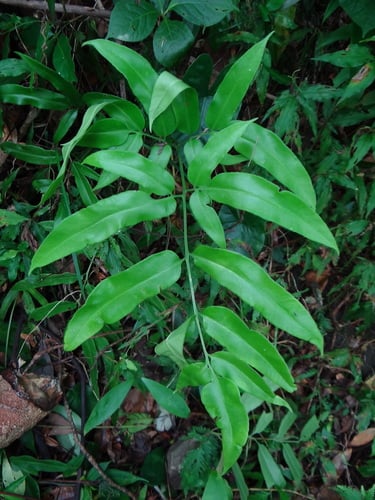
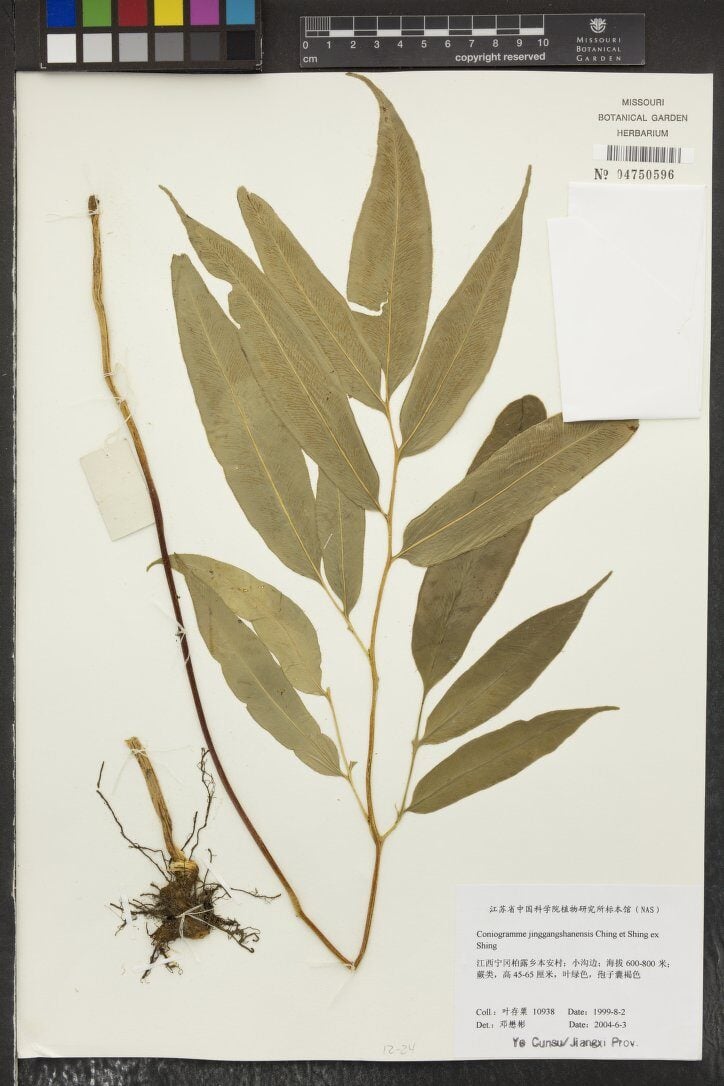
Ceratopteris thalictroides
(L.) Brongniart
Swamp fern, Water sprite, Water hornfern
iNaturalist· cc-by
(c) Татьяна Максимова, some rights reserved (CC BY), uploaded by Татьяна Максимова
iNaturalist· cc-by-nc
(c) Biswas Sajib, some rights reserved (CC BY-NC)
iNaturalist· cc-by-nc
(c) Biswas Sajib, some rights reserved (CC BY-NC)
Summary
Source: WikipediaCeratopteris thalictroides is a fern species belonging to the genus Ceratopteris, one of only two genera of the subfamily Parkerioideae of the family Pteridaceae.
Description
A fern which grows in water. It is an annual plant. It grows 10-35 cm tall. It has soft upright stalks with light green soft fronds. The rhizome is short and sticks up. There are thin, clear, scales on the rhizome. The leaves vary from simple leaves, to leaves which are divided 3 times. The stem is anchored in mud. It grows as tufted clumps. Leaves are like carrot tops. The stem of the frond is spongy and air filled. It can grow under the water or be free floating. It produces small plants on the fronds. The fertile fronds which produce the spores, are longer and more finely divided, than the other fronds. They are more stiff and erect and turn brown when mature. The plant only lasts a few months.
Edible Uses
The fronds are cooked and eaten as a vegetable in Madagascar and Swaziland, New Guinea, Nepal, and Vietnam, and other parts of Asia. It has been used similarly to watercress. In Malaysia and Japan, uncurled fronds have been used in salads. Some ferns are potentially carcinogenic when eaten; this may be the case in Ceratopteris thalictroides.
Traditional Uses
The plant is edible. It can be used raw or cooked. The young fronds are eaten in stir-fries. The young uncurled fronds can be eaten raw.
This uses section is brief — help expand it
Medicinal Uses
Rhizomes and fronds are used as medicine for foetal toxins and accumulation of phlegm. Both the leaves and the root are used as a poultice against skin complaints, e.g. as a drawing agent on carbuncles. In China they are used as a styptic to stop bleeding. Alkaloids, arbutin and tannin have been found in the green parts of the plant.
Known Hazards
Although we have found no reports of toxicity for this species, a number of ferns contain carcinogens so some caution is advisable. Many ferns also contain thiaminase, an enzyme that robs the body of its vitamin B complex. In small quantities this enzyme will do no harm to people eating an adequate diet that is rich in vitamin B, though large quantities can cause severe health problems. The enzyme is destroyed by heat or thorough drying, so cooking the plant will remove the thiaminase.
Distribution
A tropical plant. It grows in still or slow flowing fresh water in the tropics. It occurs in swamps up to 1300 m altitude in Papua New Guinea, but it is mostly below 500 m. It can float. It is found in all tropical countries. It is very frost tender. They occur throughout the Philippines near sea level on mud and are able to thrive in shallow water. It grows well in acidic soil (pH 5-6.5) and in shady places. It needs temperatures above 18°C. It grows in wetlands.
Where It Grows
Africa, Andaman Is., Angola, Asia, Australia, Bangladesh, Benin, Bolivia, Botswana, Brazil, Burkina Faso, Burundi, Cambodia, Cameroon, Central Africa, Central African Republic, CAR, Central America, Chad, China, Colombia, Congo DR, Congo R, Costa Rica, Côte d'Ivoire, East Africa, Ecuador, El Salvador, Eswatini, Ethiopia, Fiji, Gabon, Ghana, Guam, Guianas, French Guinea, Guatemala,Guinée, Guinea-Bissau, Guyana, Hawaii, Himalayas, Honduras, India, Indochina, Indonesia, Ivory Coast, Jamaica, Japan, Kenya, Korea, Laos, Liberia, Madagascar, Malaysia, Malawi, Mali, Marianas, Mexico, Mozambique, Myanmar, Namibia, Nepal, Nicobar Is., Nigeria, North America, Northeastern India, Pacific, Papua New Guinea, PNG, Panama, Philippines, Puerto Rico, Romania, SE Asia, Senegal, Sierra Leone, Solomon Islands, Somalia, South Africa, Southern Africa, South America, Sri Lanka, Sudan, Suriname, Swaziland, Taiwan, Tanzania, Thailand, Togo, Uganda, USA, Venezuela, Vietnam, West Africa, West Indies, Zambia, Zimbabwe,
Cultivation
It is grown as an aquarium plant. Small pieces of plant will root in mud. Spores can also grow.
Propagation
Spores - Bulbils growing on the leaves. Any part of the leaf, if left floating in the water, will give rise to new plantlets.
Other Uses
The plants can be used as a green manure in rice fields.
Other Information
It is a commercially cultivated vegetable.
Notes
There are 3-4 Ceratopteris species. They are also put in the family Ceratopteridaceae and Parkeriaceae. It grows throughout the lowland tropic in estuaries and swamps.
Nutrition
| Part | Moisture | kJ | kcal | Protein | Vit A | Vit C | Iron | Zinc |
|---|---|---|---|---|---|---|---|---|
| Leaves | 92.6 | — | 252 | 21.2 | — | — | — | — |
Synonyms
Also Known As
Floating stag's horn, Hihiawai, Oriental water fern, Pakis air, Pakis rawa, Pakis tespong, Paku chai, Paku roman, Paku tespong, Pani dhaniya, Pani dhekia, Pani shak, Sachi, Sayur kodok, Sumatra fern, Water fern
References (58)
- Ambasta S.P. (Ed.), 2000, The Useful Plants of India. CSIR India. p 117 (As Ceratopteris siliquosa)
- Amoroso, V. B., et al., 2017, Bringing back the Lost Value of Philippine EdibleFerns: Their Antioxidant, Proteins and Utilization. International Journal of Advanced research. 5(4), 757-770
- Andrews, S.B., 1990, Ferns of Queensland. A handbook to the ferns and fern allies. Queensland DPI p 90
- BARC, 2016, State of Biodiversity for Food and Agriculture in Bangladesh. Bangladesh Agricultural Research Council.
- Bodkin, F., 1991, Encyclopedia Botanica. Cornstalk publishing, p 239
Show all 58 references Hide references
- Bandyopadhyay, S., et al, 2012, A Census of Wild Edible Plants from Howrah District, West Bengal, India. Proceedings of UGC sponsored National Seminar 2012
- Bull. Sci. Soc. Philom. Paris ser. 3, 8:186. 1822 ("1821")
- Burkill, H. M., 1985, The useful plants of west tropical Africa, Vol. 5. Kew.
- Burkill, I.H., 1966, A Dictionary of the Economic Products of the Malay Peninsula. Ministry of Agriculture and Cooperatives, Kuala Lumpur, Malaysia. Vol 1 (A-H) p 519
- Calvert, G. & Liessman, L., 2014, Wetland Plants of the Townsville - Burdekin Flood Plain. LBLCA Ayr, Queensland, p 71
- Chaffey, C.H., 1999, Australian Ferns. Growing them successfully. Kangaroo Press. p 11, 117
- Cribb, A.B. & J.W., 1976, Wild Food in Australia, Fontana. p 134
- Dangol, D. R. et al, 2017, Wild Edible Plants in Nepal. Proceedings of 2nd National Workshop on CUAOGR, 2017.
- Elliot, W.R., & Jones, D.L., 1984, Encyclopedia of Australian Plants suitable for cultivation. Vol 3. Lothian. p 11
- French, B.R., 1986, Food Plants of Papua New Guinea, A Compendium. Asia Pacific Science Foundation p 329
- Gallagher, D. E., 2010, Farming beyond the escarpment: Society, Environment, and Mobility in Precolonial Southeastern Burkina Faso. PhD University of Michigan.
- Ghosh, C. & Das A. P., 2011, Some useful and poisonous tea garden weeds from the Darjiling District of West Bengal, India. Pleione 5(1): 91 - 114
- Goudey, C.J., 1988, A Handbook of Ferns for Australia and New Zealand. Lothian. p 74
- Grubben, G. J. H. and Denton, O. A. (eds), 2004, Plant Resources of Tropical Africa 2. Vegetables. PROTA, Wageningen, Netherlands. p 173
- Hu, Shiu-ying, 2005, Food Plants of China. The Chinese University Press. p 272
- Hussey, B.M.J., Keighery, G.J., Cousens, R.D., Dodd, J., Lloyd, S.G., 1997, Western Weeds. A guide to the weeds of Western Australia. Plant Protection Society of Western Australia, p 12
- Islam, M., 1983, Utilisation of Certain Ferns and Fern Allies in the North-Eastern Region, India. J. Econ. Tax. Bot. Vol.4. No.3 pp 861-
- Jacquat, C., 1990, Plants from the Markets of Thailand. D.K. Book House p 32
- Johns, R.J. & Bellamy, A., 1979, The Ferns and Fern Allies of Papua New Guinea. Forestry College, Bulolo Papua New Guinea. p 11.1
- Kays, S. J., and Dias, J. C. S., 1995, Common Names of Commercially Cultivated Vegetables of the World in 15 languages. Economic Botany, Vol. 49, No. 2, pp. 115-152
- Kenneally, K.E., Edinger, D. C., and Willing T., 1996, Broome and Beyond, Plants and People of the Dampier Peninsula, Kimberley, Western Australia. Department of Conservation and Land Management. p 49
- Kew Plants of the World Online
- Leach, G.J., Osborne, P.L., 1985, Freshwater Plants of Papua New Guinea. UPNG Press, p 54
- Liu, Y., et al, 2012, Food uses of ferns in China: a review. Acta Societatis Botanicorum Poloniae 84(4): 263-270 (
- Long, C., 2005, Swaziland's Flora - siSwati names and Uses http://www.sntc.org.sz/flora/
- Luo, B., et al, 2019, Wild edible plants collected by Hani from terraced rice paddy agroecosystem in Honghe Prefecture, Yunnan, China. Journal of Ethnobiology and Ethnomedicine 15:56
- Macmillan, H.F. (Revised Barlow, H.S., et al), 1991, Tropical Planting and Gardening. Sixth edition. Malayan Nature Society. Kuala Lumpur. p 356
- Maroyi, A., 2014, Not just minor wild edible forest products: consumption of pteridophytes in sub-Saharan Africa. Journal of Ethnobiology and Ethnomedicine. 10:78
- Monsalud, M.R., Tongacan, A.L., Lopez, F.R., & Lagrimas, M.Q., 1966, Edible Wild Plants in Philippine Forests. Philippine Journal of Science. p 513 (As Ceratopteris siliquosa)
- Ng, X. N., et al, 2012, Nutritional profile and antioxidative properties of selected tropical vegetables. International Food Research Journal 19(4): 1487-1496
- Ogle, B. M., et al, 2003, Food, Feed or Medicine: The Multiple Functions of Edible Wild Plants in Vietnam. Economic Botany 57(1): 103-117
- Ojha, R. & Devkota, H. P., 2021, Edible and Medicinal Pteridophytes of Nepal: A Review. Ethnobotany Research & Applications 22:16
- Omawale, 1973, Guyana's edible plants. Guyana University, Georgetown p 111
- Paczkowska, G . & Chapman, A.R., 2000, The Western Australian Flora. A Descriptive Catalogue. Western Australian Herbarium. p 21
- Patiri, B. & Borah, A., 2007, Wild Edible Plants of Assam. Geethaki Publishers. p 162
- Pham-Hoang Ho, 1999, An Illustrated Flora of Vietnam. Nha Xuat Ban Tre. p 49 (As Ceratopteris siliquosa)
- Peekel, P.G., 1984, (Translation E.E.Henty), Flora of the Bismarck Archipelago for Naturalists, Division of Botany, Lae, PNG. p 27, 26
- Romanowski, N., 2007, Edible Water Gardens. Hyland House. p 40
- Sainty, G.R. & Jacobs, S.W.L., 1981, Waterplants of New South Wales. Water Resources Commission. NSW p 339
- Sarker, S. K., & Enayet Hossain, A. B. M., 2009, Pteridophytes of Greater Mymensingh District of Bangladesh used as Vegetables and Medicines. Bangladesh J. Plant Taxon. 16(1) 47-56. p 51
- Singh, K.K., & Maheshwari, J.K., 1984, Studies of the Flora of Dudwa National Park. Kheri District, U.P. (Part 1) J. Econ. Tax. Bot. Vol 5 No. 2 pp 379-
- Slocum, P.D. & Robinson, P., 1999, Water Gardening. Water Lilies and Lotuses. Timber Press. p 64
- Staples, G.W. and Herbst, D.R., 2005, A tropical Garden Flora. Bishop Museum Press, Honolulu, Hawaii. p 42
- Stephens, K.M., & Dowling, R.M., 2002, Wetland Plants of Queensland. A field guide. CSIRO p 62
- Stone, B. C., 1970, The Flora of Guam. A Manual for the Identification of the Vascular Plants of the Island. Micronesica. Journal of the University of Guam. p 51 (As Ceratopteris gaudichaudii)
- Sukarya, D. G., (Ed.) 2013, 3,500 Plant Species of the Botanic Gardens of Indonesia. LIPI p 858, 1148
- Swaziland's Flora Database http://www.sntc.org.sz/flora
- Wheeler, J.R.(ed.), 1992, Flora of the Kimberley Region. CALM, Western Australian Herbarium, p 34
- Wild edible plants of Himachal Pradesh
- World Checklist of Useful Plant Species 2020. Royal Botanic Gardens, Kew
- www.eFloras.org Flora of China
- Yusuf, U. K., 2010, Ferns of Malaysian Rain Forest. A Journey Through the Fern World. Universiti Putra Malaysia Press p 34
- Zhang, Y., et al, 2014, Diversity of wetland plants used traditionally in China: a literature review. Journal of Ethnobiology and Ethnomedicine. 10:72