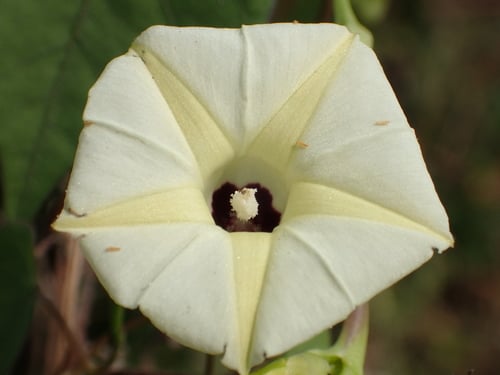
Merremia verecunda
Rendle
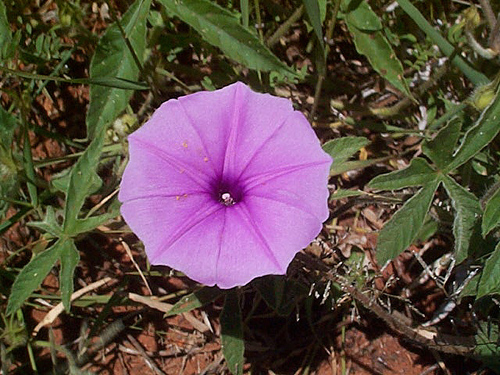
iNaturalist· cc-by-nc
(c) lorainevdb, some rights reserved (CC BY-NC), uploaded by lorainevdb
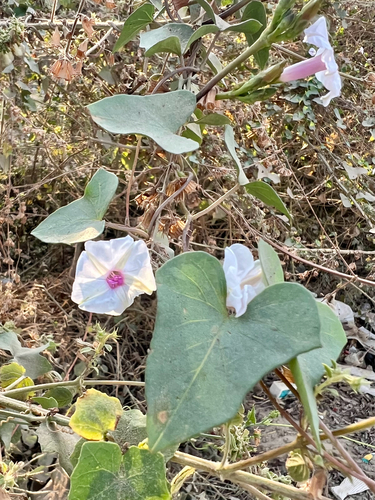
iNaturalist· cc-by-sa
(c) M Kriek, some rights reserved (CC BY-SA)
Description
A trailing or climbing vine in the Convolvulaceae family with annual stems 50-150 cm long. It is a tropical plant that grows in deep, dry sand at elevations between 930-1,070 m.
Edible Uses
The leaves are cooked and eaten as a side dish.
Traditional Uses
The leaves are cooked and eaten as a side dish.
This uses section is brief — help expand it
Medicinal Uses
In the Indigenous system of Medicine, Ipomoea reniformis chois is also known as Merremia emarginata (Burm.f.) Hallier f. has been claimed to be useful for cough, headache, neuralgia, rheumatism, diuretic, inflammation, fever due to enlargement of liver and also in kidney diseases. The tribal people use this plant for deobstruent, diuretic, rheumatism, neuralgia, cancerous wounds, migraine, purgative, snake bites, ulcer, abscesses and glandular swelling.
Distribution
It is a tropical plant. It grows in deep, dry sand between 930-1,070 m above sea level.
Where It Grows
Africa, Botswana, Namibia, South Africa, Southern Africa,
Synonyms
References (3)
- Fern, K., 2012, Tropical Species Database http://theferns.info/tropical/
- Ruiters-Welcome, A. K., 2019, Food plants of southern Africa. Ph.D. thesis. Univ. of Johannesburg p 47
- Welcome, A. K. & Van Wyk, B.-E., 2019, An inventory and analysis of the food plants of southern Africa. South African Journal of Botany 122 (2019) 136–179