Ipomoea oblongata
E. Mey. ex Choisy
Morning glory
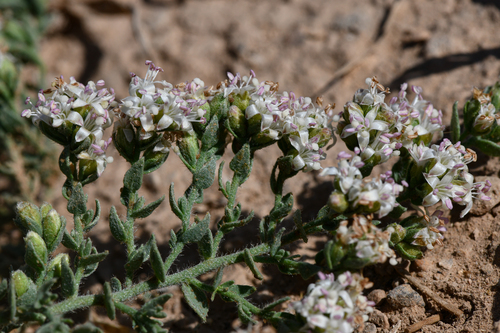
iNaturalist· cc-by-sa
(c) Nicola van Berkel, some rights reserved (CC BY-SA), uploaded by Nicola van Berkel
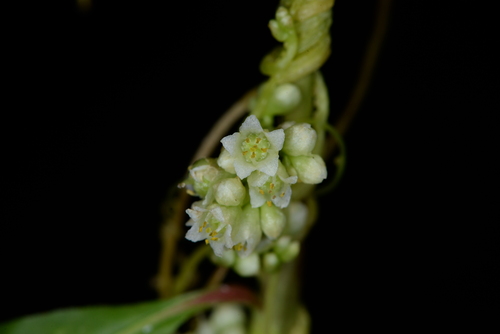
iNaturalist· cc-by-nc
(c) Emma (Ferreira) Swanepoel, some rights reserved (CC BY-NC), uploaded by Emma (Ferreira) Swanepoel
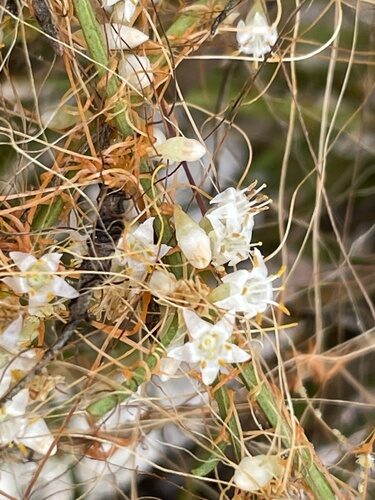
iNaturalist· cc-by-nc
(c) Troos van der Merwe, some rights reserved (CC BY-NC), uploaded by Troos van der Merwe
Description
A herb. It lies along the ground. It has broad leaves and can be a climber or scrambler. It keeps growing from year to year. The vines are 2 m long. The leaves are on short almost erect stalks. The leaves vary in shape. The edges are wavy with a fringe of hairs. The tuberous root can be 40 cm thick. The flowers usually occur singly on erect stalks. The fruit is a 1-3 seeded capsule.
Edible Uses
The roots or tubers are dried and eaten as a vegetable and valued for their moisture content; dried crushed tubers have been mixed with milk and boiled in water.
Traditional Uses
The roots or tubers are dried and eaten as a vegetable and also contain useful moisture. Caution: They may be poisonous and can be bitter. The dried crushed tubers have been mixed with milk and boiled in water.
Known Hazards
The roots or tubers may be poisonous and can be bitter.
Distribution
It is a subtropical plant. It grows in hot arid regions. It grows in places with a marked dry season. It can grow in places with a dry season of 6-11 months. It needs well-drained soils. It grows between 245-2,045 m above sea level. It can grow in arid places. It grows in woodland and grassland on wet and sandy soils.
Where It Grows
Africa, Botswana, East Africa, Eswatini, Lesotho, Mozambique, Namibia, South Africa, Southern Africa, Swaziland, Zimbabwe,
Other Information
It is often a famine food.
Synonyms
Also Known As
Bhogo, Ghoqu, Mothokxo, Ubhogo, Ubhoqo, Ubhuqu
References (9)
- Fox, F. W. & Young, M. E. N., 1982, Food from the Veld. Delta Books. p 162 (As Turbina oblongata)
- Guillarmod, J., 1971, (As Turbina oblongata)
- Jardin, C., 1970, List of Foods Used In Africa, FAO Nutrition Information Document Series No 2.p 20 (As Turbina oblongata)
- Long, C., 2005, Swaziland's Flora - siSwati names and Uses http://www.sntc.org.sz/flora/
- Peters, C. R., O'Brien, E. M., and Drummond, R.B., 1992, Edible Wild plants of Sub-saharan Africa. Kew. p 97 (As Turbina oblongata)
Show all 9 references Hide references
- Royal Botanic Gardens, Kew (1999). Survey of Economic Plants for Arid and Semi-Arid Lands (SEPASAL) database. Published on the Internet; http://www.rbgkew.org.uk/ceb/sepasal/internet [Accessed 14th April 2011]
- Ruiters-Welcome, A. K., 2019, Food plants of southern Africa. Ph.D. thesis. Univ. of Johannesburg p 46
- Welcome, A. K. & Van Wyk, B.-E., 2019, An inventory and analysis of the food plants of southern Africa. South African Journal of Botany 122 (2019) 136–179
- World Checklist of Useful Plant Species 2020. Royal Botanic Gardens, Kew