Chenopodium ficifolium
Sm.
Fig-leaved goosefoot
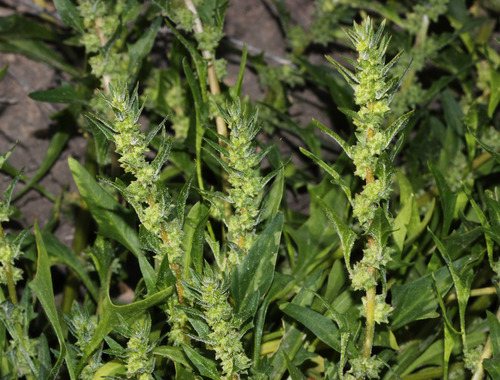
iNaturalist· cc-by-nc
(c) sppiraea, some rights reserved (CC BY-NC)
iNaturalist· cc-by-nc
(c) 傻子, some rights reserved (CC BY-NC)
iNaturalist· cc-by-nc
(c) 傻子, some rights reserved (CC BY-NC)
Summary
Source: WikipediaChenopodium ficifolium, the fig-leaved goosefoot or figleaf goosefoot, is a plant species in the family Amaranthaceae originally native to the Irano-Turanian floristic region. It an archaeophyte weed in Europe and can now be found in temperate crop-growing regions in most of the world.
Description
It is a herb. It grows 20-50 cm tall. The stems are green and have ridges along them. The leaf blade is oval and 3-5 cm long by 1-4 cm wide. They usually have 3 lobes. The flowers are in round groups spreading along the ends of the branches. The seeds are black and 1 mm across.
Edible Uses
The leaves and flower buds can be cooked and used like spinach or added to soups. Raw leaves should only be eaten in small quantities. The seed can be roasted and used as a condiment, employed in the same way as sesame for flavouring foods.
Medicinal Uses
None known.
Known Hazards
The leaves and seeds of all members of this genus are more or less edible. However, many of the species in this genus contain saponins, though usually in quantities too small to do any harm. Although toxic, saponins are poorly absorbed by the body and most pass straight through without any problem. They are also broken down to a large extent in the cooking process. Saponins are found in many foods, such as some beans. Saponins are much more toxic to some creatures, such as fish, and hunting tribes have traditionally put large quantities of them in streams, lakes etc in order to stupefy or kill the fish. The plants also contain some oxalic acid, which in large quantities can lock up some of the nutrients in the food. However, even considering this, they are very nutritious vegetables in reasonable quantities. Cooking the plants will reduce their content of oxalic acid. People with a tendency to rheumatism, arthritis, gout, kidney stones or hyperacidity should take especial caution if including this plant in their diet since it can aggravate their condition.
Distribution
It is a temperate plant. In Bhutan it grows between 500 and 1600 m above sea level.
Where It Grows
Asia, Bhutan, Britain, Cambodia, Central Asia, China, Europe, Himalayas, Indochina, Korea, Laos, North America, SE Asia, Taiwan, Tajikistan, Vietnam,
Cultivation
An easily grown plant, succeeding in most soils but disliking shade. It prefers a moderately fertile soil.
Propagation
Sow seed in spring in situ. Most seed typically germinates within a few days of sowing.
Other Uses
Gold and green dyes can be obtained from the whole plant.
Other Information
It is sold in local markets.
Notes
There are about 100-150-250 Chenopodium species. They are mostly in temperate regions. Also put in the family Chenopodiaceae.
Synonyms
Also Known As
Bethu, Kinhgioi trang, Ma lan gai, Nui za, Pa hong ge, Rau muoi
References (5)
- Cao, Y., et al, 2020, Ethnobotanical study on wild edible plants used by three trans-boundary ethnic groups in Jiangcheng County, Pu’er, Southwest China. Journal of Ethnobiology and Ethnomedicine (2020) 16:66
- Fl. brit. 1:276. 1800
- Hwang, H., et al, 2013, A Study on the Flora of 15 Islands in the Western Sea of Jeollanamdo Province, Korea. Journal of Asia-Pacific Biodiversity Vol. 6, No. 2 281-310
- Mukhia, P.K., et al, 2013, Wild plants as Non Wood Forest Products used by the rural community of Dagana, a southern foothill district of Bhutan, SAARC Journal, 27 pages
- Plants for a Future database, The Field, Penpol, Lostwithiel, Cornwall, PL22 0NG, UK. http://www.scs.leeds.ac.uk/pfaf/