Salsola soda
L.
Barilla plant, Opposite-leaf Russian-thistle
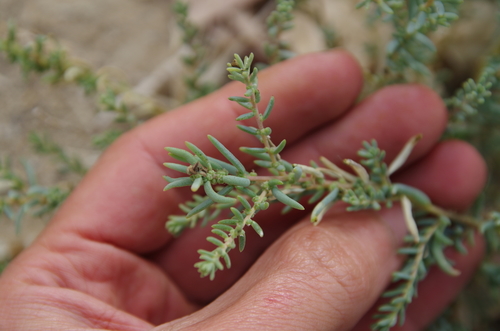
iNaturalist· cc-by-nc
(c) Theodore, some rights reserved (CC BY-NC), uploaded by Theodore
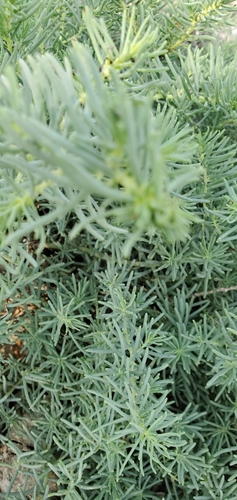
iNaturalist· cc-by-nc
(c) Theodore, some rights reserved (CC BY-NC), uploaded by Theodore
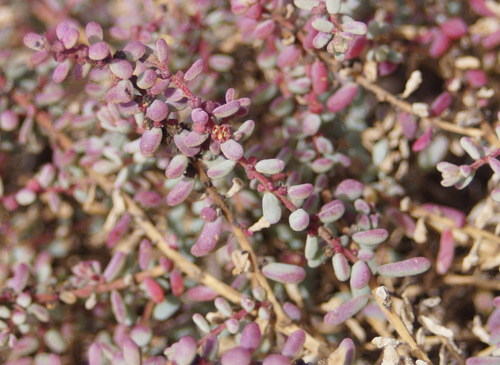
iNaturalist· cc-by-nc
(c) avocat, some rights reserved (CC BY-NC), uploaded by avocat
Summary
Annual herb growing to 0.6 m (2 ft) tall. Hermaphroditic. Grows well in light sandy and medium loamy soils across mildly acid to very alkaline pH ranges, including saline soils. Requires full sun and adapts to dry or moist soil conditions. Tolerates maritime exposure.
Description
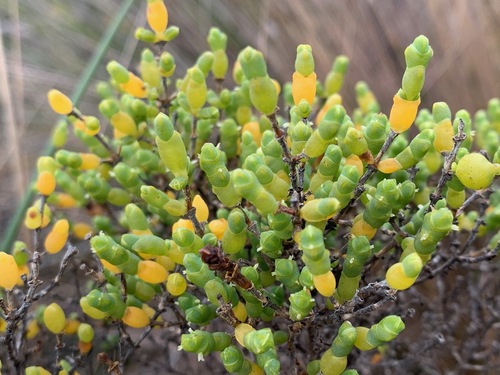
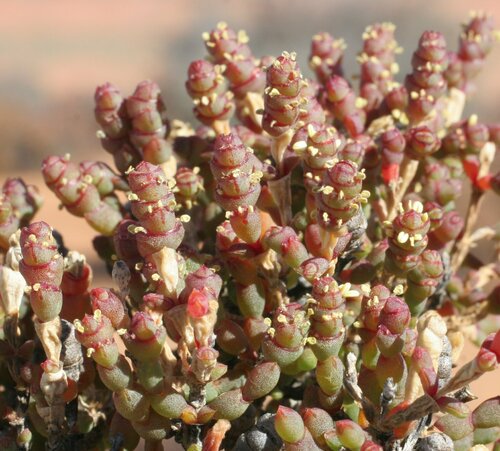
An annual herb. It grows 20-70 cm tall. It has a short taproot. The leaves are pointed but without a spiny tip. They are succulent and almost half round. They are 2-7 cm long by 2 mm wide. The flowers are small and without stalks. They are in the axils of leaves.
Edible Uses
Young leaves and stems can be cooked and used as a vegetable. They have a crunchy, tender texture.
Traditional Uses
The succulent tender young shoots are boiled or steamed and served with olive oil and lemon juice.
This uses section is brief — help expand it
Medicinal Uses
None known
Distribution
It is a Mediterranean climate plant. It grows in saline lake sides, meadows with salt-containing soils. In grows on sandy seashores. It has been used to restore salty marshes. In Argentina it grows below 500 m above sea level.
Where It Grows
Africa, Argentina, Asia, China, Europe, France, Greece, Italy, Japan, Mediterranean, North Africa, North America, Portugal, Russia, South America, Spain, Turkey, Türkiye, USA,
Cultivation
We have very little information on this species and do not know if it will be hardy in Britain, though judging by its native range it should succeed outdoors in many parts of this country. Plants are sometimes cultivated for the potash obtained from their stems. The following notes are based on the general needs of the genus. Requires a very sunny position in a light or medium well-drained soil, it tolerates salty soils, occasional inundation by salt water and maritime exposure. Succeeds in poor soils and grows more vigorously on alkaline soils.
Propagation
Sow seed in spring directly in situ. Seed has short viability and should be stored in cool conditions over winter.
Other Uses
Burning the plant produces ashes used in the manufacture of glass and soap. Large quantities were once imported into Britain for this purpose, though a chemical process using salt has since replaced this method.
Other Information
It is a commercially cultivated vegetable. The leaves are sold in local markets. It is considered a delicacy in Italy.
Notes
It has been used for the production of sodium carbonate. Also put in the family Chenopodiaceae.
Synonyms
Also Known As
Su da zhu mao cai, Saltwort, Agretti, Roscano, Riscolo, Varvi di crepe
References (12)
- Biscotti, N. & Pieroni, A., 2015, The hidden Mediterranean diet: wild vegetables traditionally gathered and consumed in the Gargano area, Apulia, SE Italy. Acta Societatis Botanicorum Poloniae 84 (3): 327-338
- Blamey, M and Grey-Wilson, C., 2005, Wild flowers of the Mediterranean. A & C Black London. p 40
- Centofanti, T. & Banuelos, G., 2019, Practical uses of Halophytic Plants as Sources of Food and Fodder. CAB International. p 330
- Ertug, F, Yenen Bitkiler. Resimli Türkiye Florası -I- Flora of Turkey - Ethnobotany supplement
- Facciola, S., 1998, Cornucopia 2: a Source Book of Edible Plants. Kampong Publications, p 222
Show all 12 references Hide references
- INFOODSUpdatedFGU-list.xls
- Kays, S. J., and Dias, J. C. S., 1995, Common Names of Commercially Cultivated Vegetables of the World in 15 languages. Economic Botany, Vol. 49, No. 2, pp. 115-152
- Plants for a Future database, The Field, Penpol, Lostwithiel, Cornwall, PL22 0NG, UK. http://www.scs.leeds.ac.uk/pfaf/
- Sp. pl. 1:223. 1753
- Uphof,
- Zeven, A. C. & de West, J. M. J., 1982, Dictionary of cultivated plants and their regions of diversity. Wageningen. p 34
- Zhu Gelin (Chu Ge-ling); Steven E. Clemants, CHENOPODIACEAE [Draft], Flora of China