Chenopodium auricomum
Lindl.
Blue bush, Golden Goosefoot, Queensland bluebush
iNaturalist· cc-by-nc
(c) miranda2372, some rights reserved (CC BY-NC)
iNaturalist· cc-by
(c) Kym Nicolson, some rights reserved (CC BY), uploaded by Kym Nicolson
iNaturalist· cc-by
(c) Kym Nicolson, some rights reserved (CC BY), uploaded by Kym Nicolson
Summary
Source: WikipediaChenopodium auricomum, the Queensland bluebush, is a species of flowering plant in the family Amaranthaceae, native to Australia (except Victoria and Tasmania). It is a specialist on heavy soils that are periodically waterlogged.
Description
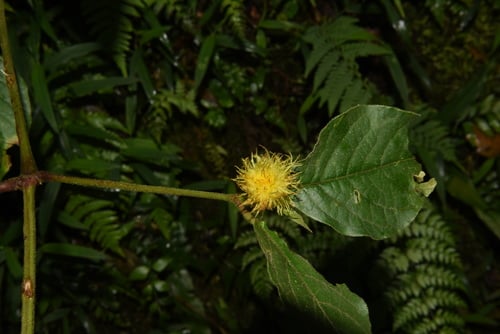
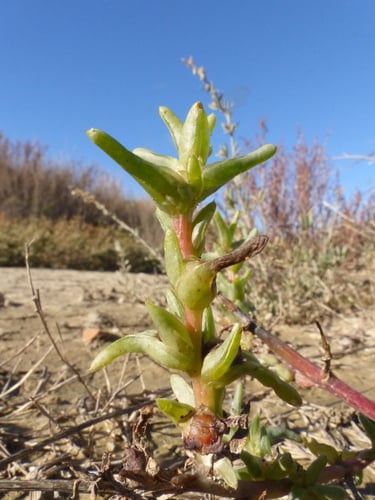
A small shrub. It keeps growing from year to year. It is 1-2 m high and 1-2 m wide. The branches have a mealy coating. The wood is soft. The leaves are 2-5 cm long and vary in shape. The flowers are small and in dense clusters. They are golden.
Edible Uses
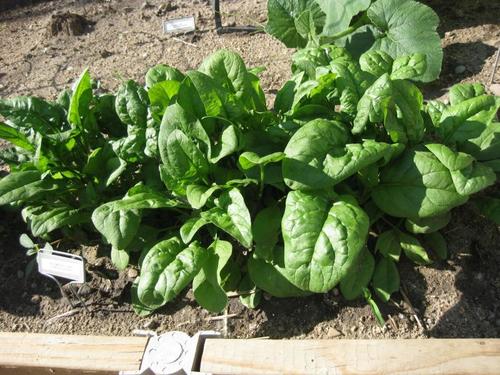
The leaves can be cooked and used like spinach. They are considered an excellent vegetable — mild, palatable, and nutritious. Raw leaves should only be eaten in small quantities. The seed can be cooked, or ground and used as a flour in bread and similar foods. It is small and fiddly, and should be soaked in water overnight and thoroughly rinsed before use to remove saponins.
Medicinal Uses
None known.
Known Hazards
The leaves and seeds of all members of this genus are more or less edible. However, many of the species in this genus contain saponins, though usually in quantities too small to do any harm. Although toxic, saponins are poorly absorbed by the body and most pass straight through without any problem. They are also broken down to a large extent in the cooking process. Saponins are found in many foods, such as some beans. Saponins are much more toxic to some creatures, such as fish, and hunting tribes have traditionally put large quantities of them in streams, lakes etc in order to stupefy or kill the fish. The plants also contain some oxalic acid, which in large quantities can lock up some of the nutrients in the food. However, even considering this, they are very nutritious vegetables in reasonable quantities. Cooking the plants will reduce their content of oxalic acid. People with a tendency to rheumatism, arthritis, gout, kidney stones or hyperacidity should take especial caution if including this plant in their diet since it can aggravate their condition.
Distribution
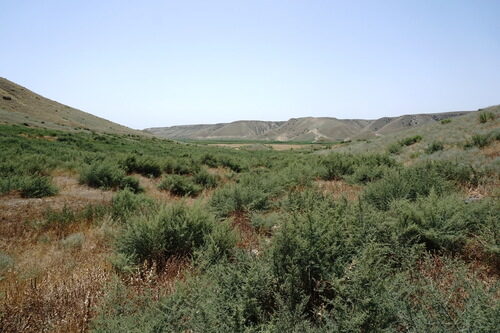
It grows in tropical and subtropical places. It grows on clays on inland drainage areas in Australia. It will grow on most soils in full sun. It can withstand frost and drought. It grows in areas with a rainfall of about 200 mm per year. It can grow in arid places.
Where It Grows
Africa, Australia*, Britain, Europe, Mediterranean, North Africa, Tunisia,
Cultivation
We have very little information on this species and do not know how well it will grow in Britain, but it should succeed as a spring sown annual. This species was cultivated as a spinach in Britain in the 19th century, it is an excellent vegetable. The following notes are based on the general needs of the genus. An easily grown plant, succeeding in most soils but disliking shade. It prefers a moderately fertile soil.
Propagation
Sow seed in spring in situ. Most seed typically germinates within a few days of sowing.
Other Uses
Gold and green dyes can be obtained from the whole plant.
Notes
There are about 100-150-250 Chenopodium species. They are mostly in temperate regions. Also put in the family Chenopodiaceae.
References (7)
- Altschul, S.V.R., 1973, Drugs and Foods from Little-known Plants. Notes in Harvard University Herbaria. Harvard Univ. Press. Massachusetts. no. 877
- Cancilla, D., 2018, Ethnobotanical and Ethnozoological Values Desktop Assessment - Eliwana Project. p 38
- Hedrick, U.P., 1919, (Ed.), Sturtevant's edible plants of the world. p 184
- Hunter, J.T., 2017, Is there a relationship between contemporary high Aboriginal plant resource locations and mapped vegetation communities? Cunninghamia 17:27-34. The Royal Botanic Garden Sydney. ISSN 2200 - 405X
- Paczkowska, G. & Chapman, A.R., 2000, The Western Australian Flora. A Descriptive Catalogue. Western Australian Herbarium. p 201
Show all 7 references Hide references
- Plants for a Future database, The Field, Penpol, Lostwithiel, Cornwall, PL22 0NG, UK. http://www.scs.leeds.ac.uk/pfaf/
- Royal Botanic Gardens, Kew (1999). Survey of Economic Plants for Arid and Semi-Arid Lands (SEPASAL) database. Published on the Internet; http://www.rbgkew.org.uk/ceb/sepasal/internet [Accessed 8th April 2011]