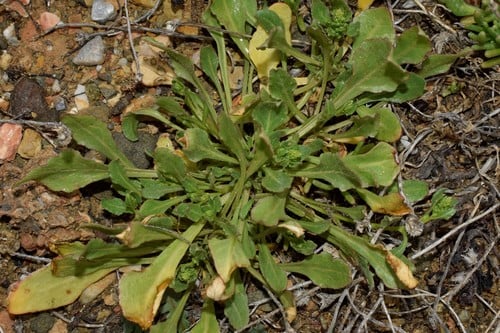
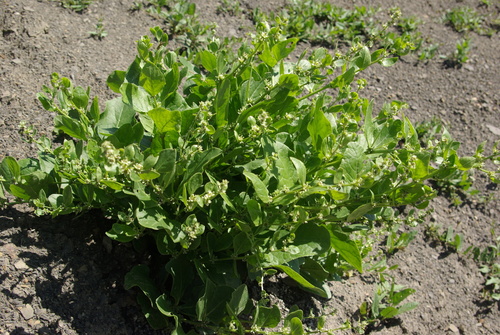
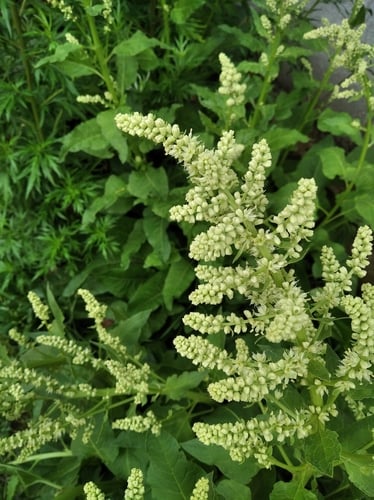
Amaranthus blitum subsp. oleraceus
(L.) Costea
Slender Amaranth
gbif· cc-by-nc
Joseph Knight
gbif· cc-by-nc
Joseph Knight
gbif· cc-by-nc
Chris Buddenhagen
Summary
Source: WikipediaAmaranthus blitum, commonly called purple amaranth or Guernsey pigweed, is an annual plant species in the economically important plant family Amaranthaceae. It has a number of culinary uses.
Description
A herb which can be erect or hang over. It is 80 cm tall. The stems are angular and curve in a zigzag manner. They often branch from the base upwards. The leaves are oval and 1-3 cm long by 0.3-1.5 cm wide. The leaves are wedge shaped at the base and have a sharp point at the tip. The leaf stalk is 0.3-2.5 cm long. The side veins can be clearly seen under the leaf. The leaves are without hairs but are sometimes tinged with purple. The flower spikes can be 1-10 cm long and have side clusters. The fruit are smooth and pale. Seeds are 1-1.2 mm across.
Edible Uses
Although not cultivated, this plant is gathered from the wild and eaten in many parts of the world. The Greeks refer to A. blitum var. silvestre as vlita (Modern Greek: βλίτα) and eat the leaves and the cooked tender shoots, served with olive oil, lemon and salt. In Lebanon (especially to the north) a side dish is made from the young shoots; they are cooked in olive oil, onion, chilli, and burghul, seasoned with salt and lemon, and eaten with pita.
Traditional Uses
Leaves are eaten as a green vegetable, after cooking.
This uses section is brief — help expand it
Distribution
A tropical plant. It occurs world wide in the tropics. In Papua New Guinea it grows best between 1,200 and 2,000 m altitude. In Nepal it grows between 1500-2300 m altitude.
Where It Grows
Africa, Argentina, Asia, Australia, Bangladesh, Brazil, Burundi, Central Africa, China, East Africa, Ecuador, Europe, Gabon, Himalayas, India, Indochina, Japan, Kenya, Korea, Laos, Malawi, Mediterranean, Morocco, Nepal, New Zealand, North Africa, Northeastern India, Pacific, Pakistan, Papua New Guinea, PNG, Paraguay, Philippines, SE Asia, Sierra Leone, Southern Africa, South America, St Helena, Tanzania, Thailand, Uruguay, Vietnam, West Africa,
Cultivation
Mostly plants are self sown. Plants can be grown from seed.
Other Information
It is a commercially cultivated vegetable. It is sold in local markets. In Papua New Guinea an occasionally used wild edible leaf.
Notes
There are about 60 Amaranthus species.
Synonyms
Also Known As
Ataco, Ban lunde, Bledo, Bwora, Carurd, Data shak, Den tai, Elope, Gerupu, Ilupu, Khuria, Kude sag, Kudum, Lattesag, Mboog'ennene, Tampala, Wild blite
References (50)
- Agea, J. G., et al 2011, Wild and Semi-wild Food Plants of Bunyoro-Kitara Kingdom of Uganda: etc. Environmental Research Journal 5(2) 74-86 (As Amaranthus lividus)
- Ara, R. I. T., 2015, Leafy Vegetables in Bangladesh. Photon eBooks. p 32 (As Amaranthus oleraceus)
- Borrell, O.W., 1989, An Annotated Checklist of the Flora of Kairiru Island, New Guinea. Marcellin College, Victoria Australia. p 47
- Burkill, H. M., 1985, The useful plants of west tropical Africa, Vol. 1. Kew.
- Chen, B. & Qiu, Z., Consumer's Attitudes towards Edible Wild Plants, Ishikawa Prefecture, Japan. p 22 www.hindawi.com/journals/ijfr/aip/872413.pdf
Show all 50 references Hide references
- Chowdhury, A. & Das, A. P., 2014, Conservation through sustainable utilization of wetland leafy vegetables of Terai and Duars, West Bengal, India. International Journal of Advanced Life Sciences (IJALS), 7(4) p 653
- Chowdhury, M. & Mukherjee, R., 2012, Wild Edible Plants Consumed by Local Communities of Maldah of West Bengal, India. Indian J.Sci.Res.3(2) : 163-170 (As Amaranthus lividus)
- Dangol, D. R. et al, 2017, Wild Edible Plants in Nepal. Proceedings of 2nd National Workshop on CUAOGR, 2017.
- Facciola, S., 1998, Cornucopia 2: a Source Book of Edible Plants. Kampong Publications, p 8 (Also as Amaranthus lividus subsp. oleraceus)
- Flora Zambesiaca. http://apps.kew.org/efloras
- Fox, F. W. & Young, M. E. N., 1982, Food from the Veld. Delta Books. p 69 (As Amaranthus lividus and Amaranthus oleraceus)
- French, B., 1986, Food Plants of Papua New Guinea, Asia Pacific Science Foundation p 55
- Henty, E.E., & Pritchard, G.S., 1973, Weeds of New Guinea and their control. Botany Bulletin No 7, Division of Botany, Lae, PNG. p 57
- Hossain, U. & Rahman, A., 2018, Study and quantitative analysis of wild vegetable floral diversity available in Barisal district, Bangladesh. Asian J. Med. Biol. Res. 2018, 4 (4), 362-371 (As Amaranthus lividus)
- Hussey, B.M.J., Keighery, G.J., Cousens, R.D., Dodd, J., Lloyd, S.G., 1997, Western Weeds. A guide to the weeds of Western Australia. Plant Protection Society of Western Australia. p 80
- Hwang, H., et al, 2013, A Study on the Flora of 15 Islands in the Western Sea of Jeollanamdo Province, Korea. Journal of Asia-Pacific Biodiversity Vol. 6, No. 2 281-310 (As Amaranthus lividus)
- Jardin, C., 1970, List of Foods Used In Africa, FAO Nutrition Information Document Series No 2.p 38, 54 (Also as Amaranthus lividus subsp. oleraceus)
- Japanese International Research Centre for Agricultural Science www.jircas.affrc.go.jp/project/value_addition/Vegetables
- Joshi, N., et al, 2007, Traditional neglected vegetables of Nepal: Their sustainable utilization for meeting human needs. Tropentag 2007. Conference on International Agricultural Research for Development. (As Amaranthus lividus)
- Joshi, N. & Siwakoti, M., 2012, Wild Vegetables Used by Local Community of Makawanpur District and Their Contribution to Food Security and Income Generation. Nepal Journal of Science and Technology Vol. 13, No. 1 (2012) 59-66 (As Amaranthus lividus)
- Kanis, A in Womersley, J.S., (Ed), 1978, Handbooks of the Flora of Papua New Guinea. Melbourne University Press. Vol 1. p 25
- Kays, S. J., and Dias, J. C. S., 1995, Common Names of Commercially Cultivated Vegetables of the World in 15 languages. Economic Botany, Vol. 49, No. 2, pp. 115-152
- Macmillan, H.F. (Revised Barlow, H.S., et al) 1991, Tropical Planting and Gardening. Sixth edition. Malayan Nature Society. Kuala Lumpur. p 343 (As Amaranthus lividus subsp. oleraceus)
- Malezas Comestibles del Cono Sur, INTA, 2009, Buernos Aires (As Amaranthus lividus L.)
- Martin, F.W. & Ruberte, R.M., 1979, Edible Leaves of the Tropics. Antillian College Press, Mayaguez, Puerto Rico. p 173 (Also as Amaranthus lividus subsp. oleraceus)
- Marshall, F., Agriculture and Use of Wild and Weedy Greens by the Piik ap Oom Okiek of Kenya. Economic Botany, Vo. 55, No. 1, pp. 32-47 (As Amaranthus lividus subsp. oleraceus)
- Maundu, P. et al, 1999, Traditional Food Plants of Kenya. National Museum of Kenya. 288p (As Amaranthus blitum)
- Mot So Rau Dai an Duoc O Vietnam. Wild edible Vegetables. Ha Noi 1994, p 32
- Nakahara, K. et al, 2002, Antimutagenicity of Some Edible Thai Plants, and a Biocative Carbazole Alkaloid, Mahanine, Isolated from Micromelum minutum. Journal of Agricultural and Food Chemistry. 50: 4796-4892 (As Amaranthus lividus)
- Nzigidahera, B., 2006, Assessment of Socio-cultural, Economic Characteristics and Livelihood of Riparian Population of the Kibira National Park. (Rukoma-Mutana locality). UNDP p 30 (As Amaranthus lividus)
- Paczkowska, G. & Chapman, A.R., 2000, The Western Australian Flora. A Descriptive Catalogue. Western Australian Herbarium. p 136
- Peters, C. R., O'Brien, E. M., and Drummond, R.B., 1992, Edible Wild plants of Sub-saharan Africa. Kew. p 47
- Pham-Hoang Ho, 1999, An Illustrated Flora of Vietnam. Nha Xuat Ban Tre. p 728
- Plants for a Future database, The Field, Penpol, Lostwithiel, Cornwall, PL22 0NG, UK.
- Plowes, N. J. & Taylor, F. W., 1997, The Processing of Indigenous Fruits and other Wildfoods of Southern Africa. in Smartt, L. & Haq. (Eds) Domestication, Production and Utilization of New Crops. ICUC p 185
- Rajkalkshmi, P. et al, 2001, Total carotenoid and beta-carotene contents of forest green leafy vegetables consumed by tribals of south India. Plant Foods for Human Nutrition 56:225-238
- Raponda-Walker, A & Sillans, R., 1961, Les Plantes Utiles du Gabon. Editions Paul Lechevalier, Paris. p 48 (As Amaranthus lividus subsp. oleraceus)
- Sakar, A. & Das, A. P., 2018, The traditional knowledge on edible wild leafy vegetables of Rabha Tribe in Duars of North Bengal: a potential reinforcement to food security. Pleione 12(2): 275 - 281. 2018.
- Sang, D. T., & Mizoue, K. O. N., 2012, Use of Edible Forest Plants among Indigenous Ethnic Minorities in Cat Tien Biosphere Reserve, Vietnam. Asian Journal of Biodiversity Vol. 3 (1), p 23-49 (As Amaranthus lividus)
- Sasi, R. et al, 2011, Wild edible plant Diversity of Kotagiri Hills - a Part of Nilgiri Biosphere Reserve, Southern India. Journal of Research in Biology. Vol. 1 No. 2, pp 80-87 (As Amaranthus lividus)
- Sharma, B.B., 2005, Growing fruits and vegetables. Publications Division. Ministry of Information and broadcasting. India. p 189
- Sp. pl. ed. 2, 2:1403. 1763 (As Amaranthus lividus subsp. oleraceus)
- Terra, G.J.A., 1973, Tropical Vegetables. Communication 54e Royal Tropical Institute, Amsterdam, p 23 (Also as Amaranthus lividus subsp. oleraceus)
- Tindall, H.D., 1983, Vegetables in the tropics. Macmillan p. 38
- Torre, de la L., et al, 2008, Enciclopedia de las Plantas Útiles del Ecuador. Herbario QCA. Pontificia Universidad Católica del Ecuador. p 155 (As Amaranthus lividus)
- Vainio-Mattila, K., 2000, Wild vegetables used by the Sambaa in the Usumbara Mountains, NE Tanzania. Ann. Bot. Fennici 37:57-67 (As Amaranthus lividus)
- WATT (As Amaranthus lividus subsp. oleraceus)
- Wiersema, J. H. & Leon, B., 2013, World Economic Plants. A Standard Reference CRC Press. 2nd Ed. p 42
- www.pngplants.org
- Zeven, A. C. & de West, J. M. J., 1982, Dictionary of cultivated plants and their regions of diversity. Wageningen. p 103 (As Amaranthus lividus)