Ceroxylon alpinum
Bonpl. ex DC.
Wax palm, Andean Wax Palm
iNaturalist· cc-by-sa
(c) Oscar Marín, some rights reserved (CC BY-SA), uploaded by Oscar Marín
iNaturalist· cc-by-nc
(c) Sebas Arango, some rights reserved (CC BY-NC)
iNaturalist· cc-by-nc
(c) Mauricio Ocampo, some rights reserved (CC BY-NC)
Summary
Source: WikipediaCeroxylon alpinum, also known as the Andean wax palm is a species of palm tree native to Colombia, Ecuador, and Venezuela. It is threatened by habitat loss.
Description
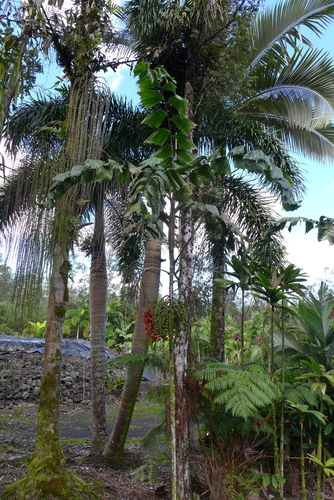
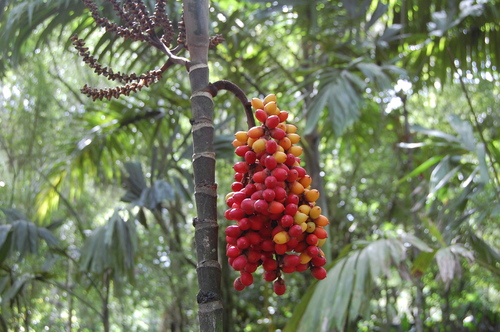
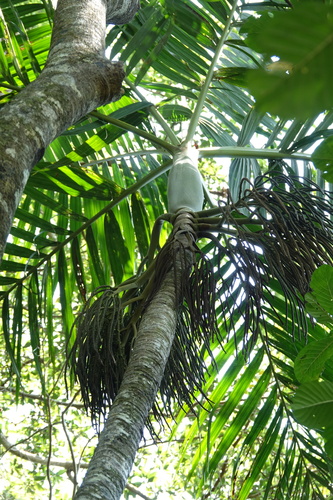
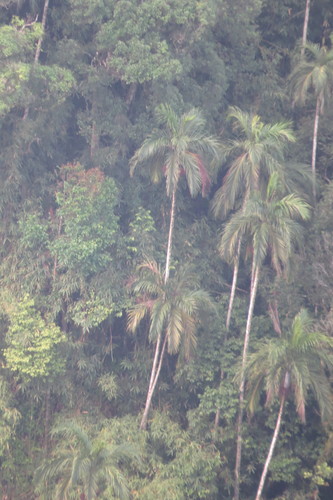
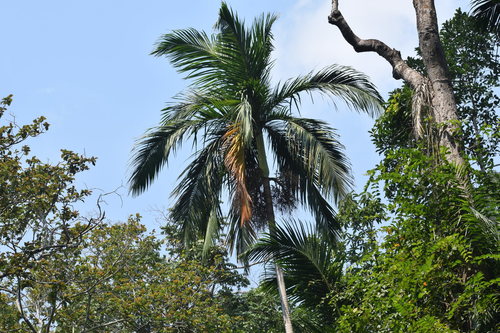
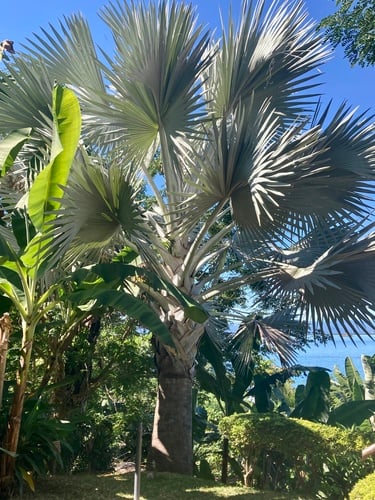
A solitary, feather-leafed palm. It can be 30 m high and 20-30 cm across the trunk. It has a waxy trunk. It does not have a crown-shaft. The trunk is tall and slender. There are rings on the trunk. The leaves form a rounded crown. They are dark green and divided along the stalk. The leaves have a sheathing base but not a crown-shaft. The leaves are 2-3.5 m long. The leaflets are long and narrow. They are deep glossy green above and silvery white underneath. The flowering stalk is 1.5-2 m long. These arise amongst the leaves and there can be several at one time. The bracts are covered with brown woolly scales. Flowers are pale yellow. The fruit are orange-red with a rough surface. They are 17-19 mm across.
Edible Uses
The fruit is likely edible, though no specific reports for this species have been recorded.
Medicinal Uses
None known
Distribution
A tropical plant. It grows naturally in the Andes at 1500-2000 m altitude. It grows in subtropical and temperate climates. They suit cool moist locations. It prefers an acid soil.
Where It Grows
Andes, Australia, Colombia, Ecuador, South America, Venezuela,
Cultivation
Succeeds in most fertile moist but well-drained soils in a sheltered sunny position. Requires a humus-rich soil with bright filtered light and cool high humidity. This species tolerates several degrees of short-lived frost in its native climate, it can be grown outdoors in essentially frost-free temperate climates. Palms usually have deep penetrating root systems and generally establish best when planted out at a young stage. However, older plants are substantially more cold tolerant than juvenile plants. In areas at the limit of their cold tolerance, therefore, it is prudent to grow the plants in containers for some years, giving them winter protection, and only planting them into their permanent positions when sheer size dictates. Palms can also often be transplanted even when very large. Although the thick fleshy roots are easily damaged and/or desiccated, new roots are generally freely produced. It is important to stake the plant very firmly to prevent rock, and also to give it plenty of water until re-established - removing many of the leaves can also help. Dioecious, male and female plants must be grown if seed is required.
Propagation
Seed is best sown as soon as it is ripe in a warm greenhouse at no less than 24°C. Stored seed is very slow to germinate. Pre-soaking seed for 24 hours in warm water before sowing may shorten germination time. As plants form a long taproot before producing a shoot, seed is best sown in groups of two or three per deep pot, thinning to the strongest seedling if necessary. Germination of fresh seed usually takes 3–4 months at 25°C. Grow plants in the greenhouse for at least their first two winters before planting out in summer. Provide protection from cold for at least the first few winters outdoors.
Other Uses
A wax obtained from the trunk is used for making candles. Suited to carbon farming use.
Synonyms
Also Known As
Palma de cera
References (12)
- Balick, M.J. and Beck, H.T., (Ed.), 1990, Useful palms of the World. A Synoptic Bibliography. Colombia p 67, 561 (As Ceroxylon andicola),
- Blomberry, A. & Rodd, T., 1982, Palms. An informative practical guide. Angus & Robertson. p 74
- Bull. Soc. Philom. Paris 3(7):240. 1804 (type species)
- Gibbons, M., 1993, Palms. Compact study Guide and Identifier. Sandstone. p 27
- Gibbons, M., 2003, A pocket guide to Palms. Chartwell Books. p 69
Show all 12 references Hide references
- Grandtner, M. M. & Chevrette, J., 2013, Dictionary of Trees, Volume 2: South America: Nomenclature, Taxonomy and Ecology. Academic Press p 118
- Henderson, A., Galeano, G and Bernal, R., 1995, Field Guide to the Palms of the Americas. Princeton. p 74
- Jones, D.L., 2000, Palms of Australia 3rd edition. Reed/New Holland. p 133
- Plants for a Future database, The Field, Penpol, Lostwithiel, Cornwall, PL22 0NG, UK. http://www.scs.leeds.ac.uk/pfaf/
- Riffle, R.L. & Craft, P., 2003, An Encyclopedia of Cultivated Palms. Timber Press. p 293
- Roa, J. A. G. & Boada, D. S. G., 2018, Fundación para el Fortalecimiento de la Fruticultura y Plantas Alimenticias no Convencionales en Colombia.
- Schuler, S., (Ed.), 1977, Simon & Schuster's Guide to Trees. Simon & Schuster. No. 50 (As Ceroxylon andicola)