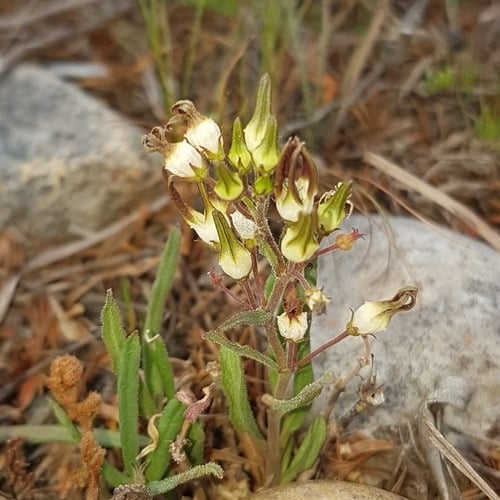
Cerbera manghas
L.
Sea Mango, Grey Milkwood
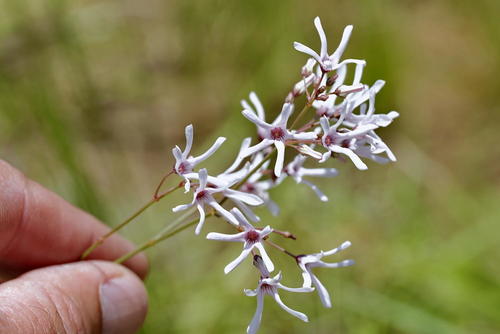
iNaturalist· cc0
no rights reserved, uploaded by 葉子
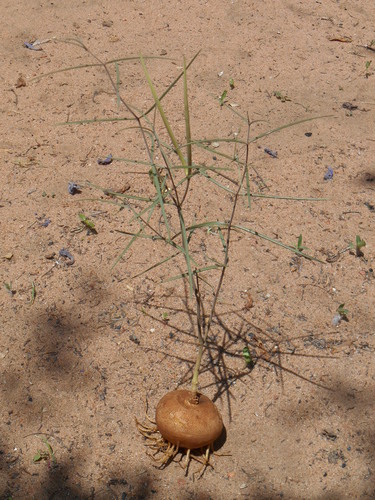
iNaturalist· cc0
no rights reserved, uploaded by 葉子
iNaturalist· cc0
no rights reserved, uploaded by 葉子
Summary
Source: WikipediaCerbera manghas (formerly Cerbera tanghin), commonly known as the sea mango, wawai, pink-eyed cerbera, tangena or bintaro is a small evergreen coastal tree growing up to 12 metres (39 ft) tall. It is native to coastal areas in Africa, Asia, Australasia, and the Pacific islands. It is classified as one of the three species in the genus Cerbera that constitute mangroves. Despite its name, it is not closely related to the mango (Mangifera indica).
Description
An evergreen tree up to 8 m tall. It can reach 20 m high. It spreads to 2-5 m across. The stem is erect and branching. It has milky sap. The bark is grey brown. The branches come out in whorls, and they are marked with leaf scars. The leaves are bright green. The leaf stalk is 3-6 cm long. The leaf blade is oblong, and narrowing towards the tip. It is 6-37 cm long by 3-8 cm wide. Leaves are deeply veined and arranged in spirals around the stem. The flowers are white with a yellow throat. They are like tubes and 7.5 cm long by 2.5-5 cm across. They occur in dense clusters at the ends of branches. The flowers have a strong scent. The fruit are round and fleshy berries, which are 7.5 cm across. They are pink, tinged with purple. Often the fruit occur in pairs. They hang down.
Traditional Uses
CAUTION: The fruit, and especially the seed, are very poisonous and contain hydrocyanic acid and the cardiac glycosides thevetin and cerberin. The leaves have been recorded as being eaten.
Medicinal Uses
The leaves have been recorded as being eaten and used more traditionally as a medicine.
Known Hazards
The leaves and the fruits contain the extremely toxic cardiac glycoside cerberin, as well as tanghinin, deactyltanghin, and neriifolin. Only the mechanism of action for cerberin has been extensively studied, although tanghinin and the other molecules are likely to proceed through a similar mechanism. Cerberin acts by affecting sodium-potassium pumps in cardiac muscle cells via inhibition of Na+/K+-ATPase. In addition to its cardiac effects, symptoms of poisoning include numbness in the upper extremities followed by nausea, vomiting, chest tightness, and dyspnea. Cerberin is believed to be the most important contributor to the toxicity of the plant, although it is found in lower quantities than the other cardiac glycosides. Like the closely related Cerbera odollam, C. manghas seeds have been purposely ingested in suicide attempts. Treatment of poisoning by Cerbera manghas is similar to treatment for digoxin poisoning. Administrations of calcium gluconate in moderation has been shown to be effective at reducing hyperkalemia. More modern medical research indicates that the cerberin found in the plant might have favorable properties for chemotherapy as the cardiac glycoside might be able to selectively induce apoptosis in tumor cells. Goffin's cockatoo is one of the creatures known to eat sea mangos. In addition, the coconut crab can become toxic to humans if it eats too much sea mango due to a buildup of cardiac cardenolides.
Distribution
A tropical plant. It grows best in rich, moist, well drained soils. It needs a sheltered and partly shaded position. It is drought and frost tender. It is often near swamps, near the sea and on rocky and sandy coasts. It can tolerate exposure near the coast, but is cold sensitive. In XTBG Yunnan. It suits hardiness zones 11-12. In Townsville Anderson BG.
Where It Grows
Africa, American Samoa, Asia, Australia, Bangladesh, British Indian Ocean Terr., BIOT, Cambodia, China, East Africa, East Timor, Fiji, Hawaii, India, Indochina, Indonesia, Japan, Kiribati, Laos, Madagascar, Malaysia, Marquesas, Micronesia, Myanmar, Nauru, Pacific, Palau, Papua New Guinea, PNG, Philippines, Rotuma, Samoa, SE Asia, Seychelles, Sri Lanka, Taiwan, Thailand, Timor-Leste, Tonga, USA, Vanuatu, Vietnam,
Cultivation
Plants are grown from seed.
Propagation
Seed - germination is erratic. Cuttings
Other Uses
An oil is obtained from the seed. It is used as an illuminant. It can be used to make candles. The wood is lightweight to medium-weight, with the white to pale yellow-brown heartwood not demarcated from the sapwood. The grain is straight to slightly interlocked, texture fine and uneven. The shrinkage upon seasoning is moderate, and the wood works easily. It is not durable, highly susceptible to blue-staining fungi, and resistant to preservative treatment under pressure. Trees seldom grow to timber size, but the wood is useful for the production of veneer. The wood is occasionally used in tropical Asia for mouldings, interior trim, fruit cases, core veneer, matches, shuttering, clogs, plain furniture and carving, and also for charcoal. The wood is used for fine charcoal.
Other Information
The leaves are sometimes used but more as a medicine.
Notes
The seeds are poisonous. There are 3-4-7 Cerbera species.
Synonyms
Also Known As
Baraibai, Batano, Bentan, Bintaro, Bintaru, Cande, Chattankaya, Chemeridech, Dabur, Derei-yongo, Dhakur, Dog bane, Dteen-ped-nam, Hahoo, Kalwa, Kameduangel, Kassi Kattarali, Khakhou, Kodalma, Kottuma, Laholaho, Leva, Magkana, Monde, Native Frangipani, Pink eyed Cerbera, Pompong, Pong-pong, Reva, Rewa, Rubber tree, Salut, Sukanu, Te reiango, Tiin-pet-lek, Tin ped, Tok-tok kalau, Toto, Truc dao, Utalam, Vasa, Vasavasa, Za-lat
References (39)
- Ambasta S.P. (Ed.), 2000, The Useful Plants of India. CSIR India. p 117
- Barwick, M., 2004, Tropical and Subtropical Trees. A Worldwide Encyclopedic Guide. Thames and Hudson p 108
- Bodkin, F., 1991, Encyclopedia Botanica. Cornstalk publishing, p 240
- Bodkin, F., 1991, Encyclopedia Botanica. Cornstalk publishing, p 240 (As Cerbera lactaria)
- Borrell, O.W., 1989, An Annotated Checklist of the Flora of Kairiru Island, New Guinea. Marcellin College, Victoria Australia. p 51
Show all 39 references Hide references
- Burkill, I.H., 1966, A Dictionary of the Economic Products of the Malay Peninsula. Ministry of Agriculture and Cooperatives, Kuala Lumpur, Malaysia. Vol 1 (A-H) p 520
- Burkill, I.H., 1966, A Dictionary of the Economic Products of the Malay Peninsula. Ministry of Agriculture and Cooperatives, Kuala Lumpur, Malaysia. Vol 1 (A-H) p 520 (As Cerbera lactaria)
- Cabalion, P. and Morat, P., 1983, Introduction le vegetation, la flore et aux noms vernaculaires de l'ile de Pentcoste (Vanuatu), In: Journal d'agriculture traditionnelle et de botanique appliquee JATBA Vol. 30, 3-4 (As Cerbera odollam)
- Checklist of NT Vascular Plant Species. January 2003.
- Cooper, W. and Cooper, W., 2004, Fruits of the Australian Tropical Rainforest. Nokomis Editions, Victoria, Australia. p 36
- Cowie, I, 2006, A Survey of Flora and vegetation of the proposed Jaco-Tutuala-Lore National Park. Timor-Lests (East Timor) www.territorystories.nt/gov.au p 43
- Elliot, W.R., & Jones, D.L., 1984, Encyclopedia of Australian Plants suitable for cultivation. Vol 3. Lothian. p 12 Lists Cerbera odollam.
- Elliot, W.R., & Jones, D.L., 1984, Encyclopedia of Australian Plants suitable for cultivation. Vol 3. Lothian. p 12
- Engel, D.H., & Phummai, S., 2000, A Field Guide to Tropical Plants of Asia. Timber Press. p 46
- Etherington, K., & Imwold, D., (Eds), 2001, Botanica's Trees & Shrubs. The illustrated A-Z of over 8500 trees and shrubs. Random House, Australia. p 199
- Flora of Australia, Volume 28, Gentiales, Melbourne:CSIRO Australia, 1996. p 142, Fig 59 p 146, Map 182, p 297
- Franklin, J., Keppel, G., & Whistler, W., 2008, The vegetation and flora of Lakeba, Nayau and Aiwa Islands, Central Lau Group, Fiji. Micronesica 40(1/2): 169–225, 2008 (Also as Cerbera odollam)
- GTZ 1996, A Guide to some Indigenous Fijian Trees. GTZ Suva. p 197
- Haslam, S., 2004, Noosa's Native Plants. Noosa Integrated Catchment Assn. Inc. p 20
- Henty, E.E., 1980, Harmful Plants in Papua New Guinea. Botany Bulletin No 12. Division Botany, Lae, Papua New Guinea. p 20
- Jones D, L, 1986, Ornamental Rainforest Plants in Australia, Reed Books, p 206
- Kitalong, A. H., DeMeo, R. A., & Holm, T., 2013, A Field Guide to the Native Trees of Palau. 2nd edition. USDA p58
- Lazarides, M. & Hince, B., 1993, Handbook of Economic Plants of Australia, CSIRO. p 55
- Liefting, A., et al, Samoan plant names. http://en.wikipedia.org
- Li Ping-tao; Antony J. M. Leeuwenberg, David J. Middleton, Apocynaceae, Flora of China
- Martin, F.W. & Ruberte, R.M., 1979, Edible Leaves of the Tropics. Antillian College Press, Mayaguez, Puerto Rico. p 175
- McMakin, P.D., 2000, Flowering Plants of Thailand. A Field Guide. White Lotus. p 7
- Parham, B. E. V., 1972, Plants of Samoa. New Zealand Department of Scientific and Industrial Research. Information Series. No. 85 p 65
- Peekel, P.G., 1984, (Translation E.E.Henty), Flora of the Bismarck Archipelago for Naturalists, Division of Botany, Lae, PNG. p 443, 442
- Scarth-Johnson, V., 2000, National Treasures. Flowering Plants of Cooktown and Northern Australia. Vera Scarth-Johnson Gallery Association. Cooktown, Australia. p 38
- Schatz, G.E., 2001, Generic Tree Flora of Madagascar. Royal Botanical Gardens, Kew and Missouri Botanical Garden. p 52
- Smith, A.C., 1988, Flora Vitiensis Nova, Lawaii, Kuai, Hawaii, Volume 4 p 89
- Sp. pl. 1:208. 1753
- Sukarya, D. G., (Ed.) 2013, 3,500 Plant Species of the Botanic Gardens of Indonesia. LIPI p 190
- Thaman, R. R., 1987, Plants of Kiribati: A listing and analysis of vernacular names. Atoll Research Bulletin No. 296
- Topp, J. M. W., 1988, An Annotated Check List of the Flora of Diego Garcia, British Ocean Territory. Atoll Research Bulletin No. 313 (As Cerbera odollam) (Rare)
- Townsend, K., 1994, Across the Top. Gardening with Australian Plants in the tropics. Society for Growing Australian Plants, Townsville Branch Inc. p 130
- World Checklist of Useful Plant Species 2020. Royal Botanic Gardens, Kew
- Yuncker, T.G., 1959, Plants of Tonga, Bernice P. Bishop Museum, Hawaii, Bulletin 220. p 221