Alpinia purpurata
(Vieill.) K. Schum.
Red ginger
iNaturalist· cc-by-nc
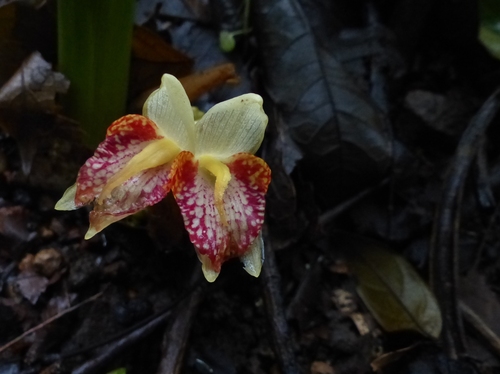
(c) cinthya_molina, some rights reserved (CC BY-NC)
iNaturalist· cc-by-nc
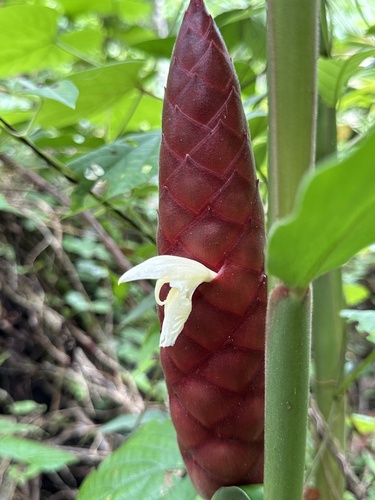
(c) yaneador, some rights reserved (CC BY-NC)
iNaturalist· cc-by
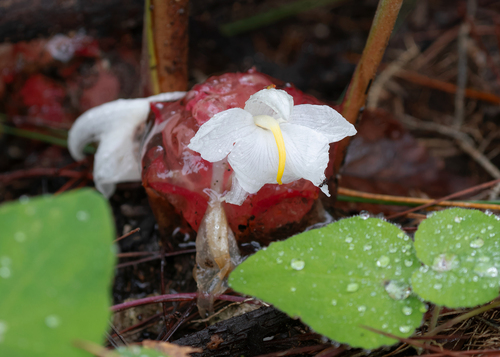
(c) Kristof Zyskowski, some rights reserved (CC BY), uploaded by Kristof Zyskowski
Summary
Source: WikipediaAlpinia purpurata, commonly referred to as red ginger, ostrich plume and pink cone ginger, is a ginger native to Maluku and the southwest Pacific islands. In typical ginger fashion, A. purpurata is a rhizomatous plant, spreading underground in a horizontal growth habit, sending feeder roots downwards into the substrate and sprouting leafy vertical stems from nodes located along the rhizome. As its common name implies, red ginger blooms with showy inflorescences on long, bright magenta- to red-hued bracts; while they appear to be a blossom, bracts are in fact modified leaves that contain the plant's actual flowers. Bracts are a common feature of many botanical genera (such as Euphorbia sp. or the Araceae family), having evolved to protect and resemble the flowers and appeal to pollinators. The actual flower "parts" (pollen, pistil, stamen, etc.) are located inside, often accessed by crawling insects like ants or beetles. Red ginger has several cultivars, such as A. purpurata 'Jungle King' and 'Jungle Queen'. The plant grows in many regions outside of its native southwest Pacific islands, including the countries and territories of Dominica, Grenada, Guadeloupe, Hawaii, Jamaica, Martinique, Puerto Rico, St. Lucia, St. Vincent, Suriname (where its Dutch name is bokkepoot, or "billy-goat's foot") and Trinidad and Tobago, in addition to several Central American nations, including Belize and Panama. It is also found in Samoa, where it is the national flower, locally called teuila. Red ginger can also be grown successfully in the United States, in places such as South Florida and coastal Southern California, as these regions' winter low temperatures do not typically reach freezing, usually dropping no lower than 45°-50 °F (about 7°-10 °C) at the coldest points of the year. Additionally, the plant may require extra overhead sun protection, as well as irrigation, in drier, hotter or sunnier climes outside its native range; as with many ginger species, red ginger prefers partial shade, indirect light and consistently moist—but not saturated—soil conditions, with preferably high levels of ambient humidity. If care is provided that the leaves do not sunburn, the red ginger can tolerate a few hours of full sun, earlier in the day. Extra light may help to stimulate more vivid foliage and vibrant blooms. In addition to planting in outdoor landscapes, red ginger may also be grown as an indoor houseplant (if provided with adequate light exposure). It can be successfully conditioned to grow in LECA or PON (in full, passive or semi-hydroponic setups). Its cut flowers and leaves are often used in floral arrangements and tropical bouquets. In Hawaii, the flowers of red ginger are grown commercially for sale, and have been associated with the Hamakua area for a long time. Once a very common flower regionally, the gardening community there has experienced a slight decline in recent years, though is starting to make a comeback. Red ginger blooms are also, sometimes, called "graveyard flowers" as they are customarily placed at loved ones' headstones, lasting for quite a while thanks to their vigor & long shelf-life as a cut flower.
Description
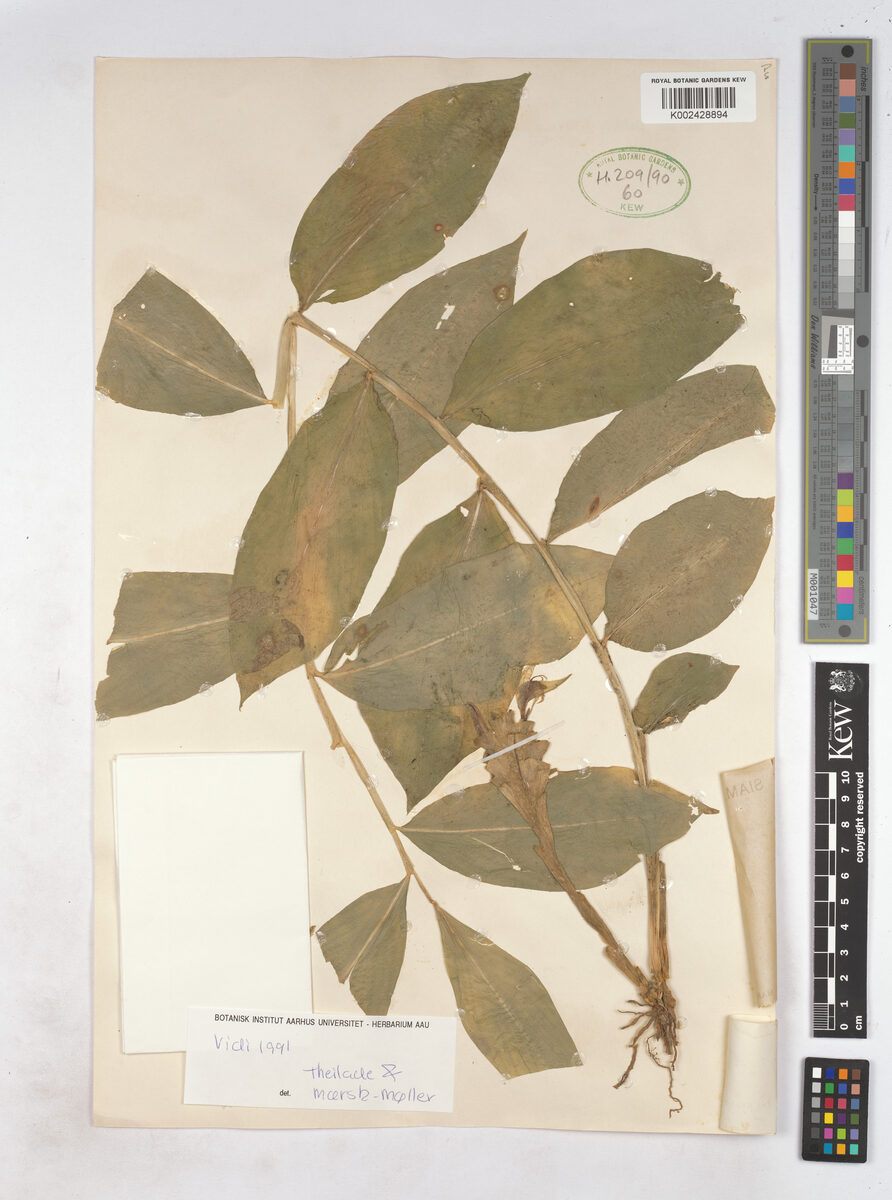
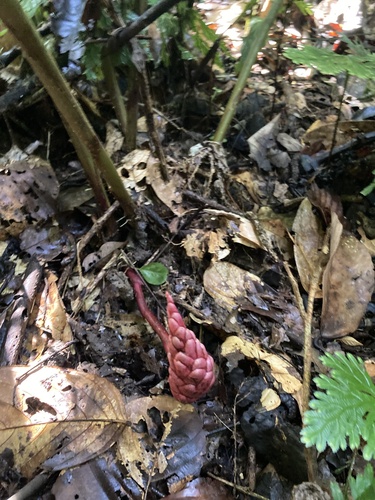
A ginger family herb. It is upright and keeps growing from year to year. The stems are leafy and cane like. It grows 1-5 m tall. It has spreading underground stems or rhizomes. These cause the plant to form thick clusters. The flower arrangement is at the top of the stems and is 25 cm long. The flowers have bright red bracts. The actual flowers are small and white on top of these bracts. The fruit are round capsules. These split open when the seeds are ripe.
Edible Uses
The leaves are used to flavour coconut oil.
Traditional Uses
The leaves are used to flavour coconut oil.
This uses section is brief — help expand it
Medicinal Uses
The fruit is used to treat sores. A decoction of the leaves is used in the treatment of stomach complaints.
Distribution
It is a tropical plant. It is best with part shade and moist conditions. It cannot tolerate frost. It does well in rich, wet soils. It needs an acid soil with pH between 6.0-6.8. In Townsville Queens BG.
Where It Grows
Asia, Australia, Caribbean, Chuuk, Colombia, Ecuador, Fiji, FSM, Guam, Hawaii, Indonesia, Malaysia, Marquesas, Micronesia, Myanmar, Nauru, New Caledonia, Niue, Pacific, Palau, Papua New Guinea, PNG, Peru, Philippines, Puerto Rico, Rotuma, Samoa, SE Asia, Solomon Islands, Thailand, Trinidad, Tuvalu, USA, Vanuatu, West Indies, Yap,
Cultivation
Prefers a position in light shade. Requires a moist, fertile soil. Widely cultivated as an ornamental, the plant has become naturalized in many areas. It is considered to be invasive in many Pacific islands, including Fiji and Hawaii. Plants can flower all year round.
Propagation
Seed - Division of the rhizome.
Other Uses
The nectar of this flower is attractive to bees, butterflies and birds.
Notes
It has potential as a plant that can fight TB.
Synonyms
Also Known As
Kamapui futi kula, Kapui mi'a, Ostrich plume, Pink cone ginger, Teuila
References (4)
- Parham, B. E. V., 1972, Plants of Samoa. New Zealand Department of Scientific and Industrial Research. Information Series. No. 85 p 125
- Stone, B.,
- Thaman, R. R, 2016, The flora of Tuvalu. Atoll Research Bulletin No. 611. Smithsonian Institute p 57
- Yuncker, T. G., 1943, The Flora of Niue Island. Bernice P. Bishop Museum Bulletin 178 p 40