Vateria copallifera
(Retz.) Alston
Hal
iNaturalist· cc-by-nc
(c) Yuwaree Kamolsawat, some rights reserved (CC BY-NC)
iNaturalist· cc-by-nc
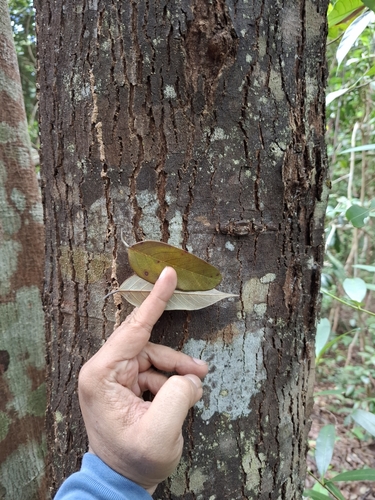
(c) rookantha, some rights reserved (CC BY-NC)
iNaturalist· cc-by-nc
(c) Peter Zika, some rights reserved (CC BY-NC)
Summary
Source: WikipediaVateria copallifera is a species of plant in the family Dipterocarpaceae. It is endemic to Sri Lanka. Fruits have a bitter taste. Traditionally people in the surrounding villages of the tree growing areas collect fruits for preparation of various food items including one of famous food called 'Hal Guti'. A preparation made from this tree is used in preserving traditional manuscripts written on palm leaves.
Description
A large evergreen tree. It grows 40 m tall. The branches are spreading and the crown is round. The leaves are 11-50 cm long by 8-18 cm wide. They are oblong. The flowers are in panicles 25 cm long and 4 cm wide. They have 12 cm long branches with 8 flowers. The fruit is a nut 11 cm long by 7 cm wide.
Edible Uses
The seeds are ground into meal, soaked in running water for a day to remove bitterness, then mixed with rice flour for use in cooked dishes.
Traditional Uses
The seeds are ground into meal and eaten. They are put in bag in running water for a day to remove the bitter taste. It is then mixed with rice flour and used in cooked dishes.
Distribution
It is a tropical plant. It grows in the wet, lowland tropics. It grows up to 1,000 m above sea level.
Where It Grows
Asia, Sri Lanka*,
Cultivation
A plant of the moist to wet, lowland tropics.
Other Uses
The stem exudes a clear yellowish resin abundantly, equal to the best dammar. It makes a good varnish. Dammar is a hard resin, obtained from various trees of Southeast Asia. Traditionally, it is used for purposes such as caulking boats and baskets, as an adhesive, a medicine, as a fuel for torches and sometimes in foods. Dammar has many commercial applications, though many of these uses are less important nowadays due to the advent of synthetic materials. Commercially, it is an ingredient of inks, lacquers, oil paints, varnishes etc, and is used as a glazing agent in foods. Harvesting of the resin commences when the bole is around 25cm in diameter (approx 20 years old). Triangular cuts (becoming circular with age) are arranged in vertical rows around the trunk. The cuts are several centimetres wide at first, but become enlarged at every tapping and eventually become holes of 15 - 20cm in depth and width. The average number of holes for a tree about 30 metres tall and 60 - 80cm in diameter is 9 - 11 in each of 4 - 5 vertical rows. For the higher holes, the tapper climbs the tree supported by a rattan belt and using the lower holes as footholds. The exuded resin is allowed to dry on the tree before it is collected. The frequency with which the tree is visited to refreshen the cut varies from once a week to once a month, depending on how far the tree is from the village. Tapping can continue for 30 years. The yellowish-gray wood is light in weight, rather hard. It was at one time extensively used for making tea boxes.
Synonyms
References (3)
- Bandaratillake, H. M., Use of non-wood forest products by village communities in Sri Lanka.
- Fern, K., 2012, Tropical Species Database http://theferns.info/tropical/
- Rajapaksha, U., 1998, Traditional Food Plants in Sri Lanka. HARTI, Sri Lanka. p 197