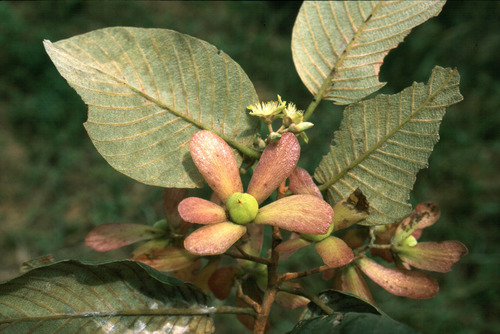
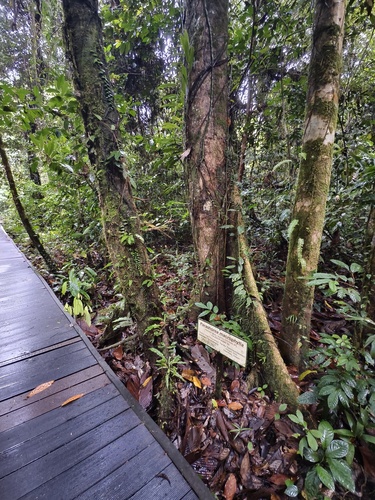
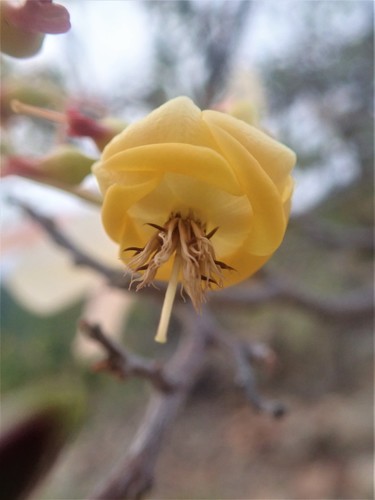
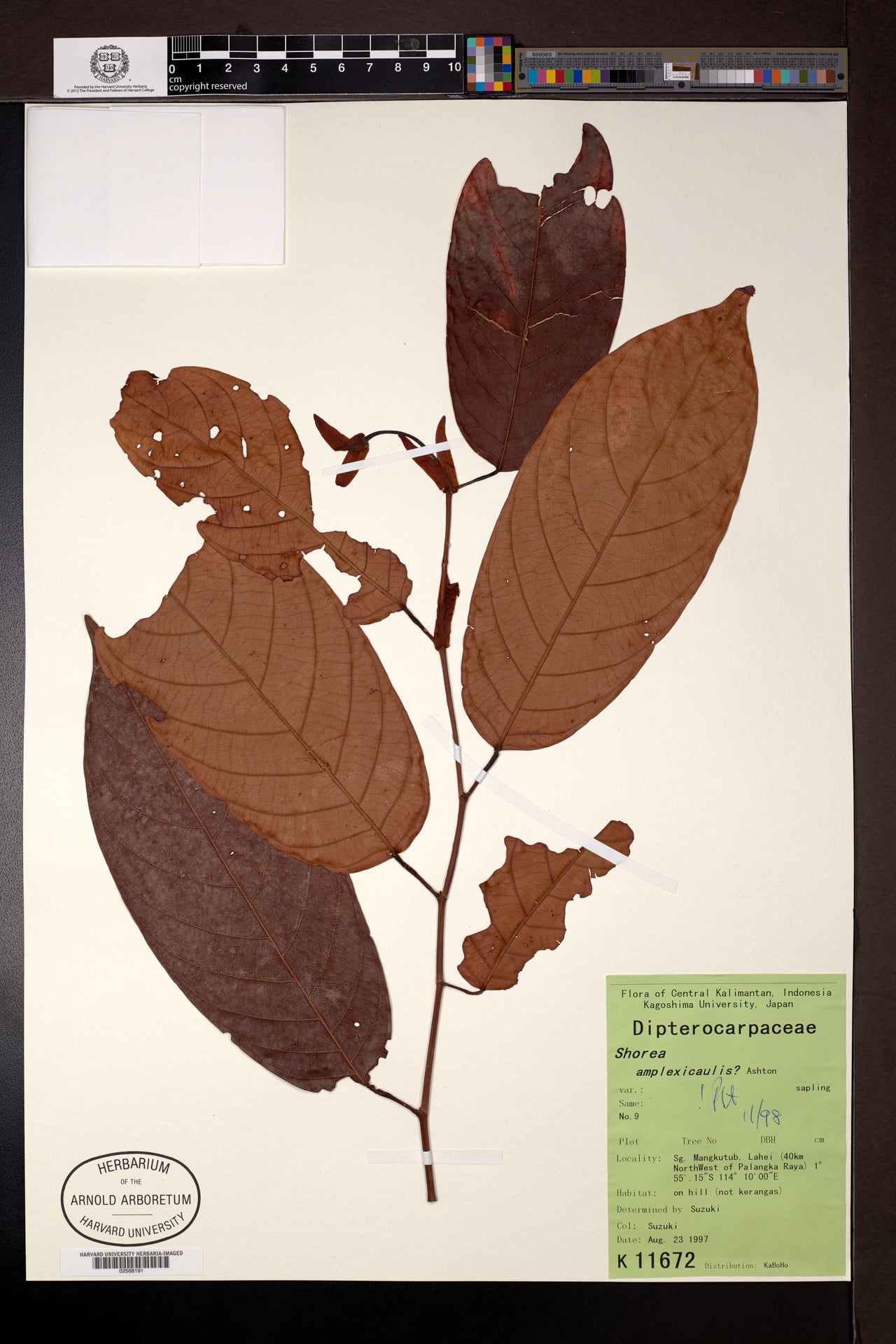
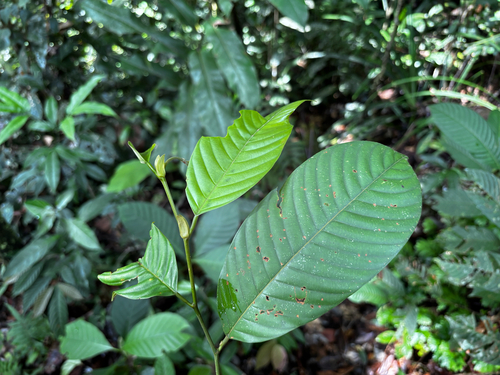
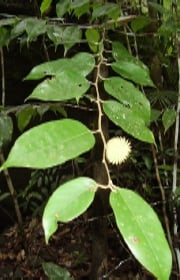
Shorea hypochra
Hance
White meranti
iNaturalist· cc-by-nc
(c) Tom Kirschey, some rights reserved (CC BY-NC)
gbif· cc0
President and Fellows of Harvard College
gbif· cc0
President and Fellows of Harvard College
Description
A tree. It grows 40-60 m tall.
This description is brief — help expand it
Distribution
It is a tropical plant.
Where It Grows
Asia, Cambodia, Indonesia, Laos, Malaysia, SE Asia, Thailand, Vietnam,
Cultivation
A plant of lowland areas in the moist tropics.
Propagation
We have no specific information for this species - the information below is a general guide for the genus. Seed - best sown as soon as possible. It does not require pre-treatment, but it is recommended to soak the seed for 12 hours prior to sowing. The seeds are sown in seedbeds, where they are covered with a mixture of sand and soil (1:1) or with a thin layer of sawdust. Germination of fresh seeds is usually good and rapid. About two weeks after germination, when the seedlings are 5 - 6cm tall, they are potted up into individual containers about 15 x 23cm with good drainage holes at their base. It is normally recommended to use a mixture of forest soil and sand (at a ratio of 3:1) as the potting medium in order to introduce the appropriate mycorrhiza to the roots. The seedlings are placed in 50 - 60% sunlight and watered twice daily. Seedlings can be planted out when 30 - 40cm tall - harden the seedlings off in full sunlight for one month prior to planting.
Other Uses
A dammar suitable for varnishes is obtained from the tree. Dammar is a hard resin, obtained from various trees of Southeast Asia. Traditionally, it is used for purposes such as caulking boats and baskets, as an adhesive, a medicine, as a fuel for torches and sometimes in foods. Dammar has many commercial applications, though many of these uses are less important nowadays due to the advent of synthetic materials. Commercially, it is an ingredient of inks, lacquers, oil paints, varnishes etc, and is used as a glazing agent in foods. Harvesting of the resin commences when the bole is around 25cm in diameter (approx 20 years old). Triangular cuts (becoming circular with age) are arranged in vertical rows around the trunk. The cuts are several centimetres wide at first, but become enlarged at every tapping and eventually become holes of 15 - 20cm in depth and width. The average number of holes for a tree about 30 metres tall and 60 - 80cm in diameter is 9 - 11 in each of 4 - 5 vertical rows. For the higher holes, the tapper climbs the tree supported by a rattan belt and using the lower holes as footholds. The exuded resin is allowed to dry on the tree before it is collected. The frequency with which the tree is visited to refreshen the cut varies from once a week to once a month, depending on how far the tree is from the village. Tapping can continue for 30 years. The heartwood is whitish when freshly cut, becoming light yellow-brown on exposure; the sapwood, which is about 5 - 7cm wide, is poorly defined. The texture is moderately coarse and even; the grain interlocked; slightly lustrous; dried material without characteristic odour or taste. Silica is abundant in the ray tissue. Very difficult to saw or machine due to rapid dulling of cutters caused by the high silica content; stellite-tipped or carbide-tipped tools are suggested; sawn surfaces tend to be woolly. The wood is not durable in ground contact and is vulnerable to dry-wood and subterranean termite attack. Though silica content is high, there is no immunity to marine borer attack. The wood is used for veneer and plywood, flooring, general construction, vats and casks, boat framing.
Synonyms
References (1)
- World Checklist of Useful Plant Species 2020. Royal Botanic Gardens, Kew