Calamus australis
C. Martius
Hairy Mary, Lawyer cane, Wait-a while
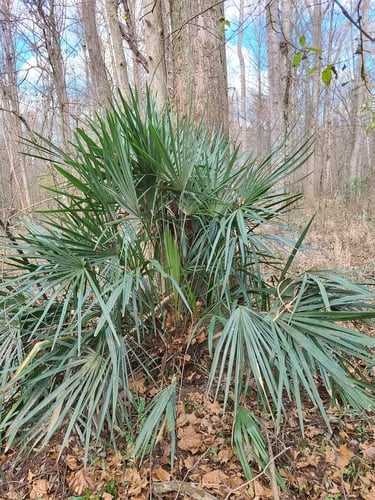
iNaturalist· cc-by-nc
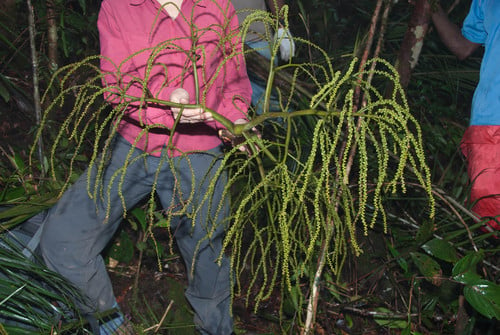
(c) Anneke Jonker, some rights reserved (CC BY-NC), uploaded by Anneke Jonker
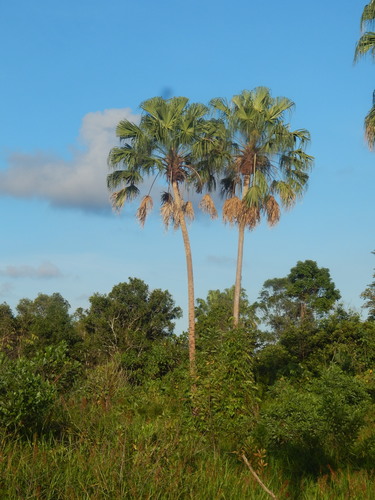
iNaturalist· cc-by-sa
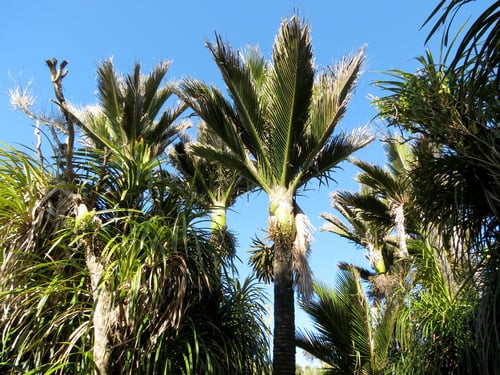
(c) Steve Fitzgerald, some rights reserved (CC BY-SA), uploaded by Steve Fitzgerald
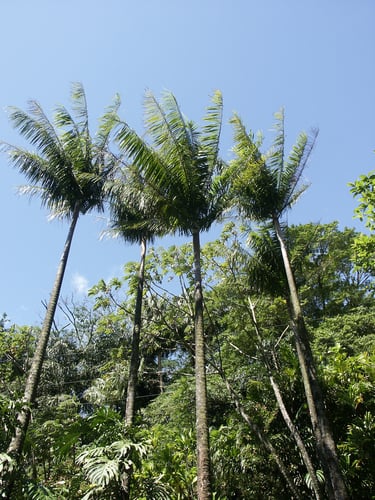
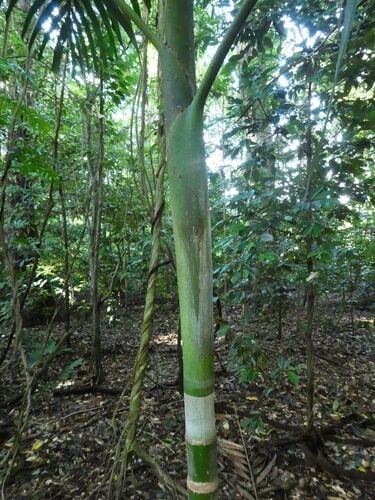
iNaturalist· cc-by-sa
(c) Steve Fitzgerald, some rights reserved (CC BY-SA), uploaded by Steve Fitzgerald
Summary
Source: WikipediaCalamus australis, commonly known as wait-a-while, hairy mary or lawyer cane, is a plant in the palm family Arecaceae which is endemic to the rainforests of north east Queensland, Australia. Like other species in the genus Calamus, this is a climbing plant with a very long and flexible stem. It uses sharp strong hooks on the fronds and tendrils to attach itself to other vegetation, such as taller established trees, thus gaining support that enables it to grow higher towards the canopy. This species is very similar to C. radicalis, with which it coexists, but is smaller in almost all respects. Sharp hooks on the plant can snag the clothing of walkers, giving rise to the name "wait-a-while".
Description
A climbing cane. It climbs high into trees using other plants as support. It can climb 26 m high. There are many stems which are very slender and covered with sharp spines. The stems are 2-3 cm across and the spines can be 8 cm long. These arise from an underground rhizome. There are purple hairs on the new growth. The leaves can be 1-2.5 m long. The leaf has many narrow leaflets with a feather-like appearance. There are many backward pointing spines along the leaf stalk. There are 25-56 leaflets. They are 10-30 cm long and 2-3 cm wide. The edges are curved downwards at the base of the leaf. The leaf can also have a 3 m long armed extension on the end. The flower stalk is long and spiny and hangs down. It can be 2-3 m long. Male and female flowers occur on separate plants. The fruit are pea sized and whitish and covered with scales. They are 1.5-2.6 cm wide. They hang in bunches. The flesh is edible. The seed are small and irregularly shaped. There is one seed in each fruit and the seed are 10 mm across.
Edible Uses
Indigenous Australians had many uses for this plant and its sister species. The young shoots were eaten, along with the fruits. The long flexible stem was used to make shelters, axe handles, fish traps, snares, and waist straps for climbing trees, and the thorny tendrils were used to catch fish.
Traditional Uses
The flesh of the fruit can be eaten. This can also be used for a drink.
This uses section is brief — help expand it
Medicinal Uses
The leaves and stem of this plant are considered to be contraceptive.
Distribution
It is a tropical plant. It grows in rainforests forming impenetrable thickets along the edge of the forest. They do best in cool, shady sites. They need rich, well-drained soil. They will grow in temperate places. In northern Australia they grow from sea level to above 1,000 m altitude.
Where It Grows
Australia*,
Cultivation
Plants can be grown from seed which must be planted very fresh. The seed germinate in a few weeks. If allowed to dry out, seed germinate very erratically. Seedlings are not easy to transplant.
Propagation
Seed - it has a fairly short viability and is best sown as soon as it is ripe.
Other Uses
The stems are used in basket making. The long and slender stems of Calamus species are put to various uses according to their size, length, flexibility, elasticity and toughness. The most slender canes are employed entire for binding purposes, and in making chairs, blinds, mats, wicker or basketwork, fishing implements, etc. Twisted together, they make very strong cables. The largest and more resistent canes are used entire as cables, the framework of wicker chairs etc. Usually, however, for many purposes the stems are split throughout their length into 2 - 4 or more strips from which the inner soft brittle and spongy portion is removed by means of a knife or same other instrument, so as to leave the external portion, which is hard, tough, flexible, elastic and has its outer surface very clean and smooth as if it had been varnished. Strips vary in width according to the use to which they are to be put. Those for delicate work, such as the network of furniture, small bags, hats, etc, are from 1 - 3mm wide; those employed as lashings in native housebuilding or in fastening the removable head of the Malay axe to its handle are from 5-6 mm wide. Collecting and preparing the stems is very simple. The stem is cut near the ground and detached from the trees by taking a strong hold of its base and thus pulling down the entire plant with its leaves. The most recent growth at the top of the plant is removed and then, handling it from the upper end, the stem is forcibly drawn in the opposite direction between two pieces of wood, thus removing the spiny coverings. It is then cut into lengths of about 5 metres, each piece is bent into two equal parts and the stems are fastened into bundles ready for market. The most valued stems are not thicker than a man's little finger and have a fine polished straw-yellow glassy surface.
Production
In Australia, fruit occur from November to February.
Notes
There are 375-400 Calamus species. There are 175 species in tropical Asia.
Synonyms
References (18)
- Blomberry, A. & Rodd, T., 1982, Palms. An informative practical guide. Angus & Robertson. p 70
- Cooper W & Cooper W T, 1994, Fruits of the Rain Forest. RD Press p 60
- Cooper, W. and Cooper, W., 2004, Fruits of the Australian Tropical Rainforest. Nokomis Editions, Victoria, Australia. p 69
- Cribb, A.B. & J.W., 1976, Wild Food in Australia, Fontana. p 63
- Cronin, L., 1989, The Concise Australian Flora. Reed. p 231
Show all 18 references Hide references
- Cronin, L., 2000, Australian Palms, Ferns, Cycads and Pandans. Cronin Publications. p 68
- Elliot, W.R., & Jones, D.L., 1982, Encyclopedia of Australian Plants suitable for cultivation. Vol 2. Lothian. p 404
- Gibbons, M., 1993, Palms. Compact study Guide and Identifier. Sandstone. p 25
- Hibbert, M., 2002, The Aussie Plant Finder 2002, Florilegium. p 48
- Hiddins, L., 1999, Explore Wild Australia with the Bush Tucker Man. Penguin Books/ABC Books. p 148
- Jackes, B.R., 2001, Plants of the Tropics. Rainforest to Heath. An Identification Guide. James Cook University. p 42
- Jones, D.L., 1994, Palms throughout the World. Smithtonian Institution, Washington. p 155
- Jones, D.L., 2000, Palms of Australia 3rd edition. Reed/New Holland. p 79, 81,
- Melzer, R., & Plumb, J., 2011, Plants of Capricornia. Belgamba, Rockhampton. p 42
- Nicholson, N & H., 1994, Australian Rainforest Plants 4, Terania Rainforest Publishing. NSW. p 18
- Riffle, R.L. & Craft, P., 2003, An Encyclopedia of Cultivated Palms. Timber Press. p 284
- Townsend, K., 1994, Across the Top. Gardening with Australian Plants in the tropics. Society for Growing Australian Plants, Townsville Branch Inc. p 110
- Tucker, R., 1988, The Palms of Subequatorial Queensland. Palm and Cycad Society of Australia, Milton, Queensland. p 32