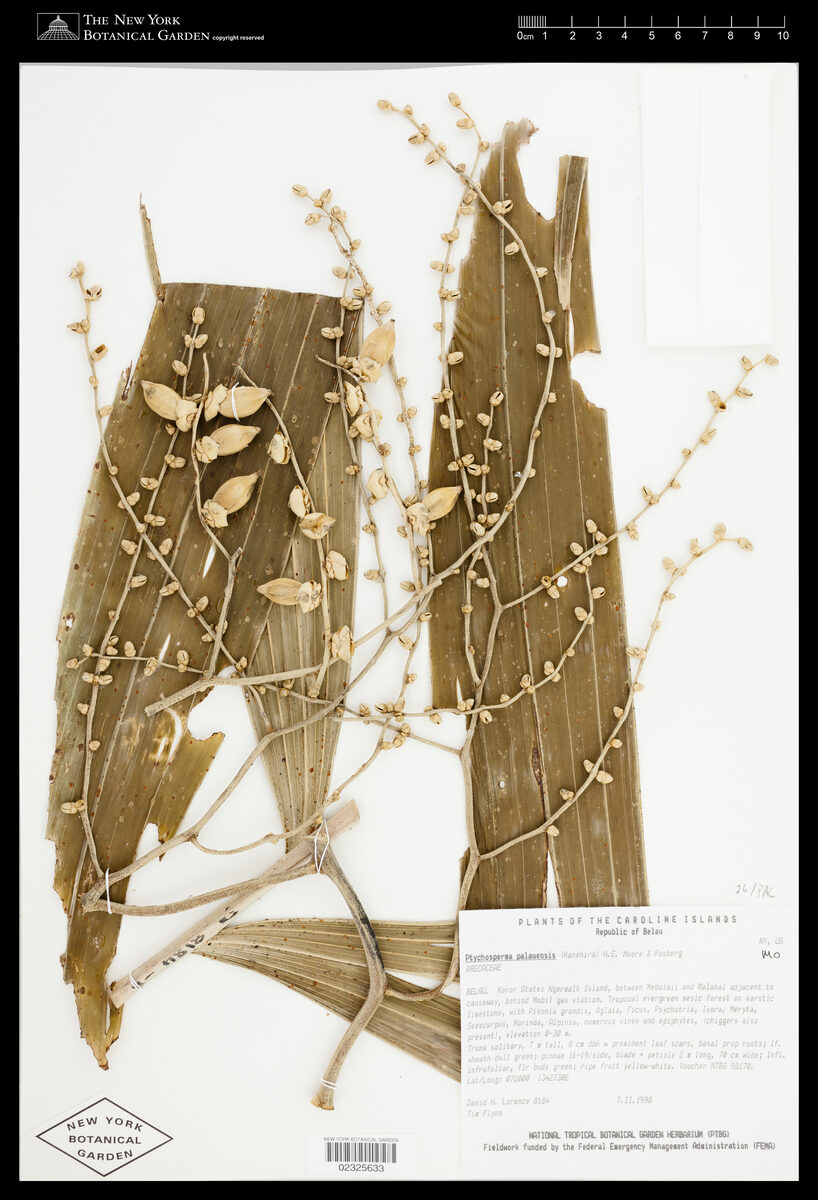
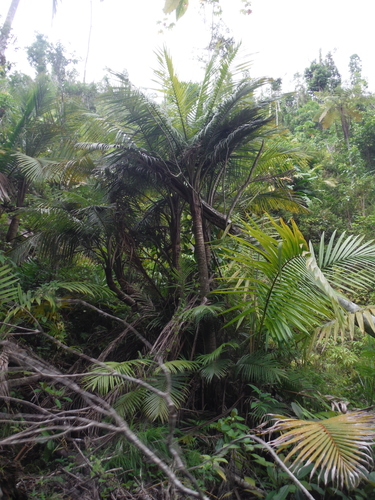
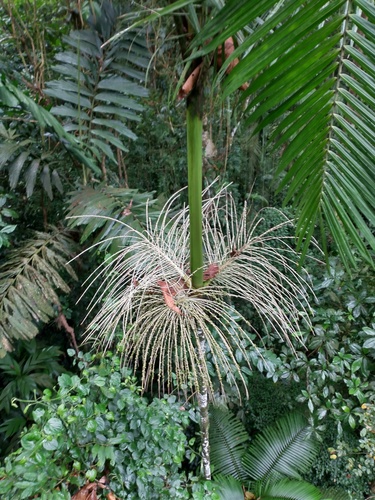
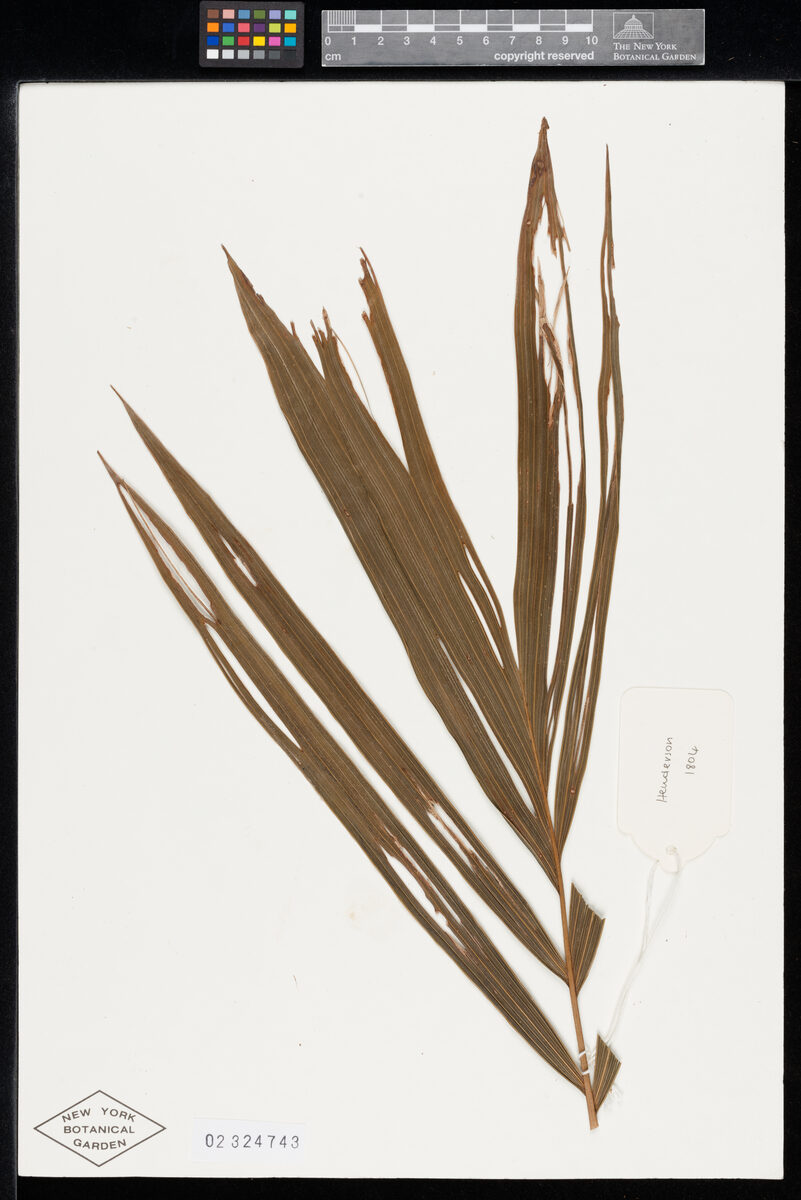
Calamus caesius
Blume
Sega rattan
wikimedia· cc-by
Wikimedia Commons - Mark Landon
wikimedia· cc0
Wikimedia Commons - Hiart
Summary
Evergreen climbing rattan reaching 100 m (328 ft) tall by 7 m (23 ft) wide, growing at fast rate. Tolerates light sandy, medium loamy, and heavy clay soils with preference for well-drained conditions. Grows in mildly acidic to basic pH, including very acidic and very alkaline soils. Adapts to semi-shade or full light with preference for moist soil. Hardy to UK zone 10; frost tender.
Description
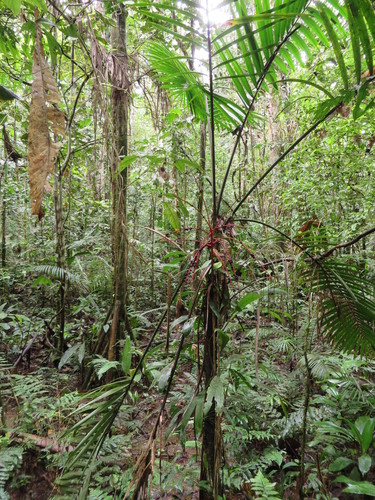
A cane or rattan. It forms clusters. It climbs and the canes can be 100 m long. The leaf sheath is dull green and has triangle shaped spines. The leaflets are usually in alternate pairs. There are 15 on each side. The fruit is oval and one seeded. It is There is an outer fleshy coat.
Edible Uses
Edible Parts: Fruit Edible Uses: Edible portion: Fruit. The fruit are eaten raw. Fruit are sold in markets and available in India from February to April.
Traditional Uses
The fruit are eaten raw.
This uses section is brief — help expand it
Medicinal Uses
None known
Distribution
A tropical plant. It needs to be grown in forest. It suits moist alluvial soils and flooded river banks. It can grow up to 800 m above sea level.
Where It Grows
Asia, India, Indochina, Indonesia, Malaysia, Northeastern India, Philippines, SE Asia, Thailand,
Cultivation
A plant of the more humid, lowland tropics, where it is found at elevations up to 800 metres. High-climbing, evergreen rattan with canes reaching a length of 100 m. The clump is often rather close and dense. It grows best in areas where annual daytime temperatures are within the range 23 - 30°c, but can tolerate 16 - 34°c. It prefers a mean annual rainfall in the range 2,500 - 3,200mm, but tolerates 1,700 - 4,200mm. Succeeds with its roots in deep shade, whilst its stems climb up to the sunlight. Grows best on rich alluvial flats and other fertile land. Prefers a pH in the range 5.5 - 7, tolerating 5 - 8. Plants can grow on drier land, but growth is less vigorous. Prefers a position in the dappled shade of the forest, with its stems climbing up towards the light. Plants flourish under mild and seasonal flooding, but dislike severe floods. Overhead shade should be manipulated at about 6-monthly intervals for 2 - 3 years to ensure seedlings receive sufficient light to grow vigorously. About 50% light/shade conditions are ideal for rattan growth Given the correct balance of shade and light, plants grow away quickly from seed. After 12 - 14 months the primary stem may exceed 1 metre; the first climbing whips and 1 or 2 sucker shoots may have already developed. As the plant grows older, more and more suckers will be produced every year, probably up to ten per year. Some of these will develop into aerial stems while others remain dormant as bulbil-like shoots, thus forming a relatively compact cluster of aerial stems. By year 10, the number of aerial stems may vary from 20 to 60 or more per cluster, depending on conditions of growing site and weather. Aerial stems may grow at rates exceeding 4 - 5 metres per year. Annual flowering may commence at an age of 4 - 5 years. Up to 4 inflorescences may be produced on one flowering stem, with each infructescence bearing 1,000 - 1,500 fruits. Selective harvesting of mature canes can be carried out from the eighth year after planting. Harvesting is carried out by cutting the rattan cane at about 30cm from the base, pulling the cane down out of the canopy as much as possible, removing the leaf-sheaths by twisting the cane around a tree trunk or hitting it with a knife. The cane, divested of its sheaths, is then cut into lengths of about 6 metres and bent, and tied in bundles of 100 pieces. Inevitably, lengths of canes will be left in the canopy and cannot be pulled out because they are entangled with the tree branches. More efficient mechanical methods of harvesting for large commercial plantation have yet to be developed. Canes should be processed soon after harvesting, in order to maintain their quality. Highly variable yield figures, ranging from 1.5 - 3 tonnes/ha per year, have been provided by cultivators and researchers. Based on a surviving population of 500 plants/ha in a commercial plantation, a cane growth rate of 2.5 metres/year and 36 000 metres of dry canes to yield one ton, the yield has been estimated to increase from 0.5 tonnes/ha per year in year 9 from planting to 1.5 tonnes/ha per year in year 12 and thereafter. This species is closely related to C. Optimus and C. Trachycoleusc. Whereas this species and C. Optimus produce short horizontal stolons not exceeding about 8 cm, C. Trachycoleus produces long horizontal stolons up to 1 metre or more long. As a result, this species produces a relatively compact cluster of aerial stems whereas .C. Trachycoleus has a diffuse colony of aerial stems which are more widely spaced and hence compete less with each other. The diffuse colony of C. Trachycoleus makes it an aggressive colonizer and a potentially higher cane yielder. A dioecious species, both male and female forms need to be grown if fruit and seed are required.
Propagation
Seed. Rattan fruits should be processed and sown as soon as possible after collection in order to maintain their viability. During processing, scales and sarcotesta are removed by repeated rubbing and washing. Cleaned seeds should be stored in a cool and shady place if they are not sown immediately after processing. Seeds are sown about 1 cm deep in a seed-bed constructed under shelter. The sowing medium should be sandy loam or loam with a top layer of 2 cm of sawdust to enhance moisture retention in the sowing medium. Regular watering is essential to keep the seeds and sowing medium moist. Most seeds germinate within 3 - 4 weeks. Seedlings are potted in black polythene bags of about 15 cm deep and 15 cm in diameter when the shoots have emerged 2 - 3 cm above the sawdust. Seedlings are nursed in these bags for 9 months or more under semi-shade provided by plastic shading sheet, palm fronds or other appropriate materials. Seedlings 40 - 50 cm tall are ready for planting out in the field. Rubber trees, bungor (Lagerstroemia sp.) and even fruit trees have been used by smallholders to provide shade and support. Although it can be propagated by using sucker shoots, cultivation is best effected using seed.
Other Uses
Basketry Furniture Raffia String Thatching Weaving Wood Other uses rating: High (4/5). Other Uses: The stems are used by rural people for making furniture, baskets, mats, carpets, handicrafts, cordage, and in house construction, and sewing of 'atap' (thatch). The round cane, skin peel and core provide extremely important high-quality materials for the now highly developed and very sophisticated rattan furniture manufacturing industry. Its unique glossy golden cane surface makes it highly sought after for making 'tatami' mats or rattan carpets for the lucrative Japanese market. This species has a resilient and durable cane with a smooth golden surface. It is particularly suited for making high-quality rattan carpets ('tatami' mats) because of the siliceous glossy surface. The quality of the cane is adversely affected by poor processing; it also depends on factors such as age, moisture content and the light conditions during growth (which affect the internodal length). Special Uses
Production
The fruit are available in India from February to April. Stems can grow 8 m long in 5 years.
Other Information
Fruit are sold in markets. It is cultivated.
Notes
There are 375-400 Calamus species. There are 175 species in tropical Asia.
Synonyms
Also Known As
Heiree, Huwi sahsah, Huwi sesah, Ratan sega, Rotan sega perak, Rotan saog, Seka, Sika, Takathong
References (7)
- Ambasta S.P. (Ed.), 2000, The Useful Plants of India. CSIR India. p 95
- Balick, M.J. and Beck, H.T., (Ed.), 1990, Useful palms of the World. A Synoptic Bibliography. Colombia p 67
- Burkill, I.H., 1966, A Dictionary of the Economic Products of the Malay Peninsula. Ministry of Agriculture and Cooperatives, Kuala Lumpur, Malaysia. Vol 1 (A-H) p 402
- Fl. pis. 2:63. 1798
- Singh, P.K., Singh, N.I., and Singh, L.J., 1988, Ethnobotanical Studies on Wild Edible Plants in the Markets of Manipur - 2. J. Econ. Tax. Bot. Vol. 12 No. 1 pp 113-119
Show all 7 references Hide references
- Sukarya, D. G., (Ed.) 2013, 3,500 Plant Species of the Botanic Gardens of Indonesia. LIPI p 761
- Zeven, A. C. & de West, J. M. J., 1982, Dictionary of cultivated plants and their regions of diversity. Wageningen. p 61