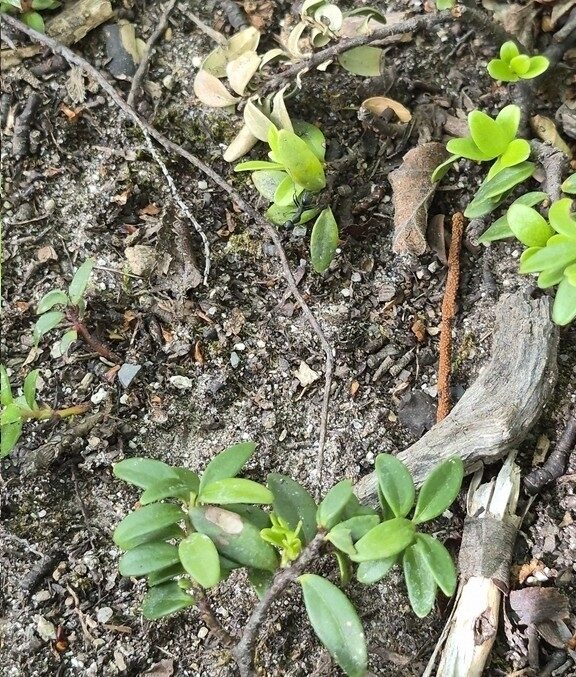
Celastrus orbiculatus
Thunb.
Oriental bittersweet
iNaturalist· cc-by-nc
(c) Jeff Skrentny, some rights reserved (CC BY-NC), uploaded by Jeff Skrentny
iNaturalist· cc-by-nc
(c) jenna_medlar, some rights reserved (CC BY-NC)
Summary
Source: WikipediaCelastrus orbiculatus is a woody vine of the family Celastraceae. It is commonly called Oriental bittersweet, as well as Chinese bittersweet, Asian bittersweet, round-leaved bittersweet, and Asiatic bittersweet. It is native to China, where it is the most widely distributed Celastrus species, and to Japan and Korea. It was introduced into North America in 1879, and is considered to be an invasive species in eastern North America. It closely resembles the native North American species, Celastrus scandens, with which it will readily hybridize.
Description
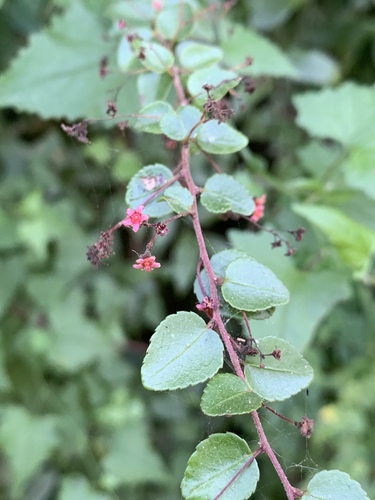
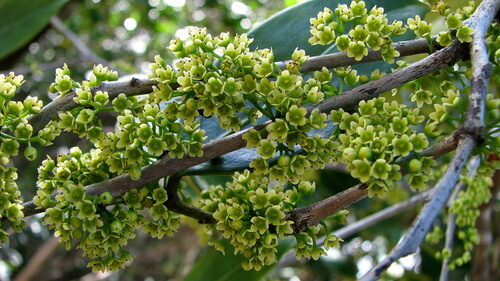
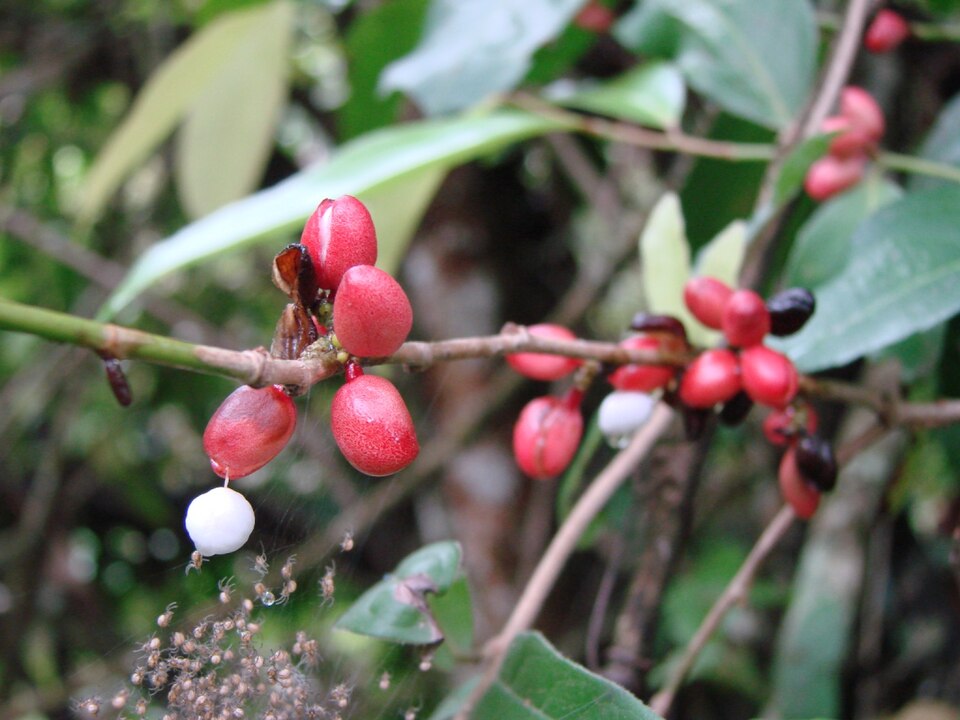
A large vigourous climber which grows 7.5-12 m tall. The leaves are almost round and scalloped. The leaves have pointed tips. The leaves turn yellow in autumn. Male and female flowers are usually on separate plants. The flowers are small and green. The fruit are bead like and yellow. These split open to reveal scarlet coated seeds.
Edible Uses
Young leaves are eaten cooked.
Traditional Uses
The young shoots are eaten in spring.
This uses section is brief — help expand it
Medicinal Uses
The roots, stems, and leaves are antiphlogistic, antirheumatic, depurative, and tonic. A decoction of the roots and stems is taken internally, while crushed fresh leaves are used for external applications. The plant is used to treat paralysis, numbness of the four extremities, headache, toothache, spontaneous abscess formation, and snake bites. Many plants in this genus also contain compounds of interest for their antitumour activity.
Distribution
It is a temperate plant. It is frost hardy. It can tolerate drought. It will grow in most soils. In China it grows between 400-2,200 m above sea level. It suits hardiness zones 4-9. In Sichuan.
Where It Grows
Asia*, Australia, Britain, Central Asia, China, Europe, Japan, Korea, Slovenia, Tajikistan, USA,
Cultivation
Prefers a deep loamy soil but succeeds in most soils so long as they are not too shallow. Succeeds in full or partial shade. Plants flower more freely if their top-growth is in the sun. Requires a humus-rich soil if it is to be at its best. A very ornamental plant, it is hardy to about -25°c. A rampant climber, it requires ample space and is best grown into an old tree[1, 200. It climbs by means of twining and also by the young stems having prickles. Plants do not normally require pruning. Plants in this genus are notably resistant to honey fungus. Plants are usually dioecious, in which case male and female plants must be grown if seed is required, but hermaphrodite forms are in cultivation.
Propagation
Gather seed when ripe, store in dry sand, and sow in February in a warm greenhouse. Three months of cold stratification improves germination rates. Remove the flesh of the fruit before sowing as it inhibits germination. Germination rates are generally good. Prick seedlings into individual pots when large enough to handle and grow on in a greenhouse through at least their first winter. Plant out in late spring or early summer after the last expected frosts. Cuttings of half-ripe wood can be taken in July or August in a frame. Layering in August using the current season's growth takes 12 months. Root cuttings 6mm thick and 25mm long, taken in December, should be planted horizontally in pots in a frame.
Other Uses
The plant is grown as a hedge and for ornamental purposes.
Production
It is fast growing.
Notes
There are about 30 Celastrus species. It can be invasive.
Synonyms
Also Known As
Baiwanye, Man she teng, Navadni davilec, Nobaktonggul
References (12)
- Altschul, S.V.R., 1973, Drugs and Foods from Little-known Plants. Notes in Harvard University Herbaria. Harvard Univ. Press. Massachusetts. no. 2546
- Bodkin, F., 1991, Encyclopedia Botanica. Cornstalk publishing, p 231
- Cundall, P., (ed.), 2004, Gardening Australia: flora: the gardener's bible. ABC Books. p 351
- Etherington, K., & Imwold, D., (Eds), 2001, Botanica's Trees & Shrubs. The illustrated A-Z of over 8500 trees and shrubs. Random House, Australia. p 196
- Fl. jap. 97. 1784
Show all 12 references Hide references
- Hwang, H., et al, 2013, A Study on the Flora of 15 Islands in the Western Sea of Jeollanamdo Province, Korea. Journal of Asia-Pacific Biodiversity Vol. 6, No. 2 281-310
- Hwang, HS, et al, 2014, Distribution characteristics of plant in the Ungseokbong Mountain, Gyeongsangnam-do, Korea. Journal of Asia-Pacific Biodiversity. 7(2014) e164-e178
- Joyce, D., 1998, The Garden Plant Selector. Ryland, Peters and Small. p 178
- Kang, Y., et al, 2012, Wild food plants and wild edible fungi in two valleys on the Qinling Mountains (Shaanxi, central China) Journal of Ethnobiology and Ethnomedicine; 9:26
- Marinelli, J. (Ed), 2004, Plant. DK. p 448
- Pemberton, R. W. & Lee, N. S., 1996, Wild Food Plants in South Korea: Market Presence, New Crops, and Exports to the United States. Economic Botany, Vol. 50, No. 1, pp. 57-70
- Plants for a Future database, The Field, Penpol, Lostwithiel, Cornwall, PL22 0NG, UK. http://www.scs.leeds.ac.uk/pfaf/