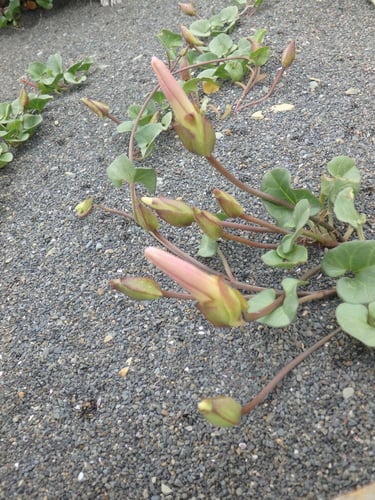
Merremia vitifolia
(Burm.f.) Hallier f.
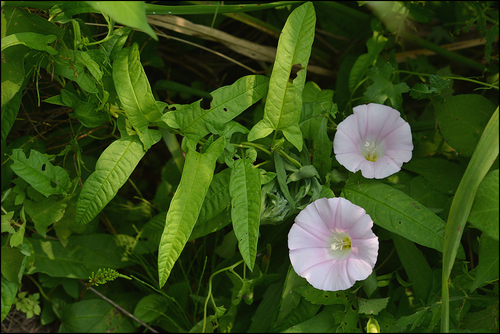
iNaturalist· cc-by-nc
(c) dhbk0709, some rights reserved (CC BY-NC)
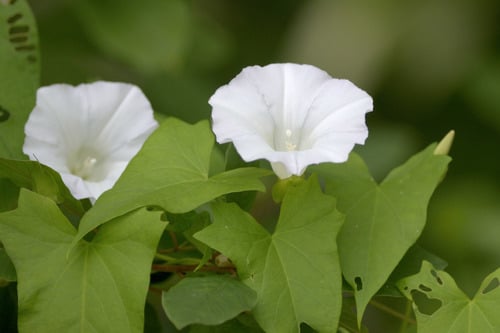
iNaturalist· cc-by-nc
(c) lubukun, some rights reserved (CC BY-NC)
iNaturalist· cc-by-nc
(c) lubukun, some rights reserved (CC BY-NC)
Description
A herb. It can be twining or lie along the ground. The leaves are round and 5-18 cm long by 4-6 cm wide. There are 5-7 lobes. These can be angular or triangle shaped. There can be one or several flowers in a group. The flowers are yellow and funnel shaped. The fruit is a capsule that is 1.2 cm across. The seeds are black to brown and 3 sided.
Edible Uses
The immature and unripe fruits are chewed raw. The roots are cooked and eaten.
Traditional Uses
The immature and unripe fruit are chewed. The roots are cooked and eaten.
This uses section is brief — help expand it
Medicinal Uses
The juice of the plant is considered cooling and diuretic. An infusion of the plant is drunk as a treatment for high fever. The plant is to treat strangury and urethral discharges. A preparation from the juice is ussed to ease inflamed eyes. An infusion of the stem is used internally and externally in the treatment of malaria and smallpox. The root is eaten raw as a stomachic.
Known Hazards
The hairs on the leaves can cause irritation.
Distribution
It is a tropical plant. It grows in roadside thickets between 400-1,600 m above sea level in southern China. In Yunnan.
Where It Grows
Asia, Cambodia, China, Himalayas, India, Indochina, Indonesia, Laos, Malaysia, Myanmar, Nepal, SE Asia, Sri Lanka, Thailand, Vietnam, West Timor,
Cultivation
A plant of tropical and subtropical regions, growing both in areas that are with or without a strong dry season.
Propagation
Seed - Stem cuttings
Synonyms
Also Known As
Cheruvayara, Kyet-hingale-nwe
References (2)
- Binu, S., 2010, Wild edible plants by the tribals in Pathanamthitta district, Kerala. Indian Journal of Traditional Knowledge. 9(2): 309-312
- Joseph, M. A. & Antony, V. T., 2014, Wild edible Convolvulacean members used by the ULLADA tribes of ALEPPEY DISTRICT, KERALA. Journal of Science Vol. 4 No. 7 p 425-427