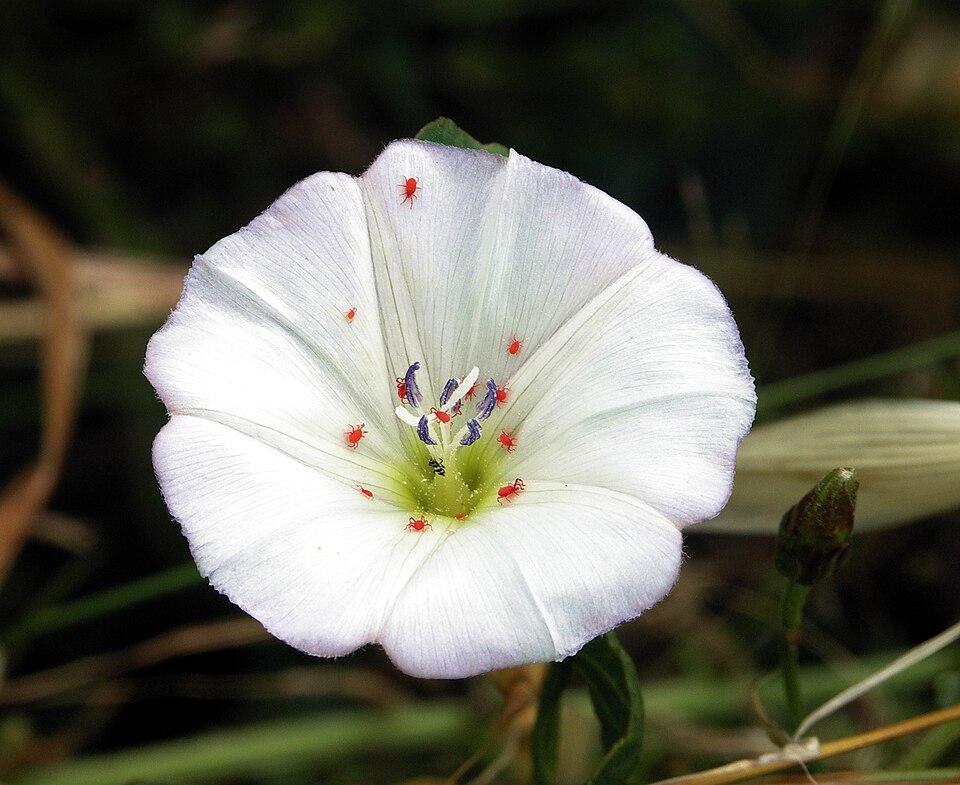
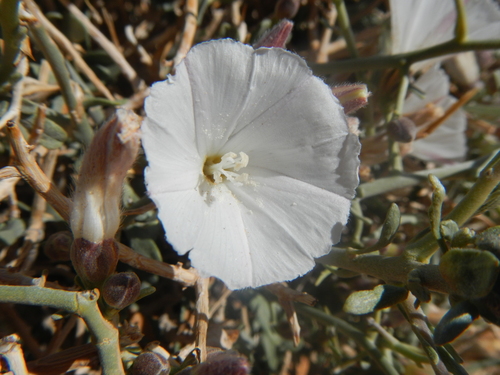
Calystegia hederacea
Wall.
Japanese False Bindweed
iNaturalist· cc-by-nc
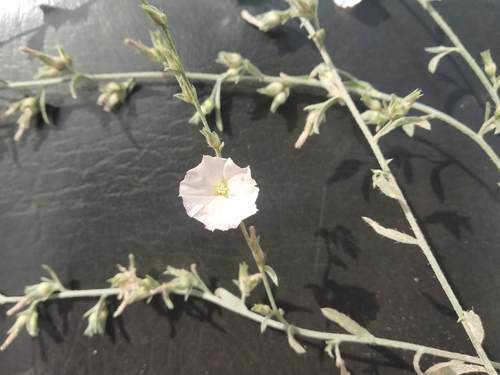
(c) nofrills, some rights reserved (CC BY-NC)
iNaturalist· cc-by-nc
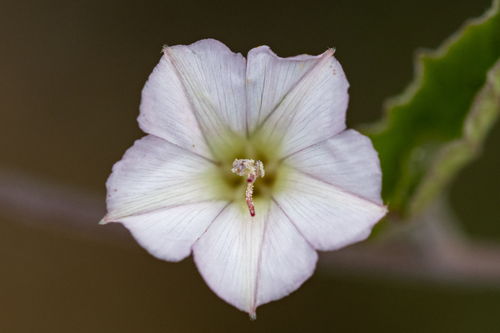
(c) 茶棚, some rights reserved (CC BY-NC), uploaded by 茶棚
iNaturalist· cc0
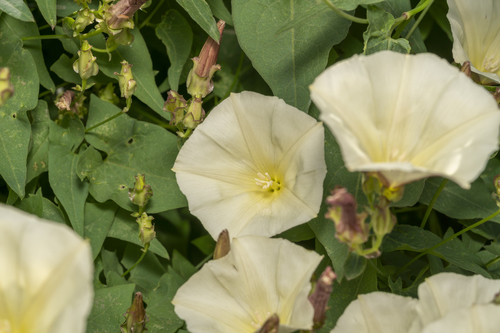
no rights reserved
Summary
A vigorous perennial climbing vine reaching 5 meters with spreading habit. Flowers bloom from August through October. The plant adapts to light, loamy, or clay soils with mildly acidic to neutral or basic pH. It requires full sun exposure and prefers moist soil conditions. Hardy to UK zone 5.
Description
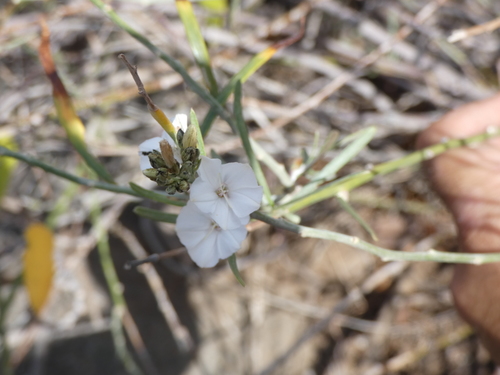
A climbing herb. It keeps growing from year to year. The shoots can climb or lay along the ground and are 3 m long. The leaves are green and arrow shaped. The flowers are pink and 5 cm across.
Edible Uses
Edible Parts: Leaves Root Shoots Edible Uses: Root - cooked, then washed and steamed. Considered to be very nutritious, it is rich in starch and sugar but it should not be eaten regularly. Young shoots - cooked.
Traditional Uses
Young leaves are cooked as a vegetable.
This uses section is brief — help expand it
Medicinal Uses
Diuretic The seed is simmered in water as a diuretic to stimulate kidney secretions.
Known Hazards
Although no reports of toxicity have been seen for this species, at least some, if not all members of this genus are purgative, some caution is advised.
Distribution
It is a temperate plant. It grows in fields, wasteland, roadsides, river banks, often on sandy soils between 100–3500 m. It needs a sunny position. It is resistant to frost and sensitive to drought. In Sichuan and Yunnan.
Where It Grows
Afghanistan, Asia, Australia, Central Asia, China, Himalayas, India, Indochina, Japan*, Korea, Malaysia, Manchuria, Mongolia, Myanmar, Nepal, Pakistan, Russia, SE Asia, Taiwan, Tajikistan, NE Africa, North America,
Cultivation
Easily grown in ordinary garden soil in a sunny position, but plants are apt to become invasive. Nearly all taxa in Calystegia intergrade geographically into neighboring taxa with the exception of the widespread coastal species, C. soldanella (Linnaeus) R. Brown. It is impossible to draw clearly defined specific limits, and intermediate forms are always found where two taxa approximate geographically.
Propagation
Seed - sow spring in a cold frame in a free draining compost and only just cover. The seed usually germinates in 1 - 3 months at 15°c. When they are large enough to handle, prick the seedlings out into individual pots and grow them on in a cold frame for at least their first winter. Plant them out into their permanent positions in late spring or early summer, after the last expected frosts. Division in early spring whilst dormant.
Other Uses
None known Special Uses
Production
It grows rapidly.
Notes
There are 25 Calystegia species.
Synonyms
Also Known As
Broken bowl flower, Dawanhua, Labahua, Rabbit's ear plant, Small twining flower
References (10)
- Bodkin, F., 1991, Encyclopedia Botanica. Cornstalk publishing, p 204
- Plants for a Future database, The Field, Penpol, Lostwithiel, Cornwall, PL22 0NG, UK. http://www.scs.leeds.ac.uk/pfaf/
- Fang Rhui-cheng; George Staples, CONVOLVULACEAE Flora of China
- Hwang, H., et al, 2013, A Study on the Flora of 15 Islands in the Western Sea of Jeollanamdo Province, Korea. Journal of Asia-Pacific Biodiversity Vol. 6, No. 2 281-310
- Kang, Y., et al, 2012, Wild food plants and wild edible fungi in two valleys on the Qinling Mountains (Shaanxi, central China) Journal of Ethnobiology and Ethnomedicine; 9:26
Show all 10 references Hide references
- Liu, Yi-tao, & Long, Chun-Lin, 2002, Studies on Edible Flowers Consumed by Ethnic Groups in Yunnan. Acta Botanica Yunnanica. 24(1):41-56
- Urgamal, M., Oyuntsetseg, B., Nyambayar, D. & Dulamsuren, Ch. 2014. Conspectus of the vascular plants of Mongolia. (Editors: Sanchir, Ch. & Jamsran, Ts.). Ulaanbaatar, Mongolia. “Admon“ Press. 334pp. (p. 158-187).
- Valder, P., 1999, The Garden Plants of China. Florilegium. p 186
- Weckerle, C. S., et al, 2006, Plant Knowledge of the Shuhi in the Hengduan Mountains, Southwest China. Economic Botany 60(1):2-23
- Wujisguleng, W., & Khasbagen. K., 2010, An integrated assessment of wild vegetable resources in Inner Mongolian Autonomous Region, China. Journal or Ethnobiology and Ethnomedicine 6:34