Castanospermum australe
A Cunn. & Fraser ex Hook.
Moreton Bay Chestnut
iNaturalist· cc-by
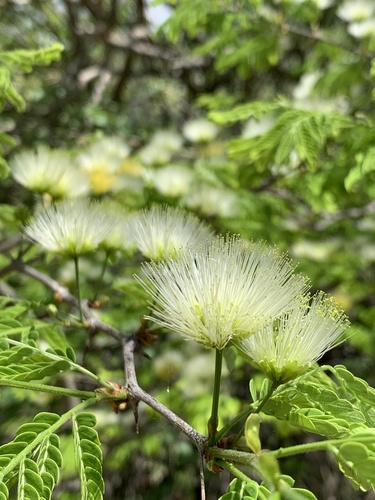
(c) Tatiana Gerus, some rights reserved (CC BY)
iNaturalist· cc-by-nc
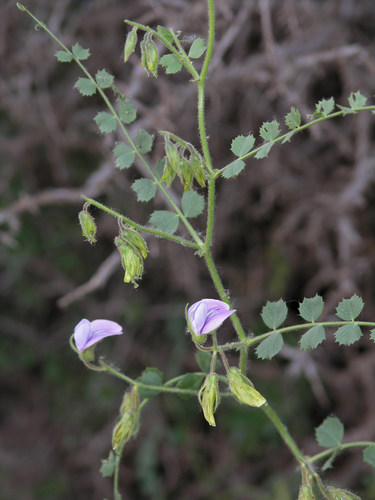
(c) ryanthughes, some rights reserved (CC BY-NC)
Summary
Source: WikipediaCastanospermum australe is an evergreen tree growing to 25 meters tall and 20 meters wide at a slow rate, hardy to UK zone 9. It flowers September to October with hermaphroditic flowers pollinated by birds. The tree has nitrogen-fixing capability and attracts wildlife. It grows in light sandy, medium loamy, and heavy clay soils preferring well-drained conditions with mildly acid to neutral or very acid pH. It requires full sun and prefers moist soil.
Description
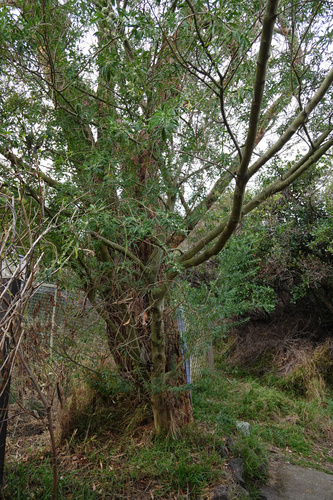
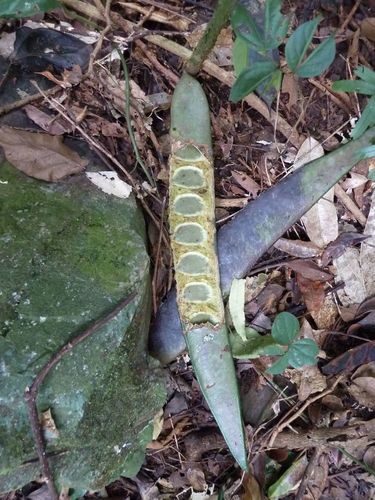
An evergreen tree up to 18-35 m tall. It spreads to 5-12 m across. The stem is erect and stout. The bark is grey to brown and smooth. The leaves are glossy dark green. The leaves are 30-45 cm long. Leaves have 11-15 leaflets. These are slightly curved. The leaflets are 7-12 cm long by 2-5 cm wide. The leaves or cut bark have a cucumber like smell. Flowers are in clusters 5-15 cm long on old wood. They are yellow to orange. The flowers are pea shaped and grow one after another along a stalk in dense clusters. The fruit are broad, bean-like pods. The pods are up to 20 cm long and thick. They can be 4-6 cm wide and woody. Inside the pods, the seeds are in a white pith. There are 1-5 seeds in a pod. The seeds are large and starchy with a shiny brown coat. They are 3-5 cm long.
Edible Uses
The seed must be cooked before eating, as the fresh raw seed contains high levels of saponins and can be harmful. When properly prepared, the cooked seed tastes like sweet chestnut, but it likely requires considerable leaching beforehand. Australian Aboriginal peoples finely sliced the seeds and soaked them in running water for 10 days before roasting and grinding them into a powder that could be stored for later use. The seeds are about 3–4.5cm wide and are carried in pods 10–25cm long, each containing 3–5 seeds.
Traditional Uses
The seeds are eaten after extensive processing (They are soaked for 10 days, pounded and baked.) They may still contain some poison. CAUTION In Australia several deaths and stomach upsets have been reported in cattle which have eaten the seeds.
Medicinal Uses
The seed yields compounds called castanospermine, which are under investigation as HIV inhibitors and may be useful in the treatment of AIDS. The seedpods are astringent. The plant has also been used to treat post-prandial hyperglycaemia in diabetic patients.
Known Hazards
The immature seed is poisonous, though mature seeds are harmless. Another report says that the raw seed is poisonous and needs treatment to render it edible.
Distribution
A tropical plant. Introduced and grown along the coast in Papua New Guinea in some areas. It suits rainforest and creek bank sites. It suits humid locations. It needs light, well drained soil in a protected sunny position. It is drought and frost tender and is damaged by wind. Trees need a temperature above 7°C but can stand very short periods down to 0°C. They are best with a mean annual temperature of 28°C. It suits warm temperate to tropical regions. In Melbourne Botanical Gardens. It suits hardiness zones 10-12.
Where It Grows
Africa, Asia, Australia, Central America, East Africa, Fiji, Hawaii, India, Indonesia, Kenya, New Caledonia, Malaysia, Mozambique, Myanmar, Norfolk Island, Pacific, Pakistan, Papua New Guinea, PNG, SE Asia, Slovenia, Solomon Islands, Southern Africa, Sri Lanka, USA, Vanuatu, West Indies, Zimbabwe,
Cultivation
It grows best in areas where annual daytime temperatures are within the range 20 - 32°c, but can tolerate 10 - 41°c. It prefers a mean annual rainfall in the range 1,600 - 3,200mm, but tolerates 1,000 - 3,800mm. Requires a very well-drained but moist high-grade soil and a very sunny position when grown in areas cooler than its natural climate. Prefers a pH in the range 5 - 6, tolerating 4.5 - 6.5. The crushed leaves smell like cucumbers. Flowers are produced on the old wood. The flowers are rich in nectar and are pollinated by parrots in the wild. This species has a symbiotic relationship with certain soil bacteria, these bacteria form nodules on the roots and fix atmospheric nitrogen. Some of this nitrogen is utilized by the growing plant but some can also be used by other plants growing nearby.
Propagation
Sow seed and prick out seedlings into individual deep pots as soon as they are large enough to handle. Plant out when 15cm or more tall.
Other Uses
The extensive root system is used to protect riverbanks and catchment areas in Australia. The seeds have a high saponin content, which could potentially be used as a soap substitute. The toxic saponins in the seeds are reportedly toxic to a serious pest of stored grain. The wood can be used as fuel. The timber is durable, hard, heavy, and resistant to decay, polishes well, and has high resistance to the passage of electric current. The sapwood ranges from white to yellow, while the heartwood is dark brown to almost black, slightly greasy, and straight-grained though sometimes interlocked. It is used in construction, cabinet making, and carving. Considered one of the most valuable woods in Australia, its sliced veneers can serve as a good substitute for teak. The wood has a density of 700 kg/m³. The tree is also used as a flowering specimen in public open spaces and as a street tree.
Production
In Australia fruit are produced from March to November.
Other Information
The tree is introduced to Papua New Guinea and may not be much used for food.
Notes
The timber is a very useful cabinet wood. There is only one Castanospermum species.
Nutrition
| Part | Moisture | kJ | kcal | Protein | Vit A | Vit C | Iron | Zinc |
|---|---|---|---|---|---|---|---|---|
| Seed | 51.4 | 824 | 197 | 4 | — | — | 6.1 | 0.3 |
Also Known As
Australian chestnut, Avstralski kostanj, Bean tree, Black bean, Huhuboi, Thawka-mala, Wuhbo
References (66)
- Ambasta S.P. (Ed.), 2000, The Useful Plants of India. CSIR India. p 111
- Bailey, F. M., 1913, Comprehensive Catalogue of Queensland Plants. Queensland Government. p 148
- Barwick, M., 2004, Tropical and Subtropical Trees. A Worldwide Encyclopedic Guide. Thames and Hudson p 96
- Beasley, J., 2011, Plants of Tropical North Queensland - the compact guide. Footloose publications. p 86
- Blomberry, A.M., 1979, Australian Native Plants. Angus and Robertson p 157
Show all 66 references Hide references
- Bodkin, F., 1991, Encyclopedia Botanica. Cornstalk publishing, p 225
- Bonney, N., 1997, Economic Native Trees and Shrubs for South Australia. Greening Australia (SA) inc. Campbelltown SA 5074 p 168
- Bot. Misc. 1:241. 1830
- Bremness, L., 1994, Herbs. Collins Eyewitness Handbooks. Harper Collins. p 43
- Brickell, C. (Ed.), 1999, The Royal Horticultural Society A-Z Encyclopedia of Garden Plants. Convent Garden Books. p 235
- Burkill, I.H., 1966, A Dictionary of the Economic Products of the Malay Peninsula. Ministry of Agriculture and Cooperatives, Kuala Lumpur, Malaysia. Vol 1 (A-H) p 495
- Cabalion, P. and Morat, P., 1983, Introduction le vegetation, la flore et aux noms vernaculaires de l'ile de Pentcoste (Vanuatu), In: Journal d'agriculture traditionnelle et de botanique appliquee JATBA Vol. 30, 3-4
- Calvert, G., 2010, The Burdekin Delta Tree Guide. Lower Burdekin Landcare Association., Inc., Ayr p 45
- Cherikoff V. & Isaacs, J., The Bush Food Handbook. How to gather, grow, process and cook Australian Wild Foods. Ti Tree Press, Australia p 198
- Cooper W & Cooper, W T, 1994, Fruits of the Rain Forest. RD Press p 68
- Cooper, W. and Cooper, W., 2004, Fruits of the Australian Tropical Rainforest. Nokomis Editions, Victoria, Australia. p 204
- Cribb, A.B. & J.W., 1976, Wild Food in Australia, Fontana. p 83
- Cronin, L., 1989, The Concise Australian Flora. Reed. p 177
- Cundall, P., (ed.), 2004, Gardening Australia: flora: the gardener's bible. ABC Books. p 339
- Dharani, N., 2002, Field Guide to common Trees & Shrubs of East Africa. Struik. p 65
- Elliot, W.R., & Jones, D.L., 1982, Encyclopedia of Australian Plants suitable for cultivation. Vol 2. Lothian. p 477
- Etherington, K., & Imwold, D., (Eds), 2001, Botanica's Trees & Shrubs. The illustrated A-Z of over 8500 trees and shrubs. Random House, Australia. p 189
- Evans, B. R, 1999, Edible nut Trees in Solomon Islands. A variety collection of Canarium, Terminalia and Barringtonia. ACIAR Technical Report No. 44 96pp
- Flora of Australia Volume 49, Oceanic Islands 1, Australian Government Publishing Service, Canberra. (1994) p 175
- Flowerdew, B., 2000, Complete Fruit Book. Kyle Cathie Ltd., London. p 209
- French, B.R., 1986, Food Plants of Papua New Guinea, A Compendium. Asia Pacific Science Foundation p 185
- Greig, D., 1996, Flowering Natives for Home Gardens. Angus & Robertson. p 110
- Hearne, D.A., & Rance, S.J., 1975, Trees for Darwin and Northern Australia. AGPS, Canberra p 42
- Hedrick, U.P., 1919, (Ed.), Sturtevant's edible plants of the world. p 175
- Henty, E.E., 1980, Harmful Plants in Papua New Guinea. Botany Bulletin No 12. Division Botany, Lae, Papua New Guinea. p 81, 82
- Hibbert, M., 2002, The Aussie Plant Finder 2002, Florilegium. p 61
- Hiddins, L., 1999, Explore Wild Australia with the Bush Tucker Man. Penguin Books/ABC Books. p 128
- Hill, R. and Baird, A., 2003, Kuku-Yalanji Rainforest Aboriginal People and Carbohydrate Resource Management in the Wet Tropics of Queensland, Australia. Human Ecology, Vol. 31, No. 1. pp 27-52
- Hinton, B & B., 1982, A Wilderness in Bloom. Wildflowers of tropical Australia. p 11
- Holliday, I., 1989, A Field Guide to Australian Trees. Hamlyn. p 104
- Isaacs, J., 1987, Bush Food, Aboriginal Food and Herbal Medicine. Weldons. p 80
- Jackes, B.R., 2001, Plants of the Tropics. Rainforest to Heath. An Identification Guide. James Cook University. p 54
- Jones D, L, 1986, Ornamental Rainforest Plants in Australia, Reed Books, p 152
- Krishen P., 2006, Trees of Delhi, A Field Guide. DK Books. p 261
- Lazarides, M. & Hince, B., 1993, Handbook of Economic Plants of Australia, CSIRO. p 52
- Lord, E.E., & Willis, J.H., 1999, Shrubs and Trees for Australian gardens. Lothian. p 13
- Low, T., 1991, Wild Food Plants of Australia. Australian Nature FieldGuide, Angus & Robertson. p 94
- Low, T., 1992, Bush Tucker. Australia’s Wild Food Harvest. Angus & Robertson. p 96, 97
- Menninger, E.A., 1977, Edible Nuts of the World. Horticultural Books. Florida p 91
- Molyneux, B & Forrester, S., 1997, The Austraflora A-Z of Australian Plants. Reed. p 64
- Morley, B.D., & Toelken, H.R., (Eds), 1983, Flowering Plants in Australia. Rigby. p 155
- Nicholson, N & H., 1996, Australian Rainforest Plants, Terania Rainforest Publishing. NSW. p 21
- Plants for a Future database, The Field, Penpol, Lostwithiel, Cornwall, PL22 0NG, UK. http://www.scs.leeds.ac.uk/pfaf/
- Radke, P & A, Sankowsky, G & N., 1993, Growing Australian Tropical Plants. Frith & Frith, Australia. p 27
- Ryan, M. (Ed.), 2003, Wild Plants of Greater Brisbane. Queensland Museum. p 16
- Scarth-Johnson, V., 2000, National Treasures. Flowering Plants of Cooktown and Northern Australia. Vera Scarth-Johnson Gallery Association. Cooktown, Australia. p 114
- Smith, A.C., 1985, Flora Vitiensis Nova, Lawaii, Kuai, Hawaii, Volume 3 p 151
- Staples, G.W. and Herbst, D.R., 2005, A tropical Garden Flora. Bishop Museum Press, Honolulu, Hawaii. p 330
- Sukarya, D. G., (Ed.) 2013, 3,500 Plant Species of the Botanic Gardens of Indonesia. LIPI p 184
- Swaminathan, M.S., and Kochnar, S.L., 2007, An Atlas of major Flowering Trees in India. Macmillan. p 291
- Tewari, D.N., 1994, Important Plants of India. International Book Distributors, India. p 13
- Townsend, K., 1994, Across the Top. Gardening with Australian Plants in the tropics. Society for Growing Australian Plants, Townsville Branch Inc. p 125
- Verdcourt, B., 1979, Manual of New Guinea Legumes. Botany Bulletin No 11, Division of Botany, Lae, Papua New Guinea. p 283
- Walter, A & Sam, C., 1995, Indigenous Nut Trees in Vanuatu: Ethnobotany and Variability. In South Pacific Indigenous Nuts. ACIAR Proceedings No 69. Canberra. p 57
- Walter, A. & Sam C., 2002, Fruits of Oceania. ACIAR Monograph No. 85. Canberra. p 136
- Wickens, G.E., 1995, Edible Nuts. FAO Non-wood forest products. FAO, Rome. p 142
- Williams, J.B., Harden, G.J., and McDonald, W.J.F., 1984, Trees and shrubs in rainforests of New South Wales and Southern Queensland. Univ. of New England, Armidale. p 42, 49
- World Checklist of Useful Plant Species 2020. Royal Botanic Gardens, Kew
- worldagroforestrycentre.org/sea/products/afdbases/af/asp/SpeciesInfo.asp?SpID=1779
- www.worldagroforestrycentre.org/treedb/
- Young, J., (Ed.), 2001, Botanica's Pocket Trees and Shrubs. Random House. p 207