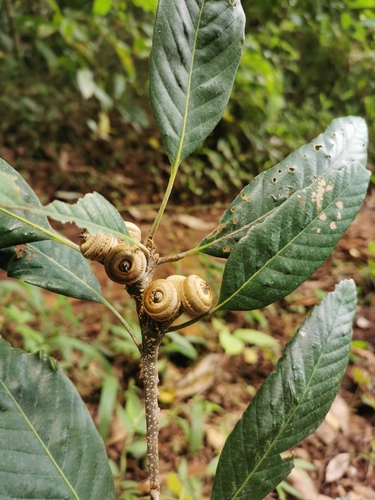
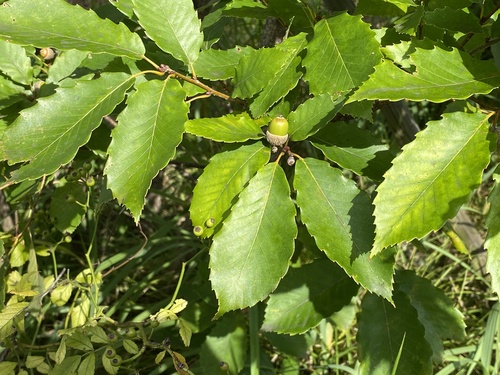
Castanea mollissima
Blume
Chinese chestnut
iNaturalist· cc0
no rights reserved, uploaded by Ken Kneidel
iNaturalist· cc-by-nc
(c) vester, some rights reserved (CC BY-NC)
iNaturalist· cc-by
(c) Evan M. Raskin, some rights reserved (CC BY), uploaded by Evan M. Raskin
Summary
Source: WikipediaCastanea mollissima, also known as the Chinese chestnut, is an Asian species of chestnut tree in the family Fagaceae.
Description
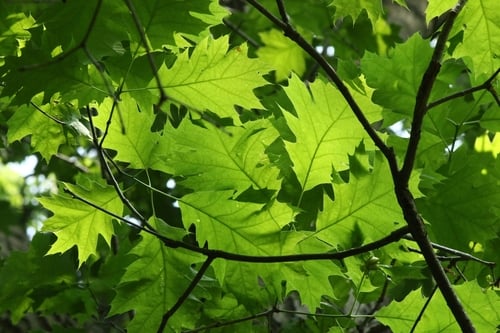
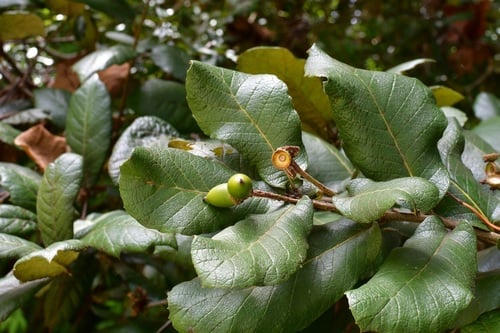
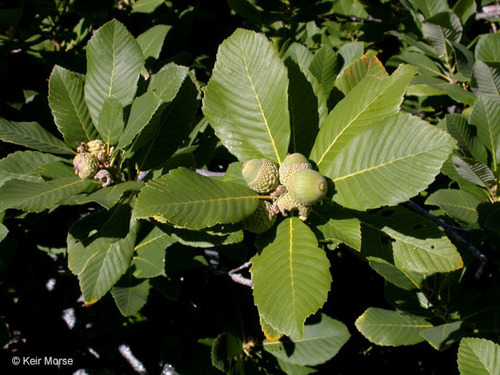
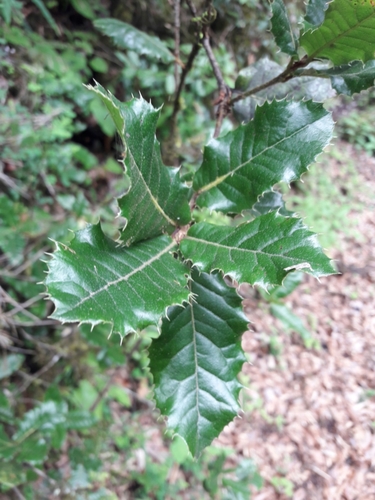
A big tree. It grows 20-25 m tall. The trunk is 1 m across. The branches have short hairs but can also have long spreading hairs. The leaf stalk is 1-2 cm long. The leaf blade is oval and 10-17 cm long. It can be slightly hairy along the veins. The base of the leaf is rounded. There are coarse teeth around the edge. The male flower is 10-20 cm long. The cup is densely covered with spine like bracts. There can be 2-3 nuts in each cup. They are 2-3 cm across. The nuts are edible.
Edible Uses
The seeds can be eaten raw or cooked, though eaten raw they have a noticeable astringency, particularly if the fleshy inner skin beneath the outer shell is not removed. Baking brings out significant sweetness and a floury texture, making them an excellent staple comparable to potatoes or cereals. The inner skin peels easily. The seeds are low in fats and oils but high in carbohydrates. Per 100g dry weight: 403 calories; protein 11.9g; fat 2.7g; carbohydrate 83.2g; fibre 2.2g; calcium 36mg; vitamin A 168mg; thiamine (B1) 0.29mg; riboflavin (B2) 0.32mg; niacin 1.44mg; vitamin C 65mg.
Traditional Uses
The seeds can be eaten. They are used both fresh and dried. They can be roasted or boiled. They are also used in cooking.
This uses section is brief — help expand it
Medicinal Uses
The burrs (seed cases) are rich in tannin and are used as an astringent and stomachic. A decoction is used to treat diarrhoea, uncontrollable nosebleed, dysentery, regurgitation, and profound thirst. The flowers are used in the treatment of scrofula. Stem bark is applied to treat poisoned wounds, and the stem sap is used to treat lacquer poisoning.
Distribution
It is native to China. It requires a dry subtropical location. It occurs in North Vietnam from 500 to 2000 m altitude. It can grow on waste land, stony soil and acidic or limestone soils. In China it grows from near sea level to about 2800 m altitude. It suits hardiness zones 5-9.
Where It Grows
Asia, Australia, Canada, China*, East Africa, Indochina, Korea, Laos, Myanmar, North America, Pacific, Philippines, SE Asia, Tanzania, USA, Vietnam,
Cultivation
Prefers a good well-drained slightly acid loam but succeeds in dry soils. Once established, it is very drought tolerant. Very tolerant of highly acid, infertile dry sands. Averse to calcareous soils but succeeds on harder limestones. Although very winter-hardy, this species does not do well in Britain, it only really thrives in areas with hot summers. Does not fruit well in Britain. A tree in semi-shade at Kew in 1990 was 9 metres tall. Extensively cultivated for its edible seed in China, and also much grown in America, there are a number of named varieties. Plants can fruit in 5 - 7 years from seed and yields from mature trees are around 25 - 60 kilos per tree. Resistant, but not immune, to blight, it is hybridized with C. dentata to try and find blight resistant cultivars with superior seeds. A shallow rooted tree. Responds well to coppicing. An excellent soil-enriching understorey in pine forests. Flowers are produced on wood of the current year's growth. Plants are fairly self-sterile. They hybridize freely with other members of this genus. Plants in this genus are notably resistant to honey fungus.
Propagation
Sow seed as soon as it is ripe, either in a cold frame or in an outdoor seedbed, and protect it from mice and squirrels. The seed has short viability and must not be allowed to dry out. It can be stored moist in a cool place such as the salad compartment of a fridge for a few months, but should be checked regularly for signs of germination. Germination typically occurs in late winter or early spring. Seedlings raised outdoors can be left in situ for one to two years before being moved to permanent positions. Plants grown in pots can go out to permanent positions in summer or autumn, with some cold protection in their first winter.
Other Uses
The bark, leaves, wood, and seed husks all contain tannin. The wood is hard, strong, and light, and is used for fence posts and similar purposes. The tree is also coppiced for fuel.
Production
Seedlings usually bear in 5-8 years. Grafted trees can bear in 2 years.
Other Information
It is a cultivated food plant. The nuts are exported.
Notes
All Castanea bear edible nuts. There are about 12 Castanea species. This is a cultivated plant. It is resistant to chestnut blight.
Dangerous Lookalikes
This plant can be confused with the following toxic species. Always verify identification carefully before consuming any wild plant.
Horse Chestnut (Conker)
Aesculus hippocastanum
Solipsist
Chinese chestnut
Castanea mollissima
no rights reserved, uploaded by Ken Kneidel
Horse Chestnut (Conker): Round smooth nuts (conkers), bumpy green husk (not very spiny), palmate compound leaves (like a hand).
Chinese chestnut: Nuts with pointed tassel, very spiny bur casing, simple toothed leaves.
Nutrition
| Part | Moisture | kJ | kcal | Protein | Vit A | Vit C | Iron | Zinc |
|---|---|---|---|---|---|---|---|---|
| Nuts | 44 | 937 | 224 | 4.2 | 20 | 36 | 1.4 | 0.9 |
Synonyms
Also Known As
Ban Li, Board chestnut, Chinese hairy chestnut, De tau, De trong, De trung khanh, Yebanli, Yemaoli
References (35)
- Arora, R. K., 2014, Diversity in Underutilized Plant Species - An Asia-Pacific Perspective. Bioversity International. p 94
- Bodkin, F., 1991, Encyclopedia Botanica. Cornstalk publishing, p 224
- Brickell, C. (Ed.), 1999, The Royal Horticultural Society A-Z Encyclopedia of Garden Plants. Convent Garden Books. p 235
- Coombes, A.J., 2000, Trees. Dorling Kindersley Handbooks. p 149
- Coronel, R.E., 1982, Fruit Collections in the Philippines. IBPGR Newsletter p 9
Show all 35 references Hide references
- Cundall, P., (ed.), 2004, Gardening Australia: flora: the gardener's bible. ABC Books. p 339
- Huang Chengjiu, Zhang Yongtian, Bartholomew, B., Fagaceae, Flora of China. and Flora of China. www.eFloras.org
- Duke, J.A., 1992, Handbook of Edible Weeds. CRC Press. p 64
- Eisenberg et al, 2009, Kam Local Indigenous Knowledge and Sustainable Resource Management in Ghuizhou and Guangxi Provinces, China. Ethnobotany Research and Applicatons 7:067-113
- Etherington, K., & Imwold, D., (Eds), 2001, Botanica's Trees & Shrubs. The illustrated A-Z of over 8500 trees and shrubs. Random House, Australia. p 188
- Facciola, S., 1998, Cornucopia 2: a Source Book of Edible Plants. Kampong Publications, p 114
- FAO, 1995, Edible Nuts. Non Wood Forest Products 5.
- Farrar, J.L., 1995, Trees of the Northern United States and Canada. Iowa State University press/Ames p 271
- Flora of China Vol. 4, p 316
- Forest Inventory and Planning Institute, 1996, Vietnam Forest Trees. Agriculture Publishing House p 251
- Flowerdew, B., 2000, Complete Fruit Book. Kyle Cathie Ltd., London. p 200
- Gouldstone, S., 1983, Growing your own Food-bearing Plants in Australia. Macmillan p 137
- Hu, Shiu-ying, 2005, Food Plants of China. The Chinese University Press. p 340
- INFOODSUpdatedFGU-list.xls
- Kang, Y., et al, 2012, Wild food plants and wild edible fungi in two valleys on the Qinling Mountains (Shaanxi, central China) Journal of Ethnobiology and Ethnomedicine; 9:26
- Krochmal, A. & Krochmal, C., 1982, Uncultivated Nuts of The United States. United States Department of Agriculture Forest Service. p 12
- Macmillan, H.F. (Revised Barlow, H.S., et al) 1991, Tropical Planting and Gardening. Sixth edition. Malayan Nature Society. Kuala Lumpur. p 313
- Menninger, E.A., 1977, Edible Nuts of the World. Horticultural Books. Florida p 13
- Mus. bot. 1:286. 1851
- Plants for a Future database, The Field, Penpol, Lostwithiel, Cornwall, PL22 0NG, UK. http://www.scs.leeds.ac.uk/pfaf/
- Sam, H. V. et al, 2004, Trees of Laos and Vietnam: A Field Guide to 100 Economically or Ecologically Important Species. BLUMEA 49: 201-349
- Solomon, C., 2001, Encyclopedia of Asian Food. New Holland. p 75
- Tozer, F., 2007, The Uses of Wild Plants. Green Man Publishing. p 59
- USDA, ARS, National Genetic Resources Program. Germplasm Resources Information Network - (GRIN). [Online Database] National Germplasm Resources Laboratory, Beltsville, Maryland. Available: www.ars-grin.gov/cgi-bin/npgs/html/econ.pl (10 April 2000)
- Valder, P., 1999, The Garden Plants of China. Florilegium. p 270
- Van Sam, H. et al, 2004, Trees of Laos and Vietnam: A Field Guide to 100 Economically or Ecologically Important Species. Blumea 29 (2004) 201-349
- Wickens, G.E., 1995, Edible Nuts. FAO Non-wood forest products. FAO, Rome. p 21, 123
- Wiersema, J. H. & Leon, B., 2013, World Economic Plants. A Standard Reference CRC Press. 2nd Ed. p 151
- World Checklist of Useful Plant Species 2020. Royal Botanic Gardens, Kew
- Zeven, A. C. & de West, J. M. J., 1982, Dictionary of cultivated plants and their regions of diversity. Wageningen. p 36