Caryota rumphiana
Becc
Fishtail palm
iNaturalist· cc-by-sa
(c) Ong Jyh Seng, some rights reserved (CC BY-SA), uploaded by Ong Jyh Seng
iNaturalist· cc-by
(c) Jiro Iguchi, some rights reserved (CC BY)
iNaturalist· cc-by-nc
(c) Diane Morton, some rights reserved (CC BY-NC)
Summary
Source: WikipediaCaryota rumphiana, whose common names include the fishtail or Albert palm, is a Caryota or fish tail palm (Family Palmae or Arecaceae). It is native to Philippines, Sulawesi, Maluku, New Guinea, Solomon Islands, Bismarck Archipelago. Its leaves have a distinctive fishtail shape and its flowers have been described as mop-like. It is monocarpic. These leaves are bipinnate with as many as 1,800 fan-shaped or wedge-shaped leaflets, each up to 15 inches (38 centimeters) long by six inches (15 cm) wide.
Description
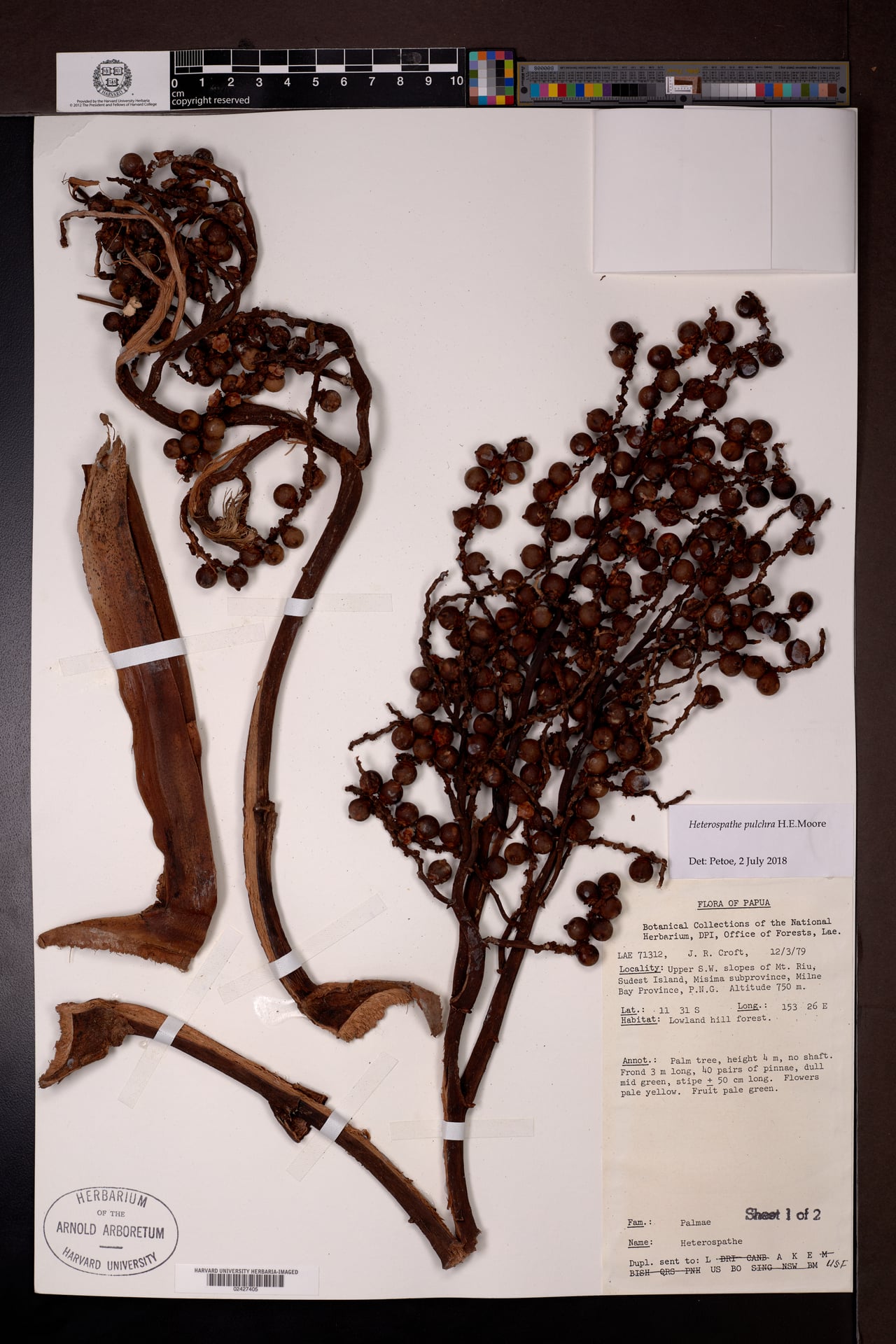
A spineless palm with delta shaped leaflets. It grows to a height of 18 m and spreads to 5 m across. The stem is slender and erect. The leaflets are bipinnate (Two branches on the leaves) and the whole leaf is up to 5-6 m long and 3-4 m wide. The leaves have irregular teeth on the edges towards the top. The leaves arch over. The flowers are purple and yellow-green. They occur on long spikes. These can be 3 m long. These fruiting stalks are stout. Long chains of fruit hang from near the leaves along this stalk. The fruit are bluish. The fruit irritate the skin of people.
Edible Uses
The pith of the young trunk is eaten as heart cabbage. The trunk can be pounded to extract sago starch or used to cultivate sago grubs. The fruit are eaten after prolonged boiling.
Traditional Uses
The pith of the young trunk is eaten (Heart cabbage) The trunk is sometimes used to pound for sago starch. The trunk is also used to cultivate sago grubs. The fruit are eaten after a long time of boiling. CAUTION The juice of the fruit can irritate the skin
Known Hazards
The fruit skin irritates the skin on contact. The sap and juice of the fruit contain irritant crystals.
Distribution
A tropical plant. The palm is common and widespread at low elevations in Papua New Guinea. It grows up to at least 1200 m altitude. It will grow on most soils. It needs a protected, warm, moist position. It is sensitive to frost. It suits hardiness zones 10-12.
Where It Grows
Asia, Australia, East Timor, Indonesia, Pacific, Papua New Guinea, PNG, Philippines, SE Asia, Solomon Islands, Timor-Leste,
Cultivation
It grows wild. It can be grown from seeds. Seed need to be sown while fresh. Seed can take 6-12 months to germinate.
Propagation
Seed - sown fresh, it takes 1 - 3 months to germinate. Young plants can be placed in their permanent positions when about 1 year old, by which time they can be 150 - 200cm tall.
Other Uses
The leaf sheath fibre ('kittul') from plants in this genus is durable and is often harvested as a source of thatch, cordage, and to make brushes and brooms. The fibre becomes very pliable after being steeped in linseed oil. The woolly hairs on the leaf sheaths, petioles and rachis can be used as tinder or as wadding. They may also be used to caulk wooden boats. The finer fibre can also be spun into fishing lines or coarse threads for sewing. The outer part of the trunk is split and made into very durable slat flooring.
Production
Using the cabbage or growing tip kills the palm.
Other Information
A common palm in lowland areas of Papua New Guinea but only of minor importance as a food. It has cultural significance in some areas e.g. Kaluli near Mt Bosavi.
Notes
There are 12 Caryota species. They are tropical. Caution: The sap from the fruit contains irritant crystals.
Synonyms
Also Known As
Doba, Kaapi, Palem nibung besar, Sabo, Sampul, Takipan
References (30)
- Alegado, A. M. & De Guzman, R. B., 2014, Indigenous food crops of the Aetas tribe in the Philippines and their traditional methods of food preparation. in Promotion of Underutilized Indigenous Food Resources for Food Security and Nutrition in Asia and Pacific. FAO. Bangkok p 160
- Baker, W.J. and Dransfield, J., 2006, Field Guide to Palms of New Guinea. Kew p 38
- Barfod, A.S., Banka R., and Dowe, J. L., 2001, Field Guide to Palms in Papua New Guinea. AAU Reports 40 Department of Systematic Botany University of Aarhus. Denmark. p 37
- Bodkin, F., 1991, Encyclopedia Botanica. Cornstalk publishing, p 219
- Borrell, O.W., 1989, An Annotated Checklist of the Flora of Kairiru Island, New Guinea. Marcellin College, Victoria Australia. p 37
Show all 30 references Hide references
- Cowie, I, 2006, A Survey of Flora and vegetation of the proposed Jaco-Tutuala-Lore National Park. Timor-Lests (East Timor) www.territorystories.nt/gov.au p 43
- Cronin, L., 1989, The Concise Australian Flora. Reed. p 218
- Cronin, L., 2000, Australian Palms, Ferns, Cycads and Pandans. Cronin Publications. p 42
- Elliot, W.R., & Jones, D.L., 1982, Encyclopedia of Australian Plants suitable for cultivation. Vol 2. Lothian. p 468
- Etherington, K., & Imwold, D., (Eds), 2001, Botanica's Trees & Shrubs. The illustrated A-Z of over 8500 trees and shrubs. Random House, Australia. p 186
- Facciola, S., 1998, Cornucopia 2: a Source Book of Edible Plants. Kampong Publications, p 27
- French, B.R., 1986, Food Plants of Papua New Guinea, A Compendium. Asia Pacific Science Foundation p 30
- French, B.R., 2010, Food Plants of Solomon Islands. A Compendium. Food Plants International Inc. p 279
- Hariyadi, B., 2008, The Entwined Tree: Traditional Natural Resource Management of Serampas, Jambi, Indonesia. Ph. D thesis. Univ. or Hawaii. p 401
- Henderson, C.P. and I.R.Hancock, 1988, A Guide to the Useful Plants of the Solomon Islands. Res. Dept. Min of Ag. & Lands. Honiara, Solomon Islands. p 150
- Henty, E.E., 1980, Harmful Plants in Papua New Guinea. Botany Bulletin No 12. Division Botany, Lae, Papua New Guinea. p 114, Pl. 42
- Hide, R. L., (Ed.) 1984, Research Report of the Simbu Land Use Project. Vol.V1 South Simbu: Studies in Demography, Nutrition, and Subsistence. p 441
- Jones D, L, 1986, Ornamental Rainforest Plants in Australia, Reed Books, p 327
- Jones, D.L., 1994, Palms throughout the World. Smithtonian Institution, Washington. p 165
- Jones, D.L., 2000, Palms of Australia 3rd edition. Reed/New Holland. p 133
- Nombo, P. & Leach, J. 2010, Reite Plants: An Ethnobotanical Study in Tok Pisin and English. ANU press. p 113
- Ochse, J. J. et al, 1931, Vegetables of the Dutch East Indies. Asher reprint. p 560
- Peekel, P.G., 1984, (Translation E.E.Henty), Flora of the Bismarck Archipelago for Naturalists, Division of Botany, Lae, PNG. p 58, 59
- Powell, J.M., Ethnobotany. In Paijmans, K., 1976, New Guinea Vegetation. Australian National University Press. p 108
- Riffle, R.L. & Craft, P., 2003, An Encyclopedia of Cultivated Palms. Timber Press. p 292
- Sillitoe, P. 1995, An Ethnobotanical Account of the Plant Resources of the Wola Region, Southern Highlands Province, Papua New Guinea. J. Ethnobiol. 15(2): 201-235
- Sosef, M. S. M., Hong, L. T., & Prawirohatmodjo, S., (Eds.), 1998, Timber tree: Lesser-known timbers. Plant Resources of South-East Asia, 5(3), p 140
- Sukarya, D. G., (Ed.) 2013, 3,500 Plant Species of the Botanic Gardens of Indonesia. LIPI p 767
- Williams, K.A.W., 1999, Native Plants of Queensland Volume 4. Keith A.W. Williams North Ipswich, Australia. p 98
- World Checklist of Useful Plant Species 2020. Royal Botanic Gardens, Kew