Caryota cumingii
Lodd. ex Mart.
Philippines fishtail palm
iNaturalist· cc-by-nc-sa
(c) filibot.web, some rights reserved (CC BY-NC-SA)
wikimedia· cc-by
Wikimedia Commons - 岸本年郎
Description
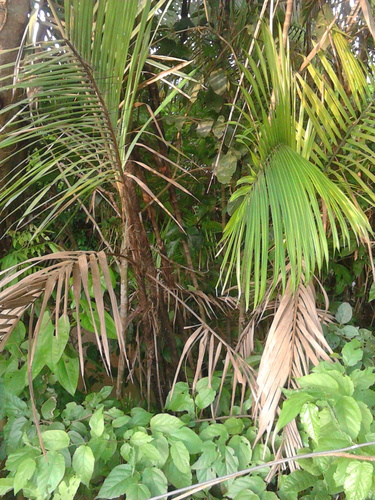
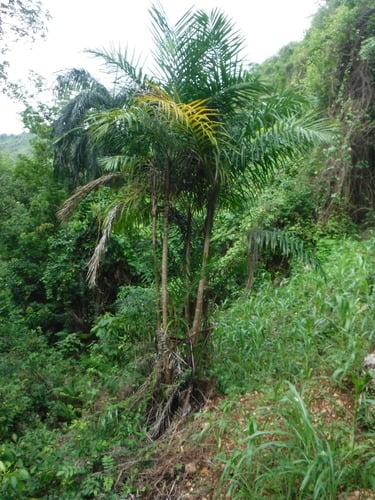
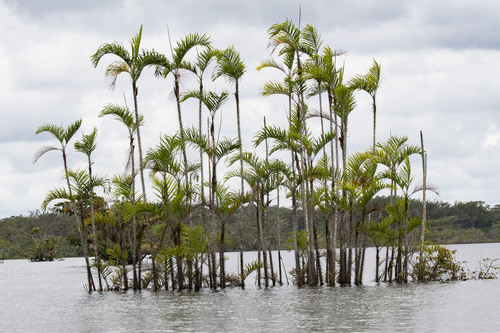
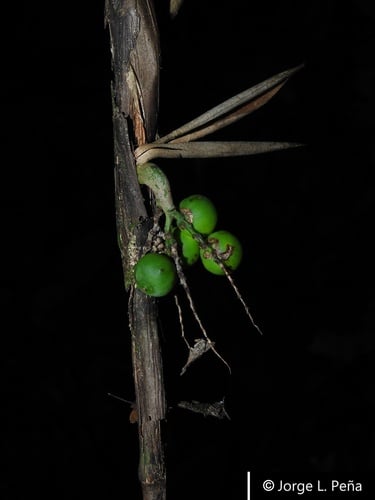
A solitary palm. It grows 5 to 8 m in height and 20 cm across. They can be 12 m high. It has a thick, deeply ringed trunk. They have spreading alternate leaves. The leaves are 3.3 m long and 2 m wide. They grow in 2 or 3 closely set tiers at the top of the plant. The tips of the leaves curve over and hang down. The bract (spathe) below the flowers is very large. The fruit is round and small in size with a single seed. The pulpy outer covering contains very many stingy needle like crystals. The seed has a brown polished surface. The branches of the flower stalk bear strongly hairy very small scales.
Edible Uses
The terminal bud is cooked and eaten as a vegetable (palm heart). Starch (sago) is extracted from the pith of the stems. The flower sap is collected for tuba or palm wine.
Traditional Uses
The bud is cooked and eaten as a vegetable. The sap of the flower is collected for tuba or palm wine. Sago starch is made from the pith of the stems.
Known Hazards
The pulpy outer covering of the fruit contains numerous stinging needle-like crystals.
Distribution
It is a tropical plant. It suits the hot humid lowlands. Widely distributed in the islands of the Philippines. It suits hardiness zones 11-12. Adelaide Botanical Gardens. In Adelaide Botanical Gardens hot house.
Where It Grows
Asia, Australia, Indonesia, Malaysia, Pacific, Philippines, SE Asia,
Cultivation
Plants are grown from seed. Germination can be irregular. Seeds may take 10-12 months to germinate. It can also be grown by suckers.
Other Uses
The leaf sheath fibre ('kittul') from plants in this genus is durable and is often harvested as a source of thatch, cordage, and to make brushes and brooms. The fibre becomes very pliable after being steeped in linseed oil. The woolly hairs on the leaf sheaths, petioles and rachis can be used as tinder or as wadding. They may also be used to caulk wooden boats. The finer fibre can also be spun into fishing lines or coarse threads for sewing.
Notes
There are 12 Caryota species. They are tropical.
Also Known As
Palem ekor ikan filipina, Pugahan
References (14)
- Cundall, P., (ed.), 2004, Gardening Australia: flora: the gardener's bible. ABC Books. p 336
- Etherington, K., & Imwold, D., (Eds), 2001, Botanica's Trees & Shrubs. The illustrated A-Z of over 8500 trees and shrubs. Random House, Australia. p 186
- Facciola, S., 1998, Cornucopia 2: a Source Book of Edible Plants. Kampong Publications, p 27
- Heywood, V.H., Brummitt, R.K., Culham, A., and Seberg, O., 2007, Flowering Plant Families of the World. Royal Botanical Gardens, Kew. p 348
- Hist. nat. palm. 3:315. 1853
Show all 14 references Hide references
- Jones, D.L., 1994, Palms throughout the World. Smithtonian Institution, Washington. p 163
- Jones, D.L., 2000, Palms of Australia 3rd edition. Reed/New Holland. p 131
- Martin, F.W. & Ruberte, R.M., 1979, Edible Leaves of the Tropics. Antillian College Press, Mayaguez, Puerto Rico. p 210
- Monsalud, M.R., Tongacan, A.L., Lopez, F.R., & Lagrimas, M.Q., 1966, Edible Wild Plants in Philippine Forests. Philippine Journal of Science. p 524
- Polinag, M. A., 2003, Food from the Wilderness. Department of Environment and Natural Resources. Laguna.
- Riffle, R.L. & Craft, P., 2003, An Encyclopedia of Cultivated Palms. Timber Press. p 290
- Sukarya, D. G., (Ed.) 2013, 3,500 Plant Species of the Botanic Gardens of Indonesia. LIPI p 767
- Wickens, G.E., 1995, Edible Nuts. FAO Non-wood forest products. FAO, Rome. p164
- World Checklist of Useful Plant Species 2020. Royal Botanic Gardens, Kew