Caryocar nuciferum
L.
Souari Nut, Butter Nut
iNaturalist· pd
English:, no known copyright restrictions (public domain)
iNaturalist· pd
Bentham-Moxon Trust.; Curtis, William; Curtis's botanical magazine dedications, 1827-1927 : portraits and biographical notes.; Royal Botanic Gardens, Kew.; Stanley Smith Horticultural Trust., no known copyright restrictions (public domain)
iNaturalist· pd
anonymous, no known copyright restrictions (public domain)
Summary
Source: WikipediaCaryocar nuciferum, the butter-nut of Guiana, is a fruit tree native to Central and South America.
Description
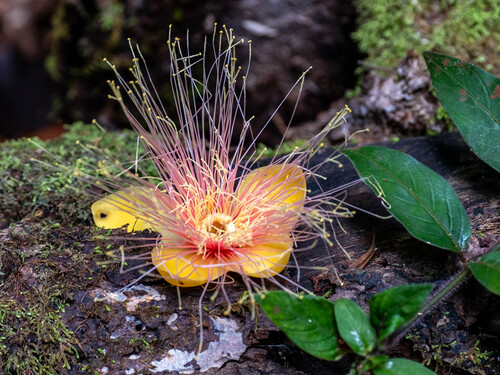
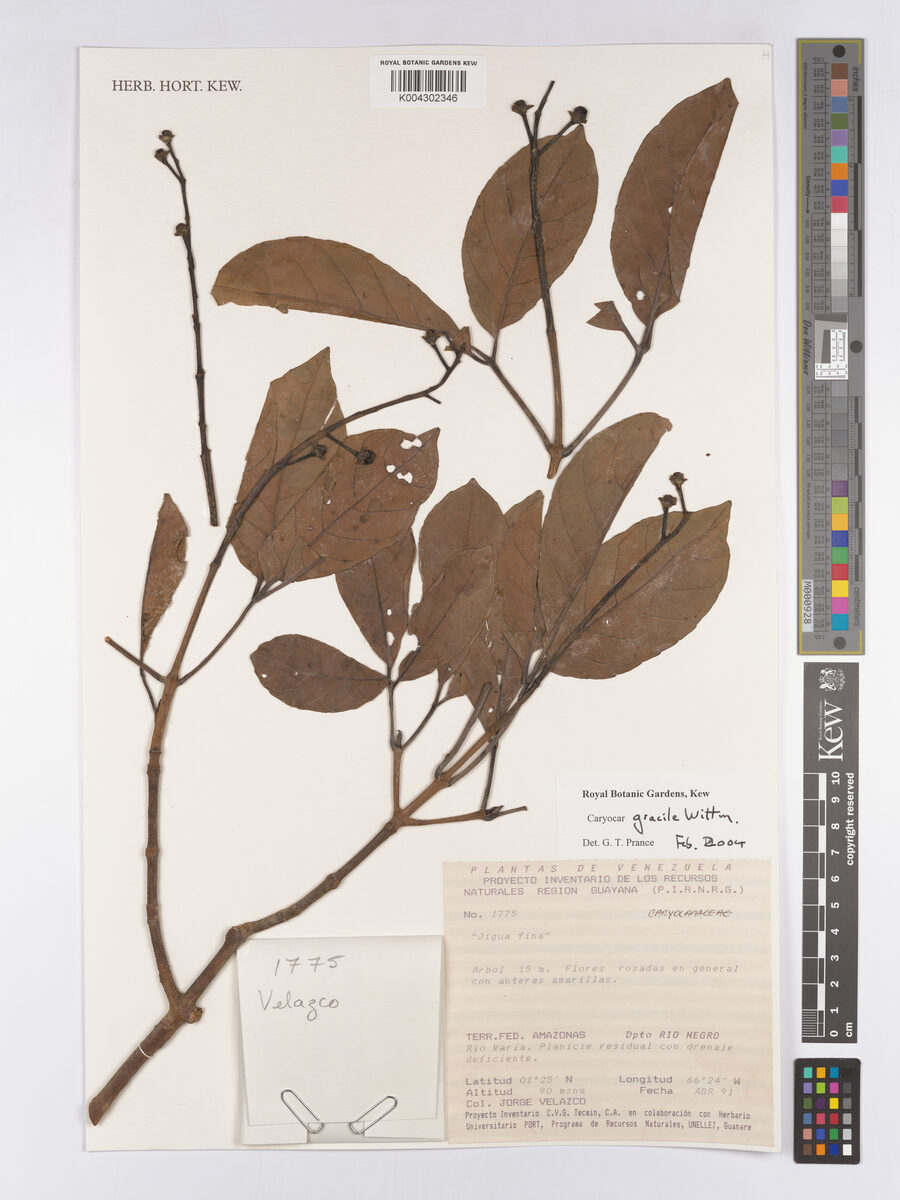
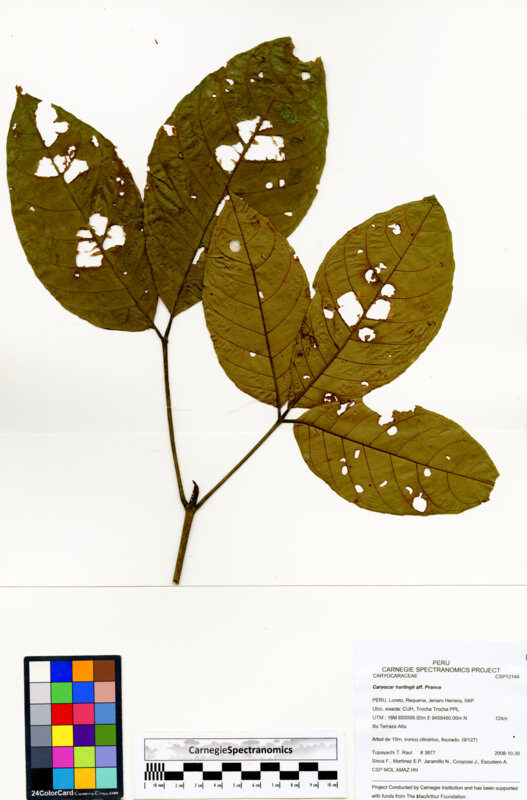
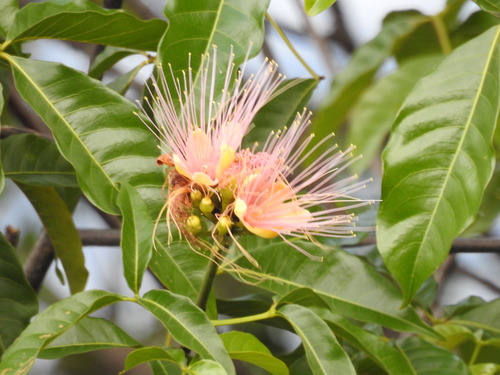
A tall tree. It grows 45 m tall. It has thick buttresses. The leaves have 3 leaflets. The end leaflet is 12-30 cm long by 6-18 cm wide. There are slightly rounded teeth along the edge. The flowers are in groups of 2-8. Flowers open at night. The flowers are very large and deep red. They have large numbers of yellow stamens. The fruit are 10-15 cm across. The nut is kidney shaped. It is about the size of a hen's egg. The nut is large, soft and sweet.
Edible Uses
The seeds of Caryocar nuciferum can be eaten raw or cooked. The large, soft, white kernels have a delicious, rich, almond-like flavour and are enclosed in a hard shell approximately 7 mm thick that is difficult to crack. Each kidney-shaped kernel is usually well over 5 cm long and 2 cm in diameter, and contains over 60% fat. The large fruit can weigh up to 11 kg and measure 18 cm in diameter, typically containing 1–4 seeds (usually 1 or 2) that are easily extracted. An edible oil is also obtained from the seed, which is excellent for bakery products. The oily, yellow fruit pulp is cooked and eaten as a vegetable.
Traditional Uses
The seeds or nuts are eaten raw. They are also roasted or cooked in salt water. They yield an oil that is used for cooking. It is edible. The oily yellow pulp of the fruit can be cooked and eaten as a vegetable.
Medicinal Uses
The whole plant is used as a febrifuge.
Distribution
A tropical plant. It suits the humid tropical lowlands. It is a rainforest tree. The flowers are pollinated by bats at night.
Where It Grows
Asia, Brazil, Central America, Colombia, Guiana, Guianas, Guyana, India, Malaysia, Panama, SE Asia, Singapore, South America*, Sri Lanka, Suriname, Venezuela,
Cultivation
It grows best in areas where annual daytime temperatures are within the range 21 - 28c, but can tolerate 10 - 35c. It prefers a mean annual rainfall in the range 1,600 - 2,000mm, but tolerates 1,200 - 2,400mm. Grows best in a sunny position. Prefers well-drained, light loams of good depth and fertile sandy soils. Dislikes poor soils. Plants are very susceptible to drought. Prefers a pH in the range 6 - 6.5, tolerating 5.5 - 7. Fruits take about 4 months to ripen from flowering. Plants can take up to 20 years to produce their first crop from seed, though this can be greatly reduced by applying shade and wind protection when the plants are young.
Propagation
Seed takes 6–12 months to germinate. Grow young plants on in a sheltered position with some protection from direct sun.
Other Uses
The wood is hard and durable, and is potentially valuable as a timber well suited for making canoes and boat crooks, though it is little used given the tree's value as a seed producer.
Production
Trees can fruit at 5 years of age. Often they fruit are 10-15 years.
Other Information
It is a cultivated food plant. It is tasty and nutritious.
Notes
The Caryocaraceae occur in tropical America. There are 16 Caryocar species.
Synonyms
Also Known As
Alokomali, Cagui, Guiana nut, Hora, Horea, Hura, Imbe, Impe-yek, Inginoto, Pineberoe, Sauari nut, Sawari, Sawarinoto, Sourie
References (29)
- Ambasta S.P. (Ed.), 2000, The Useful Plants of India. CSIR India. p 108
- Arora, R. K., 2014, Diversity in Underutilized Plant Species - An Asia-Pacific Perspective. Bioversity International. p 93
- Bircher, A. G. & Bircher, W. H., 2000, Encyclopedia of Fruit Trees and Edible Flowering Plants in Egypt and the Subtropics. AUC Press. p 87
- Burkill, I.H., 1966, A Dictionary of the Economic Products of the Malay Peninsula. Ministry of Agriculture and Cooperatives, Kuala Lumpur, Malaysia. Vol 1 (A-H) p 474
- Darley, J.J., 1993, Know and Enjoy Tropical Fruit. P & S Publishers. p 78
Show all 29 references Hide references
- Facciola, S., 1998, Cornucopia 2: a Source Book of Edible Plants. Kampong Publications, p 74
- Grandtner, M. M., 2008, World Dictionary of Trees. Wood and Forest Science Department. Laval University, Quebec, Qc Canada. (Internet database http://www.WDT.QC.ca)
- Grandtner, M. M. & Chevrette, J., 2013, Dictionary of Trees, Volume 2: South America: Nomenclature, Taxonomy and Ecology. Academic Press p 104
- Hedrick, U.P., 1919, (Ed.), Sturtevant's edible plants of the world. p 172 (Also as Caryocar tomentosum)
- Heywood, V.H., Brummitt, R.K., Culham, A., and Seberg, O. 2007, Flowering Plant Families of the World. Royal Botanical Gardens, Kew. p 89
- Johnson, M. and Colquhoun, A., 1996, Preliminary Ethnobotanical Survey of Kurupukari: An Amerindian Settlement of Central Guyana. Economic Botany, Vol. 50, No. 2, pp. 182-194
- Kiple, K.F. & Ornelas, K.C., (eds), 2000, The Cambridge World History of Food. CUP p 1854
- Maas, P.J. M., Non-Timber Forest Products of the North-West District of Guyana Part 2. The 85 most important NTFP species. p 48
- Macmillan, H.F. (Revised Barlow, H.S., et al) 1991, Tropical Planting and Gardening. Sixth edition. Malayan Nature Society. Kuala Lumpur. p 273 (Also as Caryocar tomentosum)
- Mant. pl. 2:247. 1771
- Martin, F. W., et al, 1987, Perennial Edible Fruits of the Tropics. USDA Handbook 642 p 23 (Also as Caryocar tomentosum)
- Menninger, E.A., 1977, Edible Nuts of the World. Horticultural Books. Florida p 66 (Also as Caryocar tomentosum)
- Prance, G. T. and Marlene Freitas da Silva, 1973, Caryocaraceae, Flora Neotropica, Vol. 12, Caryocaraceae p 33
- Prance, G.T., 1990, The genus Caryocar L. (Caryocaraceae): An underexploited tropical resource. Advances Econ. Bot. 8:177-88
- PROSEA (Plant Resources of South East Asia) handbook, Volume 2, 1991, Edible fruits and nuts.
- Roa, J. A. G. & Boada, D. S. G., 2018, Fundación para el Fortalecimiento de la Fruticultura y Plantas Alimenticias no Convencionales en Colombia.
- Smith, N., Mori, S.A., et al, 2004, Flowering Plants of the Neotropics. Princeton. p 88
- Sp. pl. 2(2):1244. 1799 an illegitimate, superfluous name (ICBN Art. 52) (As Caryocar tomentosum)
- USDA, ARS, National Genetic Resources Program. Germplasm Resources Information Network - (GRIN). [Online Database] National Germplasm Resources Laboratory, Beltsville, Maryland. Available: www.ars-grin.gov/cgi-bin/npgs/html/econ.pl (10 April 2000)
- van Roosmalen, M.G.M., 1985, Fruits of the Guianan Flora. Utrecht Univ. & Wageningen Univ. p 72
- Verheij, E. W. M. and Coronel, R.E., (Eds.), 1991, Plant Resources of South-East Asia. PROSEA No 2. Edible fruits and nuts. Pudoc Wageningen. p 324
- Wickens, G.E., 1995, Edible Nuts. FAO Non-wood forest products. FAO, Rome. p 114
- Wiersema, J. H. & Leon, B., 2013, World Economic Plants. A Standard Reference CRC Press. 2nd Ed. p 148
- World Checklist of Useful Plant Species 2020. Royal Botanic Gardens, Kew