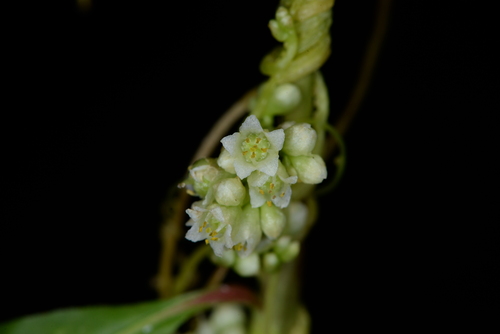
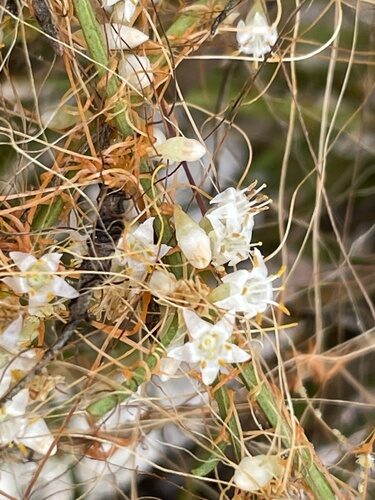
Cuscuta chinensis
Lam.
Chinese dodder
iNaturalist· cc0
no rights reserved, uploaded by S.MORE
iNaturalist· cc-by
(c) Cheng-Tao Lin, some rights reserved (CC BY), uploaded by Cheng-Tao Lin
iNaturalist· cc-by
(c) Cheng-Tao Lin, some rights reserved (CC BY), uploaded by Cheng-Tao Lin
Summary
Source: WikipediaCuscuta chinensis Lam. is a stem holoparasite vine in the family Convolvulaceae. It was first described in China in 1786.
Description
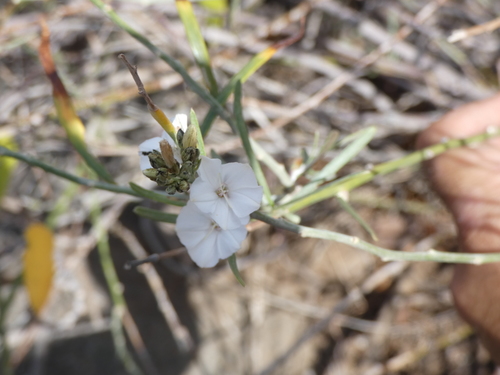
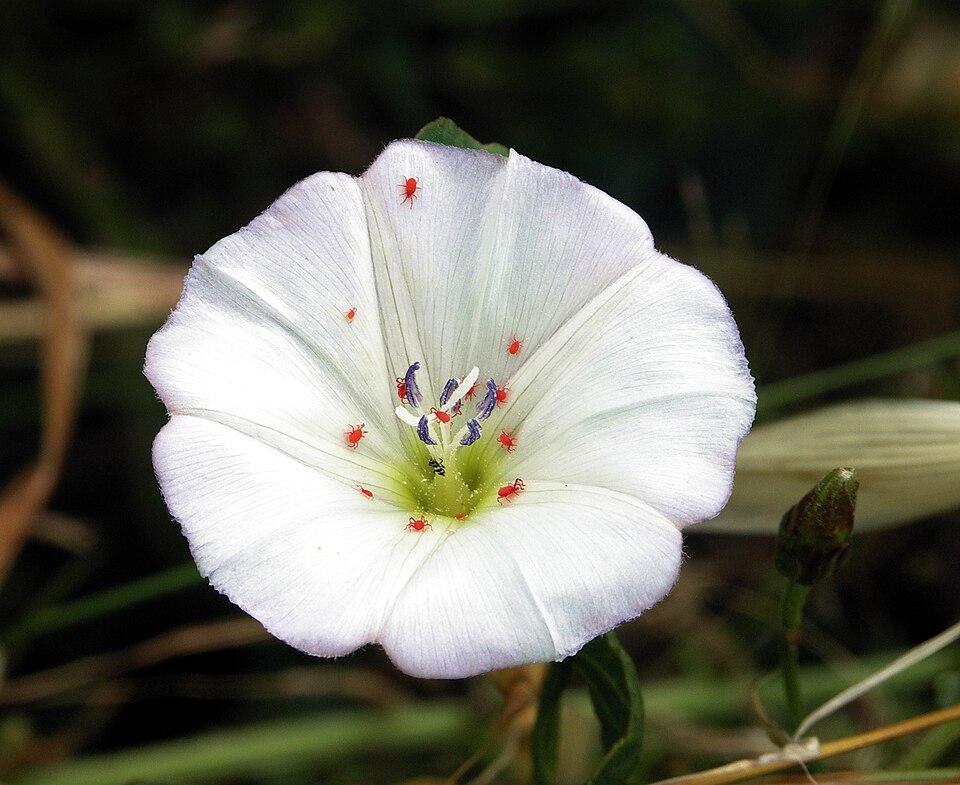
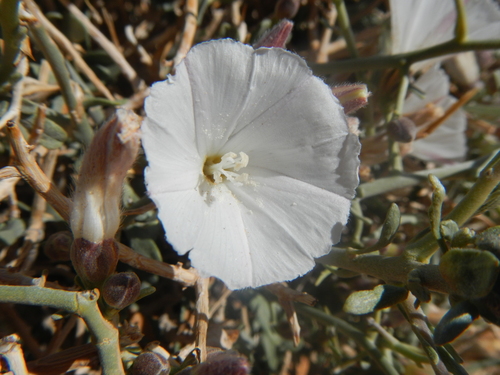
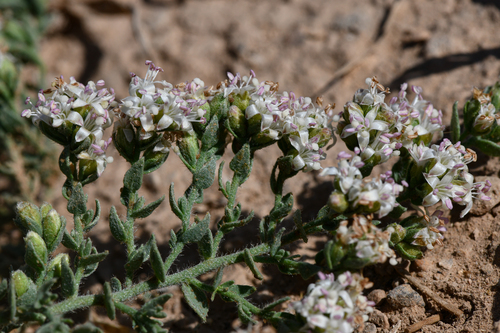
A herb. It grows attached to other plants. The stems are yellow and thin. They are 1 mm across. The flowers are in heads on the sides of the plant. They are white. The capsule is 3-4 mm across.
Edible Uses
None known
Traditional Uses
The young stems are eaten as a vegetable. They are boiled in water.
This uses section is brief — help expand it
Medicinal Uses
A lotion made from the stems is used in the treatment of sore heads and inflamed eyes. The seed is aphrodisiac, demulcent, diaphoretic, hepatic, and tonic. It is decocted and used with other herbs to treat a variety of ailments, particularly impotence, nocturnal emissions, vertigo, lumbago, leucorrhoea, frequent urination, decreased eyesight, threatened abortion, and chronic diarrhoea.
Distribution
It is a tropical to temperate plant. It grows in fields, mountain slopes and sandy beaches.
Where It Grows
Afghanistan, Africa, Asia, Australia, Cambodia, Central Asia, China, Indochina, Indonesia, Japan, Kazakhstan, Korea, Laos, Madagascar, Mongolia, Russia, SE Asia, Sri Lanka, Tajikistan, Thailand,
Cultivation
We have very little information on this species and do not know if it will be hardy in Britain, though judging by its native range it could succeed outdoors at least in the milder parts of this country. This is a parasitic species that is devoid of leaves, roots or chlorophyll and so is totally dependant upon its host. It is most commonly found growing on plants in the families Leguminosae, Compositae and Zygophyllaceae and must be grown next to the host plant, which it penetrates with suckers in order to obtain nutriment.
Propagation
Seed is best sown as soon as it is ripe in autumn, by lodging it among the stems of a host plant.
Other Uses
None known Special Uses
Other Information
These parasitic weeds can damage other crops. It is sold in local markets in China.
Notes
It has established anti-cancer properties. Cuscuta plants are parasites growing on other plants. Sometimes also put in the family Cuscutaceae.
Synonyms
Also Known As
Bonaka, Fatitrahitra, Foi thong, Huang si teng, Mulupabie, Pakmaia, Phak mai tong, Phoi thong
References (7)
- Cruz-Garcia, G. S., & Price, L. L., 2011, Ethnobotanical investigation of 'wild' food plants used by rice farmers in Kalasin, Northeast Thailand. Journal of Ethnobiology and Ethnomedicine 7:33
- Eiadthong, W., et al, 2010, Management of the Emerald Triangle Protected Forests Complex. Botanical Consultant Technical Report. p 48
- Geng, Y., et al, 2016, Traditional knowledge and its transmission of wild edibles used by the Naxi in Baidi Village, northwest Yunnan province. Journal of Ethnobiology and Ethnomedicine. 12:10
- Li, D. et al, 2017, Ethnobotanical survey of herbal tea plants from the traditional markets in Chaoshan, China. Journal of Ethnopharmacology. 205 (2017) 195-206
- Nakahara, K. et al, 2002, Antimutagenicity of Some Edible Thai Plants, and a Biocative Carbazole Alkaloid, Mahanine, Isolated from Micromelum minutum. Journal of Agricultural and Food Chemistry. 50: 4796-4892
Show all 7 references Hide references
- Srichaiwong, P., et al, 2014, A Study of the Biodiversity of Natural Food Production to Support Community Upstream of Chi Basin, Thailand. Asian Social Science 10 (2):
- Urgamal, M., Oyuntsetseg, B., Nyambayar, D. & Dulamsuren, Ch. 2014. Conspectus of the vascular plants of Mongolia. (Editors: Sanchir, Ch. & Jamsran, Ts.). Ulaanbaatar, Mongolia. “Admon“ Press. 334pp. (p. 158-187).