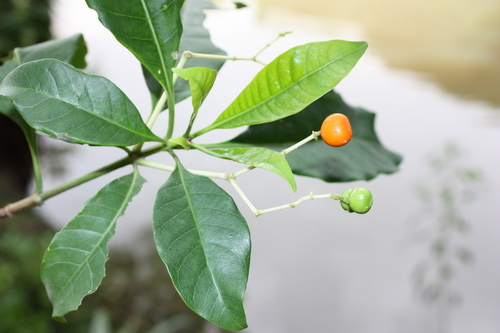
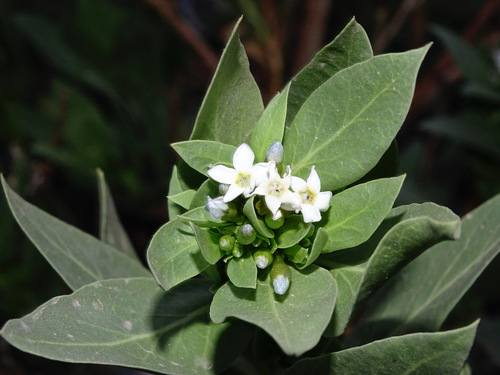
Acokanthera schimperi
(A. DC.) Schweinf.
Poison arrow tree, Rough-leaved poison-bush
iNaturalist· cc-by-nc
(c) graham_g, some rights reserved (CC BY-NC)
iNaturalist· cc-by-nc
(c) graham_g, some rights reserved (CC BY-NC)
iNaturalist· cc-by-nc
(c) graham_g, some rights reserved (CC BY-NC)
Summary
Source: WikipediaAcokanthera schimperi, arrow poison tree, belonging to the family Apocynaceae, is a small tree native to eastern and central Africa as well as to Yemen.
Description
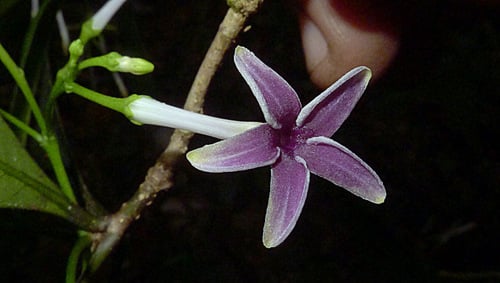
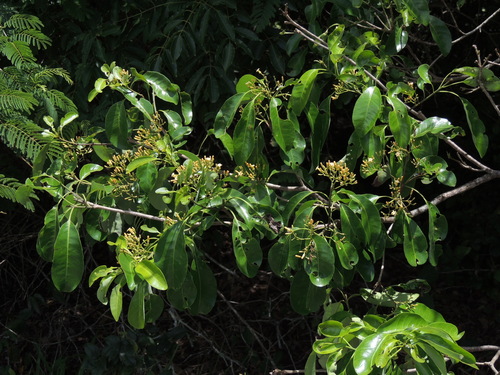
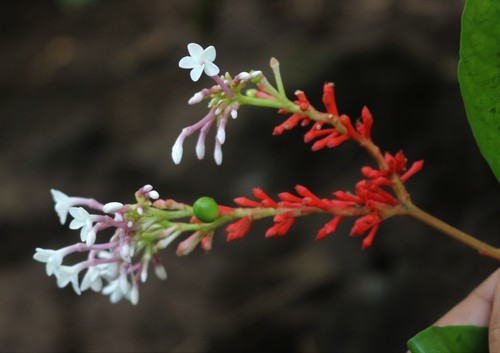
A shrub or small tree. It grows 5 m tall. There are prickles along the stem. The leaves are twice divided and there are 8-18 pairs of pinnae. There are up to 50 pairs of pinnules on each pinnae. The flowers are yellow. They are in large clusters at the ends of branches. The pods are flattened.
Edible Uses
The fruits are edible and an important famine food. They are sweet and slightly bitter when fully ripe. They are also used to make jams. The unripe fruits and seeds are highly poisonous, and several cases of accidental poisoning of children have been recorded. The latex in the fruits is used as chewing gum by children.
Traditional Uses
The ripe fruit are eaten raw. They are also used for jams. The fruit are also dried and pickled. The whole plant is poisonous so care should be taken. Caution: The unripe fruit are poisonous.
Medicinal Uses
All parts of the plant, except the fully ripe fruit, contain high levels of cardiac glycosides and are very poisonous. Internal medicinal use of this plant should not be carried out without expert guidance. Plants from the coastal zone of Kenya contain a high percentage of the glycoside ouabain, and could thus have medical and commercial potential in congestive heart failure treatment. The leaves are used both internally and externally in traditional medicine. An infusion is gargled to treat tonsillitis. The dried, pulverized leaves are taken with honey as an antifertility medicine. Externally, the leaves and bark are applied to the skin to treat skin disorders. A mixture made from the leaves, bark and butter is used for gall-bladder problems. A decoction of the bark has been used when menstruation does not stop. A hot infusion of the pounded root is drunk in small quantities to treat sexually transmitted diseases, and also as an aphrodisiac.
Known Hazards
The bark, wood and roots of Acokanthera schimperi are used as an important ingredient of arrow poison in Africa. All plant parts contain acovenoside A and ouabaïne, which are cardiotonic glycosides. Its fruit is edible, and is eaten as a famine food. When ripe they are sweet but also slightly bitter. Unripe fruits have caused accidental poisoning as they are highly toxic. The maned rat spreads the plant's poison on its fur and becomes poisonous. It is also used in traditional African medicine. In Ethiopia, for example, Acokanthera schimperi leaves have been traditionally used for jaundice.
Distribution
It is a tropical plant. It grows in Africa. It grows in dry woodland. In equatorial regions is occurs from 1,000 to 2,300 m above sea level. It does best in well drained forest soils but will grow on poorer soils. It is mostly in hill country. It can grow in arid places. It grows in areas with a rainfall between 500-900 mm. It suits hardiness zones 9-11.
Where It Grows
Africa, Australia, Central Africa, Congo, Djibouti, East Africa, Eritrea, Eswatini, Ethiopia, Kenya, Malawi, Middle East, Mozambique, Rwanda, Somalia, South Africa, Southern Africa, Swaziland, Tanzania, Uganda, Yemen, Zambia, Zimbabwe,
Cultivation
They are grown from seed. Seed do no always germinate evenly. There are 400-450 seeds per kg. The seed do not store well.
Propagation
Seed - the seeds have high moisture content and lose viability easily under ambient conditions and on storage. Seed germination is low.
Other Uses
The smoke of dried roots and twigs is insect repellent; too much smoke is harmful for humans as well. The wood is very hard and compact and branches are used in making spear shafts. The wood is used as firewood and to make charcoal.
Production
It grows at a medium rate. Fruit are collected April to July.
Other Information
It is a famine food.
Notes
There are 5-7 Acokanthera species.
Synonyms
Also Known As
Kelion, Kelyo, Kerero, Kivai, Lawa, Mchungu, Merenz, Mopte, Mshunguti, Msongu, Msungu, Msunguti, Murichu, Olmorijoi, Qaraaro, Qararuu, Umusagwe, Waabay
References (31)
- Addis, G., Asfaw, Z & Woldu, Z., 2013, Ethnobotany of Wild and Semi-wild Edible Plants of Konso Ethnic Community, South Ethiopia. Ethnobotany Research and Applications. 11:121-141
- Asfaw, Z. and Tadesse, M., 2001, Prospects for Sustainable Use and Development of Wild Food Plants in Ethiopia. Economic Botany, Vol. 55, No. 1, pp. 47-62
- Bekele-Tesemma A., Birnie, A., & Tengnas, B., 1993, Useful Trees and Shrubs for Ethiopia. Regional Soil Conservation Unit. Technical Handbook No 5. p 70
- Bethwell, O.O., 2007. Acokanthera schimperi (A.DC.) Schweinf. [Internet] Record from Protabase. Schmelzer, G.H. & Gurib-Fakim, A. (Editors). PROTA (Plant Resources of Tropical Africa / Ressources végétales de l’Afrique tropicale), Wageningen, Netherlands. < http://database.prota.org/search.htm>. Accessed 13 October 2009.
- Bigirimana, C., et al, 2016, Utilisation of Indigenous Fruit Tree Species within the Lake Victoria Basin, Rwanda. Agricultural Science: An International Journal. (AGRIJ) Vol. 1, No. 1
Show all 31 references Hide references
- Bircher, A. G. & Bircher, W. H., 2000, Encyclopedia of Fruit Trees and Edible Flowering Plants in Egypt and the Subtropics. AUC Press. p 7
- Cundall, P., (ed.), 2004, Gardening Australia: flora: the gardener's bible. ABC Books. p 94
- Dharani, N., 2002, Field Guide to common Trees & Shrubs of East Africa. Struik. p 40
- Global Plants JSTOR
- Herb., E. A., 1981,
- Katende, A.B., Birnie, A & Tengnas B., 1995, Useful Trees and Shrubs for Uganda. Identification, Propagation and Management for Agricultural and Pastoral Communities. Technical handbook No 10. Regional Soil Conservation Unit, Nairobi, Kenya. p 62
- Lulekal, E., et al, 2011, Wild edible plants in Ethiopia: a review on their potential to combat food insecurity. Afrika Focus - Vol. 24, No 2. pp 71-121
- Maundu, P. et al, 1999, Traditional Food Plants of Kenya. National Museum of Kenya. p 51
- Mbuvi, M. T. E., et al, 2019, Annonated checklist of plant species of Loita Forest Narok County, Kenya. Int. J. Adv. Res. Biol. Sci. (2019). 6(3): 54-110
- Mbuya, L.P., Msanga, H.P., Ruffo, C.K., Birnie, A & Tengnas, B., 1994, Useful Trees and Shrubs for Tanzania. Regional Soil Conservation Unit. Technical Handbook No 6. p 74
- Mpasiwakomu, R. A., 2017, The Diversity and Utilization of Wild Edible and Medicinal Plant Species found in Uvinza Miombo Woodlands, Tanzania. M. Sc. thesis University of Tanzania.
- Mutie, F. G., 2020, Conservation of Wild Food Plants and Their Potential for Combatting Food Insecurity in Kenya as Exemplified by the Drylands of Kitui County. Plants 2020, 9, 1017
- Mutie, F. M., et al, 2023, Important Medicinal and Food Taxa (Orders and Families) in Kenya, Based on Three Quantitative Approaches. Plants 2023, 12, 1145
- Palgrave, K.C., 1996, Trees of Southern Africa. Struik Publishers. p 781
- Peters, C. R., O'Brien, E. M., and Drummond, R.B., 1992, Edible Wild plants of Sub-saharan Africa. Kew. p 56
- Regassa, T., et al, 2014, Ethnobotany of Wild and Semi-Wild Edible Plants of Chelia District, West-Central Ethiopia. Science, Technology and Arts Research Journal. 3(4): 122-134
- Royal Botanic Gardens, Kew (1999). Survey of Economic Plants for Arid and Semi-Arid Lands (SEPASAL) database. Published on the Internet; http://www.rbgkew.org.uk/ceb/sepasal/internet [Accessed 28th March 2011]
- Ruffo, C. K., Birnie, A. & Tengnas, B., 2002, Edible Wild Plants of Tanzania. RELMA p 102
- Schmelzer, G.H. & Gurib-Fakim, A. (Editors), 2008. Plant Resources of Tropical Africa 11(1)-Medicinal plants 1.PROTA Foundation, Wageningen, Netherlands /791 pp
- Seyoum, Y., et al, 2015, Edible Wild Fruit Trees and Shrubs and Their Socioeconomic Significance in Central Ethiopia. Ethnobotany Research & Applications. 14:183-197
- Sina, B. & Degu, H. D., 2015, Knowledge and use of Wild Edible Plants in the Hula District of the Sidama Zone. International Journal of Bio-resource and Stress Management 6(3):352-365
- Swaziland's Flora Database http://www.sntc.org.sz/flora (As Acokanthera rotundata)
- Termote, C., et al, 2014, Assessing the potential of wild foods to reduce the cost of a nutritionally adequate diet: An example from eastern Baringo District, Kenya. Food and Nutrition Bulletin, vol. 35, no. 4
- J. Thomson, Through Masai Land Appendix 351. 1887 (G. Bentham & J. D. Hooker, Gen. pl. 2:696. 1876, nom. inval.)
- Vickery, M.L. and Vickery, B., 1979, Plant Products of Tropical Africa, Macmillan. p 104, Other species
- World Checklist of Useful Plant Species 2020. Royal Botanic Gardens, Kew