Alpinia nigra
(Gaertn.) Burtt
Black galangal
iNaturalist· cc-by-nc
(c) maruftareq, some rights reserved (CC BY-NC)
iNaturalist· cc-by-nc
(c) Smritirekha Bortamuly, some rights reserved (CC BY-NC)
iNaturalist· cc-by-nc
(c) Smritirekha Bortamuly, some rights reserved (CC BY-NC)
Summary
Source: WikipediaAlpinia nigra (synonyms Alpinia allughas Retz. and Zingiber nigrum Gaertn.) is a medium-sized herb belonging to the ginger family. The rhizome is well known in many Asian cultures as a medicinal and culinary item. In many Asian tribal communities it is a part of the diet along with rice. It is endemic to south-east Asia including Bhutan, China, India, Thailand, Bangladesh, Burma and Sri Lanka. In India it is found mainly in the hillocks and riversides of northeastern states such as Assam, Mizoram and Tripura.
Description
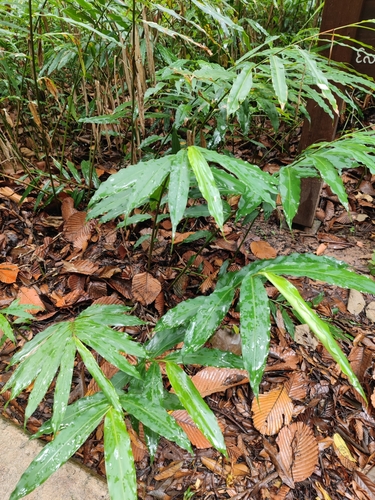
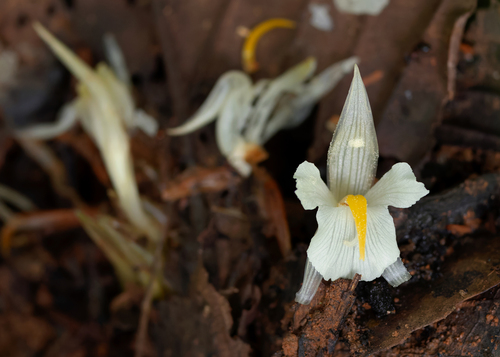
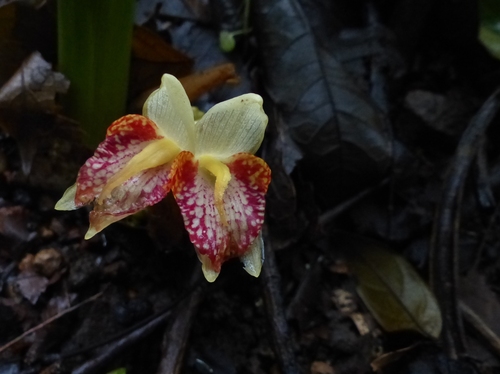
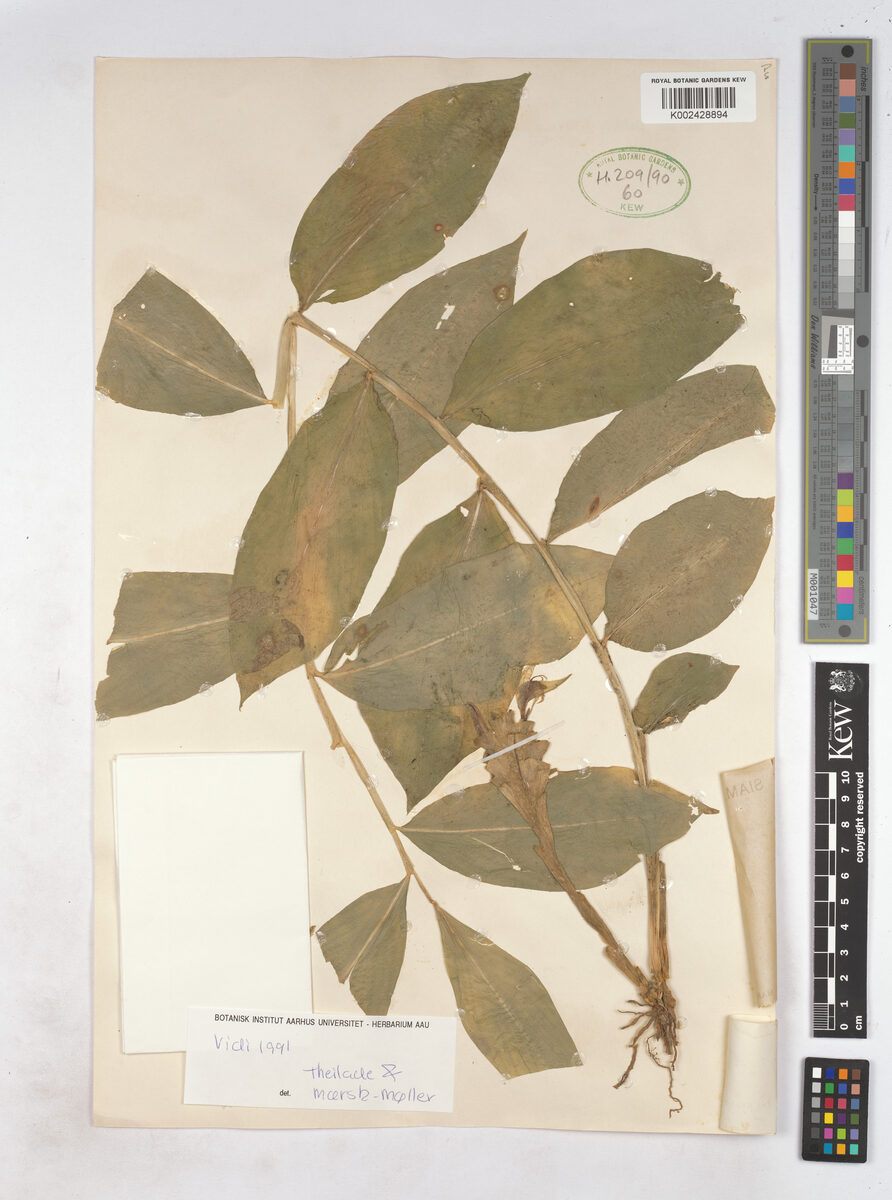
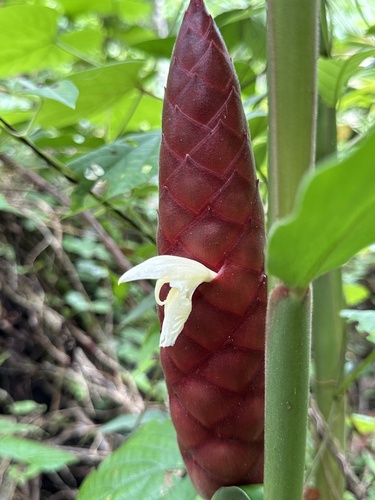
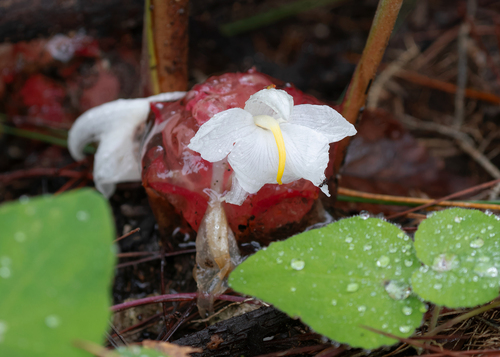
A ginger family plant. It is a herb. It can be 3-4 m high. It keeps growing from year to year. It has an aerial stem. The shoot and leaves have a scent. The leaves are large and in two rows. The flowers are white and have a scent. The fruit are capsules. They occur in clusters. They are green but turn black when ripe.
Edible Uses
The rhizome is boiled with potato to make chutney or eaten raw. Young tender shoots and leaves are cooked as a vegetable, often with small fish, or eaten raw. Stem pith is fried, flowers are used as a spice, and leaves wrap food to impart aroma. Harvested food can be stored 5–6 days, and rhizomes and stems are sold in local markets.
Traditional Uses
The rhizome is boiled with potato and made into a chutney. They are also eaten raw. The leaves are used to wrap food to provide an aroma. The young tender shoots and leaves are cooked and eaten as a vegetable. They are cooked with small fish or also eaten raw. The stem piths are eaten fried. The flowers are used as a spice. The harvested food can be stored for 5-6 days.
Distribution
It is a tropical plant. It grows in swamp and wet areas. In southern China it grows in forests between 900-1,100 m above sea level. In XTBG Yunnan.
Where It Grows
Andamans, Asia, Bangladesh, Bhutan, China, Hawaii, Himalayas, India, Indochina, Jamaica, Laos, Malaysia, Myanmar, Nepal, Northeastern India, Pacific, SE Asia, Sri Lanka, Thailand, West Indies,
Other Information
Stems are sold in local markets. The rhizomes are sold in markets.
Notes
There are about 200-230 Alpinia species. They are mostly tropical and subtropical. They are mostly in Asia.
Synonyms
Also Known As
Aigidon, Aihre don, Aihre kebeb, Deragong, Doyak, Gon-min, Inglong tara, Kashapro, Khui-jik, Pulei, Pullei, Shiraprou, Ta'ling, Tara, Tareng, Tharai, Thari bhillai, Tora, Torapat
References (30)
- Balkrishna, A., et al, 2022, Indigenous Uses of Plants among Forest-dependent Communities of Seijosa, Arunachal Pradesh. International Journal of Economic Plants 2022, 9(1):064-080
- Deb, D., et al, 2013, Wild Edible Plants and Their Utilization in Traditional Recipes of Tripura, Northeast India. Advances in Biological Research 7(5):203-211 (As Alpinia allughas)
- Devi, O.S., P. Komor & D. Das, 2010, A checklist of traditional edible bio-resources from Ima markets of Imphal Valley, Manipur, India. Journal of Threatened Taxa 2(11): 1291-1296
- Devi, O. S., et al, 2021, Wild edible plants associated with the people of Thoubal Khunou village and its migrated villagers. Int. J. Adv. Res. Biol. Sci. 8(9): 72-90 (As Alpinia allughas)
- Dutta, U., 2012, Wild Vegetables collected by the local communities from the Churang reserve of BTD, Assam. International Journal of Science and Advanced Technology. Vol. 2(4) p 119
Show all 30 references Hide references
- Jain et al, 2011, Dietary Use and Conservation Concern of Edible Wetland Plants at Indo-Burma Hotspot: A Case Study from Northeast India. Journal of Ethnobiology and Ethnomedicine 7:29 p 6
- Kar, A., & Borthakur, S. K., 2007, Wild vegetables sold in local markets of Karbi Anglong, Assam. Indian Journal of Traditional Knowledge. 6(1) January 2007, pp169-172
- Kar, A., et al, 2013, Wild Edible Plant Resources used by the Mizos of Mizoram, India. Kathmandu University Journal of Science, Engineering and Technology. Vol. 9, No. 1, July, 2013, 106-126
- Konsam, S., et al, 2016, Assessment of wild leafy vegetables traditionally consumed by the ethnic communities of Manipur, northeast India. Journal of Ethnobiology and Ethnomedicine, 12:9
- Lim, T. K., 2015, Edible Medicinal and Non Medicinal Plants. Volume 9, Modified Stems, Roots, Bulbs. Springer p 7
- Lungphi, P., Wangpan, T. & Tangjang, S., 2018, Wild edible plants and their additional uses by the Tangsa community living in the Changlang district of Arunachal Pradesh, India. Pleione 12(2): 151 - 164. 2018.
- Medhi, P. & Borthakur, S. K., 2012, Phytoresources from North Cachur Hills of Assam -3: Edible plants sold at Hflong market. Indian Journal of Natural Products and Resources. 3(1) pp 84-109
- Medhi, P. & Borthakur, S. K., 2013, Wild edible plants sold by the Zeme Nagas at the makeshift market of Mahur, Dima Hasao district of Assam. Pleione 7(1): 84 - 93. 2013
- Medhi, P., Sarma, A and Borthakur, S. K., 2014, Wild edible plants from the Dima Hasao district of Assam, India. Pleione 8(1): 133-148
- Meitei, L. R., et al, 2022, An ethnobotanical study on the wild edible plants used by forest dwellers in Yangoupokpi Lokchao Wildlife Sanctuary, Manipur, India. Ethnobotany Research and Application 23:15
- Murtem, G. & Chaudhrey, P., 2016, An ethnobotanical note on wild edible plants of Upper Eastern Himalaya, India. Brazilian Journal of Biological Sciences, 2016, v. 3, no. 5, p. 63-81
- Narzary, H., et al, 2013, Wild Edible Vegetables Consumed by Bodo tribe of Kokrajhar District (Assam), North-East India. Archives of Applied Science Research, 5(5): 182-190
- Pagag, K. & Borthakur, S.K., 2012, Wild edible wetland plants from Lakhimpur district of Assam, India. Pleione 6(2): 322 - 327
- Patiri, B. & Borah, A., 2007, Wild Edible Plants of Assam. Geethaki Publishers. p 141
- Pegu, R., et al, 2013, Ethnobotanical study of Wild Edible Plants in Poba Reserved Forest, Assam, India. Research Journal of Agriculture and Forestry Sciences 1(3):1-10 (As Alpinia allughas)
- Peduruhewa, P. S., et al, 2021, Potential of Underutilized Wild Edible Plants as the Food for the Future – A Review. Journal of Food Security, Vol. 9, No. 4, 136-147
- Pfoze, N. L., et al, 2012, Assessment of Local Dependency on Selected Wild Edible Plants and fruits from Senapati district, Manipur, Northeast India. Ethnobotany Research & Applications 10:357-367
- Pfoze, N. L., et al, 2012, Survey and assessment of floral diversity on wild edible plants from Senapati district of Manipur, Northeast India. Journal or Biodiversity and Environmental Sciences. 1(6):50-52
- Phangchopi, U., et al, 2015, Diversity of wild edible plants in Marat Longri Wildlife Sanctuary, Assam. Indian Journal of Natural Products and Resources Vol. 6(4), December 2015 pp. 305-313
- Seidemann J., 2005, World Spice Plants. Economic Usage, Botany, Taxonomy. Springer. p 30
- Shin, T., et al, 2018, Traditional knowledge of wild edible plants with special emphasis on medicinal uses in Southern Shan State, Myanmar. Journal of Ethnobiology and Ethnomedicine (2018) 14:48
- Singh, P.K., Singh, N.I., and Singh, L.J., 1988, Ethnobotanical Studies on Wild Edible Plants in the Markets of Manipur - 2. J. Econ. Tax. Bot. Vol. 12 No. 1 pp 113-119 (As Alpinia allughas)
- Teron, R. & Borthakur, S. K., 2016, Edible Medicines: An Exploration of Medicinal Plants in Dietary Practices of Karbi Tribal Population of Assam, Northeast India. In Mondal, N. & Sen, J.(Ed.) Nutrition and Health among tribal populations of India. p 156
- Trans. Linn. Soc. London 8:346. 1807 (As Alpinia allughas)
- Xu, You-Kai, et al, 2004, Wild Vegetable Resources and Market Survey in Xishuangbanna, Southwest China. Economic Botany. 58(4): 647-667.