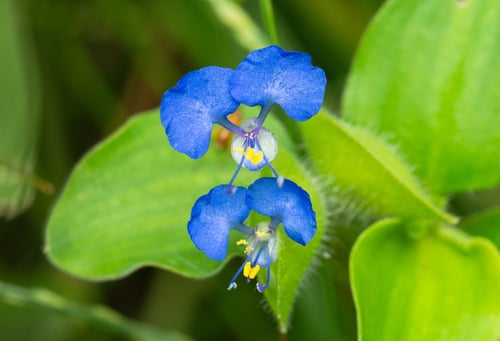
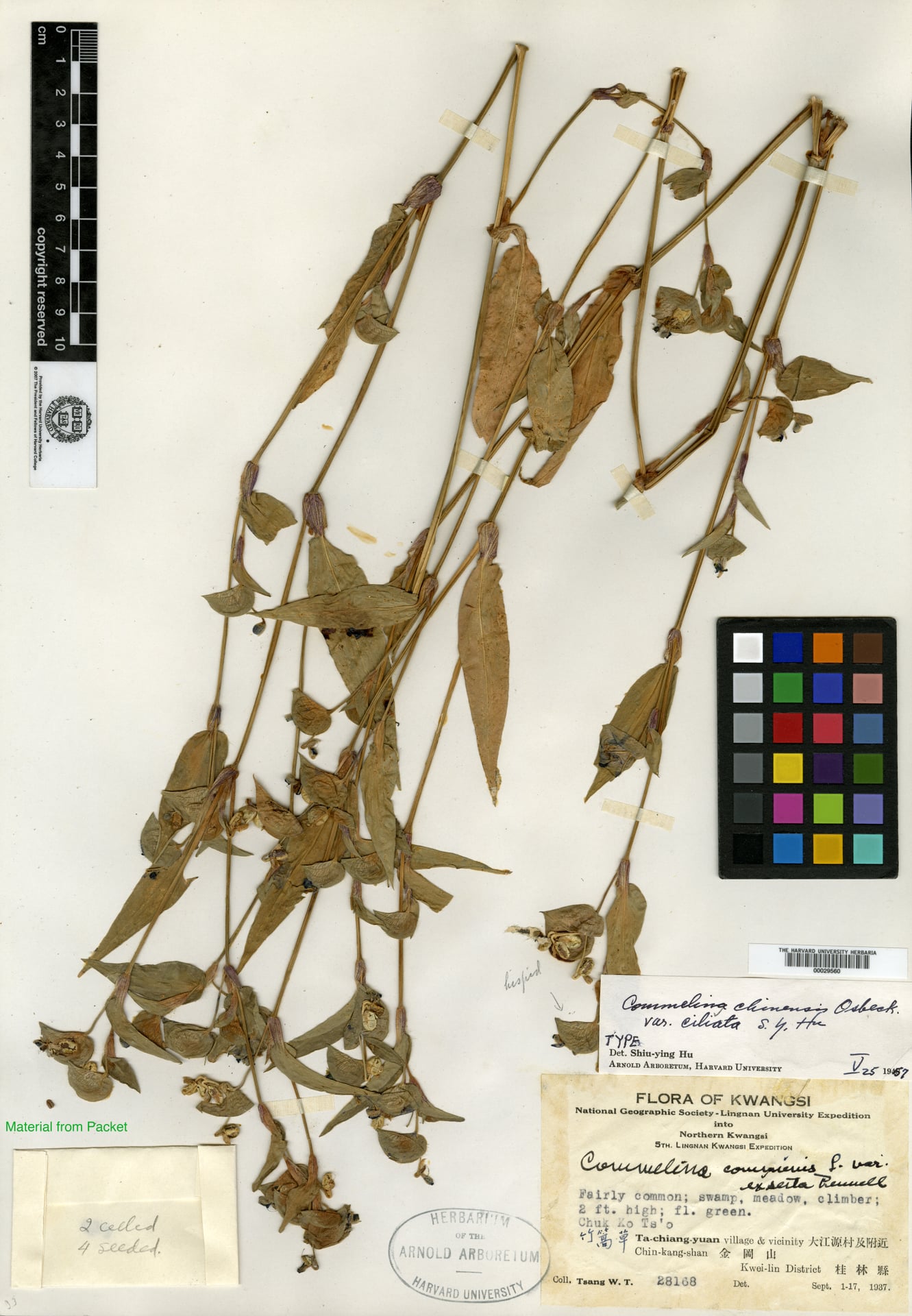
Commelina cyanea
R.Br.
Scurvy weed, Wandering Jew
iNaturalist· cc-by
(c) Thomas Mesaglio, some rights reserved (CC BY), uploaded by Thomas Mesaglio
iNaturalist· cc-by-nc
(c) peparethos, some rights reserved (CC BY-NC)
iNaturalist· cc-by-nc
(c) peparethos, some rights reserved (CC BY-NC)
Summary
Source: WikipediaCommelina cyanea, commonly known as scurvy weed, is a perennial prostrate herb of the family Commelinaceae native to moist forests and woodlands of eastern Australia, Lord Howe Island and Norfolk Island. The blue flowers appear over the warmer months and are pollinated by bees and flies.
Description
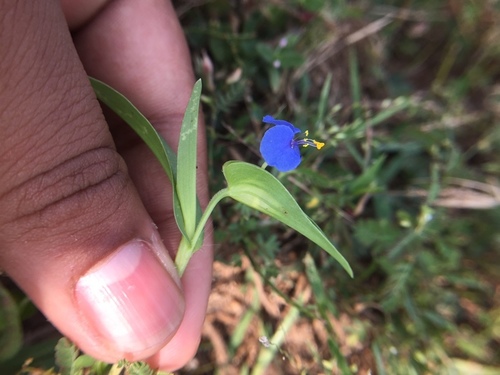
A weak straggling herb. It is an evergreen plant. It grows to 30 cm high and spreads to 2 m across. The stems are weak and fleshy, and lie along the ground, and form roots at the nodes. The leaves are green or blue, and sword shaped. They are 3-7 cm long, by 2 cm across. They form a sheath at the base. The flowers are bright blue, with 3 petals. They are 1.5 cm across. The flowers are carried on a branched flower stalk. The flowers open in the morning and collapse by afternoon.
Edible Uses
The leaves were used by early non-indigenous colonists to alleviate scurvy, and hence its common name. Attractive in flower, Commelina cyanea adapts readily to cultivation and can be grown as a groundcover or in hanging baskets. It is easily propagated from cuttings. It has a superficial resemblance (in morphology only) to the introduced weed wandering Jew (Tradescantia fluminensis), but is readily distinguished from the native by the variegated leaves and the white flowers. It also lacks the hairy leaf sheathes of the native. C. cyanea can itself be weedy in gardens at times.
Traditional Uses
The leaves are eaten after cooking.
This uses section is brief — help expand it
Distribution
It is tropical and subtropical. It grows in moist soil. It suits a sheltered, partly shaded position. It is drought and frost tender.
Where It Grows
Australia*, Norfolk Island, Pacific, Papua New Guinea, PNG,
Cultivation
Plants are grown by dividing the clump or using stem cuttings.
Notes
There are about 230 Commelina species.
Nutrition
| Part | Moisture | kJ | kcal | Protein | Vit A | Vit C | Iron | Zinc |
|---|---|---|---|---|---|---|---|---|
| Bud | 86.7 | — | — | 1.6 | — | 1 | — | — |
References (16)
- Bodkin, F., 1991, Encyclopedia Botanica. Cornstalk publishing, p 274
- Caton, J.M. & Hardwick, R. J., 2016, Field Guide to Useful Native Plants from Temperate Australia. Harbour Publishing House. p 88
- Cribb, A.B. & J.W., 1976, Wild Food in Australia, Fontana. p 118
- Cronin, L., 1989, The Concise Australian Flora. Reed. p 77
- Elliot, W.R., & Jones, D.L., 1984, Encyclopedia of Australian Plants suitable for cultivation. Vol 3. Lothian. p 62
Show all 16 references Hide references
- Flora of Australia Volume 49, Oceanic Islands 1, Australian Government Publishing Service, Canberra. (1994) p 417
- Hibbert, M., 2002, The Aussie Plant Finder 2002, Florilegium. p 72
- Jones, D.L. & Gray, B., 1977, Australian Climbing Plants. Reed. p 93
- Jones D, L, 1986, Ornamental Rainforest Plants in Australia, Reed Books, p 260
- Lazarides, M. & Hince, B., 1993, Handbook of Economic Plants of Australia, CSIRO. p 63
- Low, T., 1991, Wild Herbs of Australia and New Zealand. Angus & Robertson. p 102
- Powell, J.M., Ethnobotany. In Paijmans, K., 1976, New Guinea Vegetation. Australian National University Press. p 109
- Ratcliffe D & P., 1987, Australian Native Plants for Indoors. Little Hills press. p 72
- Recher, P, 2001, Fruit Spirit Botanical Gardens Plant Index. www.nrg.com.au/~recher/ seedlist.html p 2
- Romanowski, N., 2007, Edible Water Gardens. Hyland House. p 106
- World Checklist of Useful Plant Species 2020. Royal Botanic Gardens, Kew