Carthamus tinctorius
L.
Safflower
iNaturalist· cc0
no rights reserved, uploaded by 葉子
iNaturalist· cc0
no rights reserved
iNaturalist· cc-by-nc-sa
(c) José María Escolano, some rights reserved (CC BY-NC-SA)
Summary
Source: WikipediaAn annual growing to 1 m tall and 0.4 m wide. Foliage appears May to October; flowers August to October; seeds mature September to October. Hermaphroditic and self-fertile flowers pollinated by insects. Grows in light sandy and medium loamy, well-drained soils and tolerates poor soil. Establishes in mildly acidic to very alkaline pH. Requires full sun, tolerates both dry and moist soils, and handles drought well.
Description
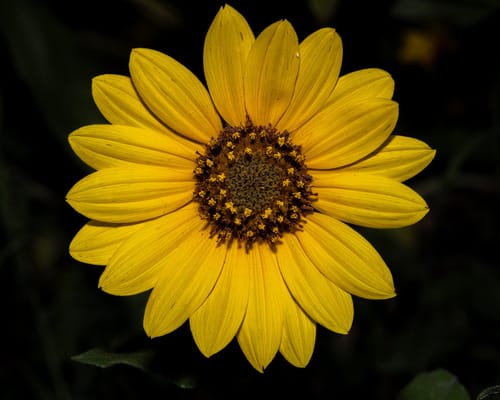
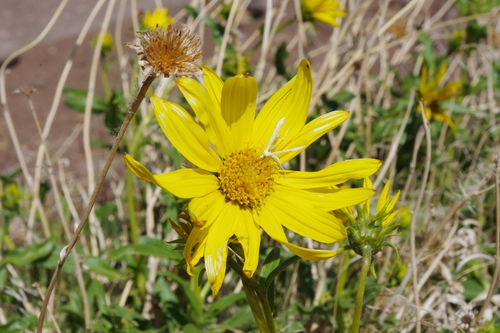
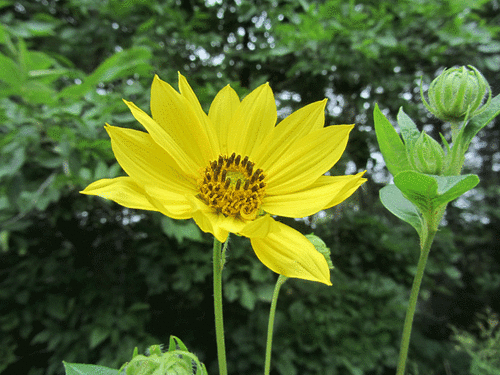
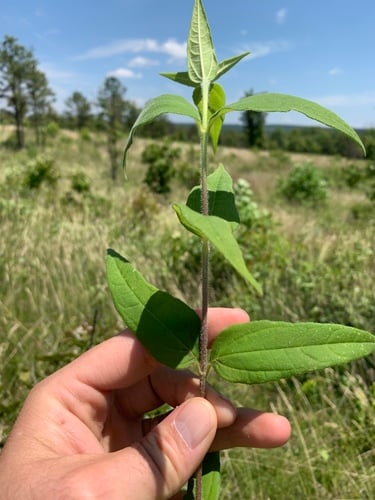
An erect annual herb. It grows to 60-150 cm high. It has any branches. It has spines but the number vary. The stems are white and stiff and round with fine grooves along their length. The kinds with more spiny leaves are better for oil production. The leaves are arranged in spirals around the stem. They do not have leaf stalks. The leaves are dark green and glossy. They are 10-15 cm long and 2-4 cm wide. The flower head is made up of many small flowers. They are 13 mm long and like tubes. They are yellow to orange in colour. The fruit is 4 angled and a hard hull and a single white or grey seed. The seed is oblong.
Edible Uses
An edible oil extracted from the seed contains a higher proportion of essential unsaturated fatty acids and a lower proportion of saturated fatty acids than most other edible vegetable seed oils. Light-coloured and easily clarified, it is used in salad dressings, cooking oils, and margarines. It is considered a very stable oil, regarded as healthier than many alternatives, and its inclusion in the diet is said to help reduce blood cholesterol levels. The seed can also be cooked — roasted, or fried and eaten in chutneys — and the fried seeds are used as a curdling agent for plant milks. Tender young leaves and shoots can be eaten raw or cooked, with a sweet flavour suitable as a spinach substitute; as a food source it is considered a famine food, used only when other options are exhausted. The flowers yield both a yellow and a red dye used in food: the yellow serves as a saffron substitute to flavour and colour dishes.
Traditional Uses
The young shoots and leaves are eaten cooked or raw. They can be seasoned with soy sauce. The seeds are hulled and roasted. They are eaten as snacks. They are also used in chutneys. The seed oil is used in cooking and as a salad oil. (This can be done by boiling the seeds and floating off the oil.) The dried edible petals are used to colour foods. They can give red or yellow dyes. The slightly bitter petals can be cooked with rice.
Medicinal Uses
Safflower is widely grown as a food plant but also carries a broad range of medicinal applications. Modern research has identified several medically active constituents in the flowers, including the capacity to reduce coronary heart disease and lower cholesterol levels. The plant is alterative, analgesic, antibacterial, antiphlogistic, and haemopoietic, and has been used to treat tumours and stomatitis. The flowers are anticholesterolemic, diaphoretic, emmenagogue, laxative, purgative, sedative, and stimulant. They are used to treat menstrual pains and complications by promoting smooth menstrual flow, and ranked third in a survey of 250 potential anti-fertility plants. In domestic practice, flowers substitute or adulterate saffron in treating infant complaints such as measles, fevers, and eruptive skin conditions. Applied externally, they address bruising, sprains, skin inflammations, and wounds. Flowers are harvested in summer and may be used fresh or dried, but should not be stored for longer than 12 months. It is possible to pick only the florets and leave the ovaries intact so seed can still be produced, though this is time-consuming. When combined with Ligusticum wallichii, the plant is said to have a definite therapeutic effect on coronary diseases. The whole plant is also febrifuge, sedative, sudorific, and vermifuge. The seed is diuretic, purgative, and tonic, used in treating rheumatism and tumours, particularly inflammatory tumours of the liver. The oil is charred and applied to heal sores and treat rheumatism; in Iran it is used as a salve for sprains and rheumatism.
Known Hazards
Avoid during pregnancy. Use with caution if suppressed or decreased immunity.
Distribution
It grows in both tropical and temperate zones. It does better in drier regions. It cannot tolerate waterlogging. It does not suit the low wet tropics. It needs a good dry season for drying. It is resistant to drought. It can stand some wind and salinity. High temperatures can result in poor seed set. It does best where temperatures are 17-20°C on average. At the equator it can grow at 1600-2000 m altitude but most commonly in other regions it grows below 900 m altitude. It grows to 3,000 m altitude in Ethiopia. A pH of 5-8 is suitable. It can grow in arid places. It can grow in salty and alkaline soils. It suits hardiness zones 4-10. Tasmania Herbarium.
Where It Grows
Africa, Afghanistan, Argentina, Armenia, Asia, Australia, Austria, Balkans, Bangladesh, Botswana, Britain, Burkina Faso, Cambodia, Canada, Canary Island, Caucasus, Central America, Central Asia, Chile, China*, Czech Republic, Dominican Republic, East Africa, Egypt, Ethiopia, Europe, France, Germany, Greece, Hawaii, Himalayas, India*, Indochina, Indonesia, Iran, Iraq, Israel, Italy, Jamaica, Japan, Jordan, Kazakhstan, Kenya, Korea, Kuwait, Laos, Macedonia, Malaysia, Mali, Mediterranean*, Mexico, Middle East, Mozambique, Myanmar, Nepal, Nigeria, North Africa, North America, Pacific, Palestine, Philippines, Portugal, Romania, SE Asia, Slovakia, Slovenia, South Africa, Southern Africa, South America, Spain, Sri Lanka, Sudan, Syria, Tajikistan, Tanzania, Tasmania, Tibet, Turkey, Türkiye, USA, Uzbekistan, West Africa, West Indies, Yugoslavia, Zambia, Zimbabwe,
Cultivation
Succeeds in ordinary garden soil. Safflower thrives in heavy clays with good water-holding capacity, but will also grow satisfactorily in deep sandy or clay loams with good drainage. It needs soil moisture from the time of planting until it is flowering. It requires a well-drained soil and a position in full sun. Safflower is reported to tolerate an annual precipitation of 20 to 137cm, an annual average temperature range of 6.3 to 27.5deg.C and a pH in the range of 5.4 to 8.2. Plants are reported to tolerate bacteria, disease, drought, frost, fungus, high pH, phage, salt, sand, rust, virus and wind. Safflower grows in the temperate zone in areas where wheat and barley do well, and grows slowly during periods of cool short days in early part of season. Seedlings can withstand temperatures lower than many species; however, varieties differ greatly in their tolerance to frost; in general, frost damages budding and flowering thus reducing yields and quality. Safflower is a long-day plant, requiring a photoperiod of about 14 hours. It is shade and weed intolerant, will not grow as a weed because other wild plants overshadow it before it becomes established. It is about as salt tolerant as cotton, but less so than barley. Safflower matures in from 110-150 days from planting to harvest as a spring crop, as most of it is grown, and from 200 or more days as an autumn-sown crop. It should be harvested when the plant is thoroughly dried. Since the seeds do not shatter easily, it may be harvested by direct combining. The crop is allowed to dry in the fields before threshing. Plants are self-fertile, though cross-pollination also takes place. Plants have a sturdy taproot that can penetrate 2.5 metres into the soil. Safflower has been grown for thousands of years for the dye that can be obtained from the flowers. This is not much used nowadays, having been replaced by chemical dyes, but the plant is still widely cultivated commercially for its oil-rich seed in warm temperate and tropical areas of the world. There are many named varieties. A number of spineless cultivars have been developed, but at present these produce much lower yields of oil than the spiny varieties. Safflower is unlikely to be a worthwhile crop in Britain since it only ripens its seed here in long hot summers. There is more chance of success in the drier eastern part of the country with its usually warmer summers, the cooler moister conditions in the west tend to act against the production of viable seed.
Propagation
Sow seed in spring with gentle heat in a greenhouse. Germination usually occurs within 2–4 weeks at 15°C. Once large enough to handle, prick seedlings into individual pots and plant into permanent positions in late spring or early summer. Seed can also be sown in situ in April or May, though plants may not ripen their seed under those conditions.
Other Uses
The seed yields up to 40% of a drying oil used in lighting, paint, varnishes, linoleum, and wax cloths, and can also serve as a diesel substitute. The oil does not yellow with age. Heated to 300°C for 2 hours and poured into cold water, it solidifies into a gelatinous mass used as a cement for glass, tiles, and stones, or as a substitute for plaster of Paris. Heated to 307°C for 2½ hours, it becomes a stiff elastic solid through polymerisation, suitable for making waterproof cloth. A yellow dye obtained by steeping the flowers in water is used as a saffron substitute; a red dye obtained by steeping in alcohol is used for dyeing cloth and, mixed with talcum powder, as a rouge for colouring the cheeks.
Production
Plants take 120 days to maturity. Seeds are ripe about 35-40 days after maximum flowering. Plants are harvested when leaves turn brown.
Other Information
It is cultivated.
Notes
There are 14 Carthamus species. They are thistle like plants. They are mostly Mediterranean.
Nutrition
| Part | Moisture | kJ | kcal | Protein | Vit A | Vit C | Iron | Zinc |
|---|---|---|---|---|---|---|---|---|
| Seeds | 5.6 | 2163 | 517 | 16.18 | 5 | 0 | 4.9 | 5.5 |
| Leaves | — | — | — | — | — | — | — | — |
| Flowers | — | — | — | — | — | — | — | — |
| Seeds - oil | — | — | — | — | — | — | — | — |
Synonyms
Also Known As
Acafroa, Cartamo, Carthame, Casubha, False saffron, Gathy tzaghik, Hong hua, Kanchrak, Kardai, Kasubha, Kurdi, Kusambe, Kushumba, Kusum, Kusumbha, Kusumbo, Kusume, Kusumphul, Mexican saffron, Navadni rumenik, Sendurakam
References (48)
- Ambasta S.P. (Ed.), 2000, The Useful Plants of India. CSIR India. p 107
- Arora, R. K., 2014, Diversity in Underutilized Plant Species - An Asia-Pacific Perspective. Bioversity International. p 112
- Beckstrom-Sternberg, Stephen M., and James A. Duke. "The Foodplant Database." http://probe.nalusda.gov:8300/cgi-bin/browse/foodplantdb.(ACEDB version 4.0 - data version July 1994)
- Bircher, A. G. & Bircher, W. H., 2000, Encyclopedia of Fruit Trees and Edible Flowering Plants in Egypt and the Subtropics. AUC Press. p 85
- Bodkin, F., 1991, Encyclopedia Botanica. Cornstalk publishing, p 218
Show all 48 references Hide references
- Brickell, C. (Ed.), 1999, The Royal Horticultural Society A-Z Encyclopedia of Garden Plants. Convent Garden Books. p 232
- Brouk, B., 1975, Plants Consumed by Man. Academic Press, London. p 322
- Burkill, H. M., 1985, The useful plants of west tropical Africa, Vol. 1. Kew.
- Burnie, G. (Ed.), 2003, Annuals and Bulbs. The Gardener's Handbooks. Fog City Press. p 135
- Cundall, P., (ed.), 2004, Gardening Australia: flora: the gardener's bible. ABC Books. p 334
- Ertug, F, Yenen Bitkiler. Resimli Türkiye Florası -I- Flora of Turkey - Ethnobotany supplement
- Facciola, S., 1998, Cornucopia 2: a Source Book of Edible Plants. Kampong Publications, p 35
- FAO, 1988, Traditional Food Plants, FAO Food and Nutrition Paper 42. FAO Rome p 145
- Hedrick, U.P., 1919, (Ed.), Sturtevant's edible plants of the world. p 164
- Hemphill, I, 2002, Spice Notes. Macmillan. p 334
- Hussey, B.M.J., Keighery, G.J., Cousens, R.D., Dodd, J., Lloyd, S.G., 1997, Western Weeds. A guide to the weeds of Western Australia. Plant Protection Society of Western Australia. p 92
- Hu, Shiu-ying, 2005, Food Plants of China. The Chinese University Press. p 720
- Jardin, C., 1970, List of Foods Used In Africa, FAO Nutrition Information Document Series No 2.p 40
- Kiple, K.F. & Ornelas, K.C., (eds), 2000, The Cambridge World History of Food. CUP p 434, 1846
- Knowles,P.F., 1979, Safflower, in Simmonds N.W.,(ed), Crop Plant Evolution. Longmans. London. p 31
- Lazarides, M. & Hince, B., 1993, Handbook of Economic Plants of Australia, CSIRO. p 49
- Li Dajue and Hans-Henning Mündel. 1996. Safflower. Carthamus tinctorius L. Promoting the conservation and use of underutilized and neglected crops. 7. Institute of Plant Genetics and Crop Plant Research, Gatersleben/International Plant Genetic Resources Institute, Rome, Italy.
- Martin, F.W. & Ruberte, R.M., 1979, Edible Leaves of the Tropics. Antillian College Press, Mayaguez, Puerto Rico. p 184
- Menninger, E.A., 1977, Edible Nuts of the World. Horticultural Books. Florida p 103
- Molla, A., Ethiopian Plant Names. http://www.ethiopic.com/aplants.htm
- Grubben, G.J.H. & El Tahir Ibrahim Mohamed, 2004. Capsicum annuum L. [Internet] Record from Protabase. Grubben, G.J.H. & Denton, O.A. (Editors). PROTA (Plant Resources of Tropical Africa), Wageningen, Netherlands. < http://database.prota.org/search.htm>. Accessed 14 October 2009.
- Paczkowska, G. & Chapman, A.R., 2000, The Western Australian Flora. A Descriptive Catalogue. Western Australian Herbarium. p 158
- Phon, P., 2000, Plants used in Cambodia. © Pauline Dy Phon, Phnom Penh, Cambodia. p 135
- Plants for a Future database, The Field, Penpol, Lostwithiel, Cornwall, PL22 0NG, UK. http://www.scs.leeds.ac.uk/pfaf/
- Polunin, O., & Stainton, A., 2006, Flowers of the Himalaya, Oxford India Paperbacks. p 211
- Purseglove, J.W., 1968, Tropical Crops Dicotyledons, Longmans. p 54
- READ
- Royal Botanic Gardens, Kew (1999). Survey of Economic Plants for Arid and Semi-Arid Lands (SEPASAL) database. Published on the Internet; http://www.rbgkew.org.uk/ceb/sepasal/internet [Accessed 11th April 2011]
- Seidemann J., 2005, World Spice Plants. Economic Usage, Botany, Taxonomy. Springer. p 86
- Shah, S. K., 2014, Dietary contribution of underutilized minor crops and indigenous plants collected from uncultivated lands and forests in Nepal. in Promotion of Underutilized Indigenous Food Resources for Food Security and Nutrition in Asia and Pacific. FAO. Bangkok p 64 - leaves
- Small, E., 2009, Top 100 Food Plants. The world's most important culinary crops. NRC Research Press. p 479
- Solomon, C., 2001, Encyclopedia of Asian Food. New Holland. p 317
- Sp. pl. 2:830. 1753
- Staples, G.W. and Herbst, D.R., 2005, A tropical Garden Flora. Bishop Museum Press, Honolulu, Hawaii. p 167
- Tasmanian Herbarium Vascular Plants list p 6
- van Wyk, B., 2005, Food Plants of the World. An illustrated guide. Timber press. p 120
- Vickery, M.L. and Vickery, B., 1979, Plant Products of Tropical Africa, Macmillan. p 33, 101
- WATT
- Wiersema, J. H. & Leon, B., 2013, World Economic Plants. A Standard Reference CRC Press. 2nd Ed. p 147
- World Checklist of Useful Plant Species 2020. Royal Botanic Gardens, Kew
- Yasukawa, K., Medicinal and Edible Plants as Cancer Preventive Agents. Drug Discovery Research in Pharmacognosy. p185 www.intechopen.com
- Zeven, A. C. & de West, J. M. J., 1982, Dictionary of cultivated plants and their regions of diversity. Wageningen. p 82, 88
- Zhang, Y. et al, 2020, Characteristics and utilization of plant diversity and resources in Central Asia. Regional Sustainability. Elsevier. p 6