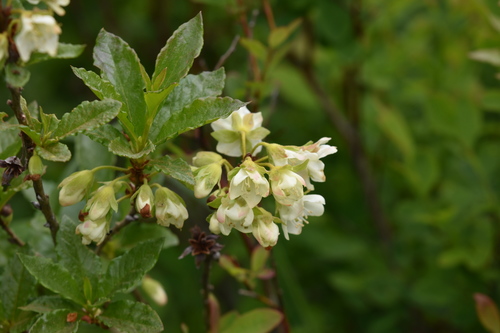
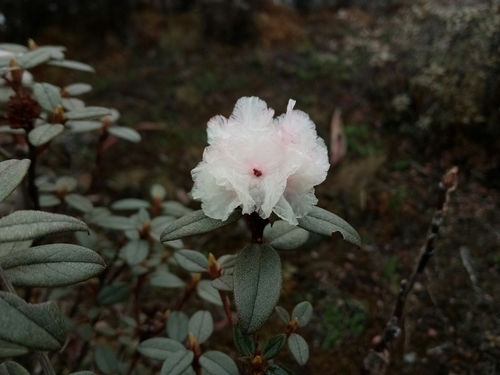
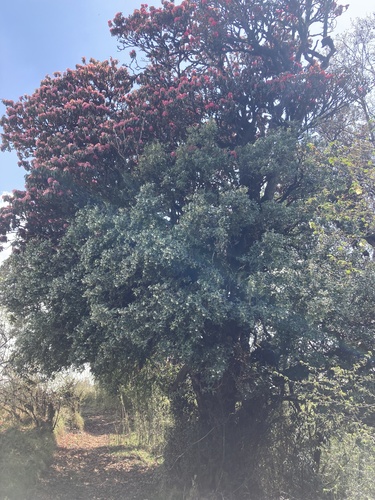
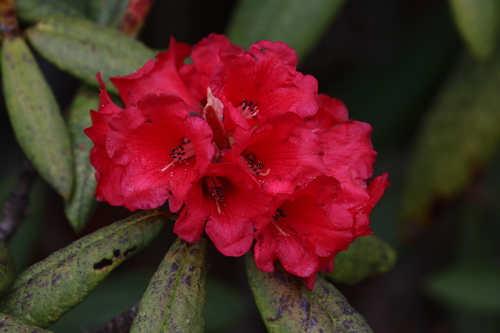
Empetrum nigrum subsp. hermaphroditum
(Lange ex Hagerup) Bocher
Black crowberry
gbif· cc-by-nc
Vojtěch Zavadil
gbif· cc-by-nc
Vojtěch Zavadil
gbif· cc-by
Rosario
Summary
Source: WikipediaEmpetrum nigrum, the crowberry, black crowberry, mossberry, rockberry, or, in western Alaska, Labrador, etc., blackberry, is a flowering plant species in the heather family Ericaceae with a near circumboreal distribution in the Northern Hemisphere. The scientific name of the plant comes from the combination of the Greek for 'upon a rock' (en = upon + petros = rock) and the Latin for black (niger). North American Indigenous names for this species include asiavik (Iñupiaq), dineechʼúh (Gwichʼin), paurngaq (Inuktut), xéelʼi (Tlingít), xa skáawaa (Haida), and ts'nełt'ida (Dena’ina).
Description
A shrub. The flowers are bisexual therefore only one tree is needed for fruit.
This description is brief — help expand it
Edible Uses
The fruit is edible and can be dried, and may have an acidic taste. In the Alaskan tundra, it is known to have a sweet and slightly tart flavor. It is often mixed with other berries in dishes like pies and puddings. It is abundant in Scandinavia and treasured for its ability to make liqueur, wine, juice, or jelly. In subarctic areas, the plant has been a vital addition to the diet of the Inuit and the Sami. It is used to make Alaskan ice cream. The Dena'ina (Tanaina) harvest it for food, sometimes storing in quantity for winter, sometimes mixed with lard or oil. In the Canadian province of Newfoundland and Labrador, the berries (known locally as “blackberries”) are used in jams, jellies, and baked goods, such as buns, or puddings. In Labrador and northern regions of Newfoundland, entire plants are harvested and the sods used to impart flavour to smoked fish. The species can also be grown as a ground cover, or as an ornamental plant in rock gardens, notably the yellow-foliaged cultivar 'Lucia'. The fruit is high in anthocyanin pigment and can be used to make a natural dye.
Traditional Uses
The fruit are eaten raw. They can also be eaten with cream. They can be stored in oil for later use.
This uses section is brief — help expand it
Distribution
It is a temperate plant.
Where It Grows
Alaska, Britain, Caucasus, Denmark, Europe, Faroe islands, Finland, Georgia, Iceland, North America, Scandinavia, Sweden, USA,
Other Information
They are an important food in Alaska.
Synonyms
Also Known As
K'ets'era, Paurngait, Tangerpak
References (12)
- Ager, T. A. & Ager, L. P., 1980, Ethnobotany of the eskimos of Nelson Island, Alaska. Arctic Anthropology Vol 17. No. 1 pp 26-48
- Bussman, R. W., et al, 2016, A comparative ethnobotany of Khevsureti, Samtskhe-Javakheti, Tusheti, Svaneti, and Racha-Lechkhumi, Republic of Georgia (Sakartvelo), Caucasus. Journal of Ethnobiology and Ethnomedicine (2016) 12:4 (As Empetrum hermaphroditum)
- Bussman, R. W., et al, 2021, Unity in diversity—food plants and fungi of Sakartvelo (Republic of Georgia), Caucasus. Journal of Ethnobiology and Ethnomedicine (2021) 17:72 p 9 (As Empetrum hermaphroditum)
- Facciola, S., 1998, Cornucopia 2: a Source Book of Edible Plants. Kampong Publications, p 94
- Hakkinen, S. H., et al, 1999, Content of the Flavonols Quercetin, Myricetin, and Kaemferol in 25 Edible Berries. Journal of Agricultural and Food Chemistry. 47: 2274-2279 (As Empetrum hermaphroditum)
Show all 12 references Hide references
- Johansson, A., Laakso, P. and Kallio, H., 1997, Characterization of seed oils of wild, edible Finnish berries. Food Chemistry 204:300-307 (As Empetrum hermaphroditum)
- Plants for a Future database, The Field, Penpol, Lostwithiel, Cornwall, PL22 0NG, UK. http://www.scs.leeds.ac.uk/pfaf/ (As Empetrum earnsii subsp. hermaphroditum)
- Mullory, C. & Aitken, S., 2012, Common Plants of Nunavut. Inhabit Media p 138
- Moerman, D. F., 2010, Native American Ethnobotany. Timber Press. p 210
- Svanberg, I., et al, 2012, Edible wild plant use in the Faroe Islands and Iceland. Acta Societatis Botanicorum Poloniae 81(4): 233-238 (As Empetrum hermaphroditum)
- Svanberg, I., 2012, The use of wild plants as food in pre-industrial Sweden. Acta Societatis Botanicorum Poloniae 81(4): 317-327 (As Empetrum hermaphroditum)
- Vanhanen, S. & Pesonen, P., 2015, Wild plant gathering in Stone Age Finland. Quaternary International xxx (2015) 1-13