Carpobrotus aequilaterus
(Haw.) N. E. Br.
Noonflower, Angular pigface, Chilean pigface
iNaturalist· cc-by-nc
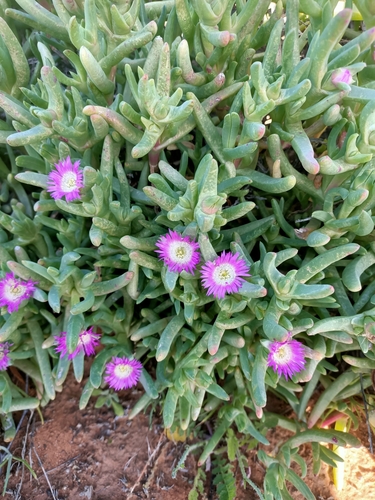
(c) Alison Victoria Carey, some rights reserved (CC BY-NC), uploaded by Alison Victoria Carey
iNaturalist· cc-by
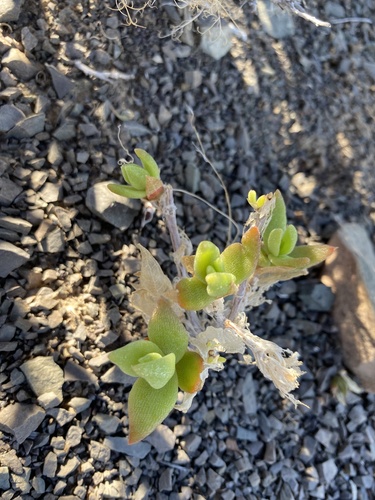
(c) Rosario Nieto Chadwick, some rights reserved (CC BY)
iNaturalist· cc-by-nc
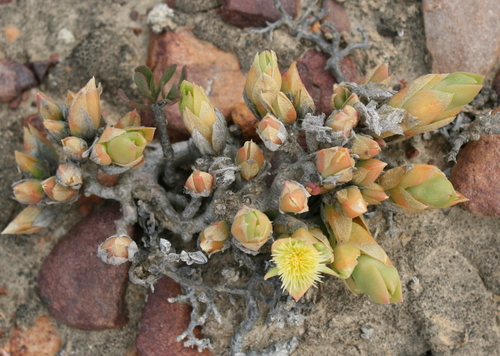
(c) gh143, some rights reserved (CC BY-NC)
Summary
Source: WikipediaCarpobrotus aequilaterus, common names: angled pigface, Chilean pigface, This species is thought to have originated in southern Africa (or possibly South America) and a naturalised weed elsewhere. However, according to VicFlora it is native to South Africa, It is also known as the sea fig. The plant grows along the coast from sea level and up to 100 metres higher. It can be found in Chile, California, Mexico, and Australia. It is a naturalised weed in North America, New Zealand, and Australia (in New South Wales, Tasmania, Victoria, South Australia), and Western Australia).
Description
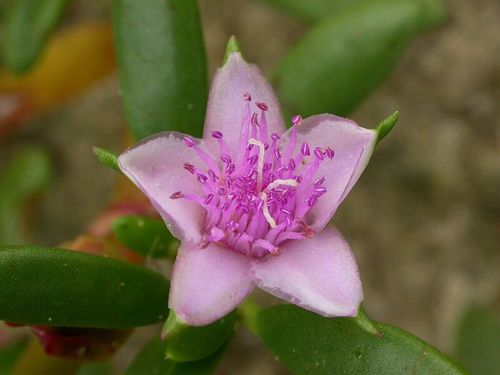
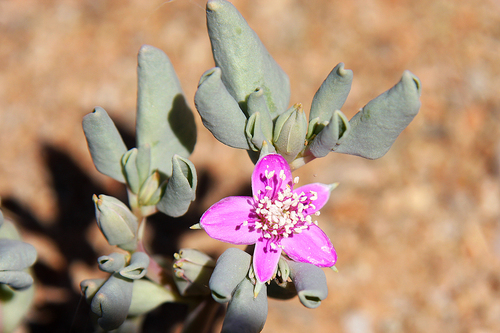
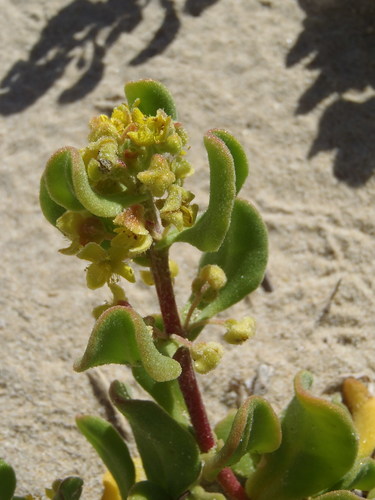
A fleshy plant which keeps growing from year to year. It grows about 30 cm high but spreads about 1 m wide. The stems are stout and lie along the ground. They develop suckers. The leaves are succulent and opposite. The leaves are triangle shaped in cross section. They are greyish-green. Leaves can be 9 cm long. The flowers are large. They are pinkish-purple. They occur singly on short stalks between the 2 end leaves. The fruit are fleshy and edible.
Edible Uses
The fruit is eaten raw and is said to faintly suggest the flavour of strawberry. The leaves can be baked but are too mucilaginous to be particularly enjoyable.
Traditional Uses
The leaves are baked and eaten. The fruit are also eaten.
This uses section is brief — help expand it
Medicinal Uses
None known
Distribution
It grows in coastal regions. It can grow in slightly salty areas. It grows in temperate places. It will grow in most soils but needs an open sunny position. It is drought resistant but sensitive to frost. It suits hardiness zones 10 & 11. Tasmania Herbarium.
Where It Grows
Africa, Australia*, Chile, East Africa, North America, South Africa, South America, Tasmania*, USA, Zimbabwe,
Cultivation
It can be grown easily using broken pieces. It can also be grown by seed.
Propagation
Surface sow seed from March to June in a greenhouse, with lower night-time temperatures being beneficial. Seed typically germinates in 7–10 days at 23°C. Prick seedlings out into individual pots once large enough to handle and grow on in a greenhouse for at least their first winter. Plant out into permanent positions in late spring or early summer, after the last expected frosts. Cuttings can be taken at any point during the growing season — allow the cutting to dry in the sun for a day or two, then pot up in a very sandy mix. Very easy to propagate this way.
Other Uses
Planted in maritime areas to prevent soil erosion in sandy soils and on steep banks. The plant is moderately fire-resistant and can be used in barrier plantings to limit the spread of forest fires.
Notes
There are about 25 Carpobrotus species. Also put in the family Mesembryanthemaceae.
Synonyms
Also Known As
Doca, Frutilla del mar, Pigface, Sea fig
References (20)
- Beckstrom-Sternberg, Stephen M., and James A. Duke. "The Foodplant Database." http://probe.nalusda.gov:8300/cgi-bin/browse/foodplantdb.(ACEDB version 4.0 - data version July 1994) (As Mesembryanthemum aequilaterale)
- Bircher, A. G. & Bircher, W. H., 2000, Encyclopedia of Fruit Trees and Edible Flowering Plants in Egypt and the Subtropics. AUC Press. p 85
- Bodkin, F., 1991, Encyclopedia Botanica. Cornstalk publishing, p 217
- Cherikoff V. & Isaacs, J., The Bush Food Handbook. How to gather, grow, process and cook Australian Wild Foods. Ti Tree Press, Australia p 194
- Cronin, L., 1989, The Concise Australian Flora. Reed. p 103
Show all 20 references Hide references
- Facciola, S., 1998, Cornucopia 2: a Source Book of Edible Plants. Kampong Publications, p 150
- Flora of Australia, Volume 4, Phytolaccaceae to Chenopodiaceae, Australian Government Publishing Service, Canberra (1984) p 25
- Hedrick, U.P., 1919, (Ed.), Sturtevant's edible plants of the world. p 412 (As Mesembryanthemum aequilaterale)
- Heyne, G. & P., 1985, Australian Plants for your Garden. Lothian. p 60
- Hiddins, L., 1999, Explore Wild Australia with the Bush Tucker Man. Penguin Books/ABC Books. p 158
- Hussey, B.M.J., Keighery, G.J., Cousens, R.D., Dodd, J., Lloyd, S.G., 1997, Western Weeds. A guide to the weeds of Western Australia. Plant Protection Society of Western Australia. p 76
- J. Bot. 66:324. 1928
- Lamp, C & Collet F., 1989, Field Guide to Weeds in Australia. Inkata Press. p 54
- Lazarides, M. & Hince, B., 1993, Handbook of Economic Plants of Australia, CSIRO. p 49
- Low, T., 1992, Bush Tucker. Australia’s Wild Food Harvest. Angus & Robertson. p 58
- Paczkowska, G. & Chapman, A.R., 2000, The Western Australian Flora. A Descriptive Catalogue. Western Australian Herbarium. p 132
- Plants for a Future database, The Field, Penpol, Lostwithiel, Cornwall, PL22 0NG, UK. http://www.scs.leeds.ac.uk/pfaf/
- Smith, K & I., 1999, Grow your own bushfoods. New Holland. Australia. p 69
- Uphof,
- www.chileflora.com