Carpobrotus acinaciformis
(L.) L. Bolus.
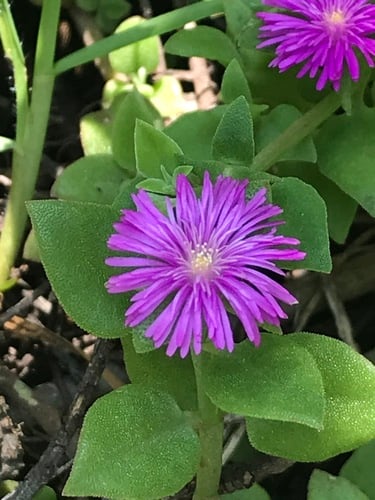
Red Hottentot fig, Giant pigface
iNaturalist· cc-by-nc
(c) tania_morkel, some rights reserved (CC BY-NC)
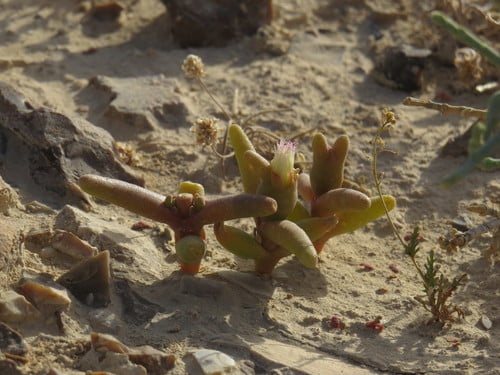
iNaturalist· cc-by-sa
(c) Chris Vynbos, some rights reserved (CC BY-SA), uploaded by Chris Vynbos
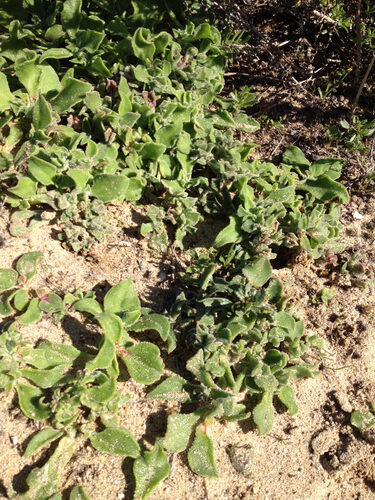
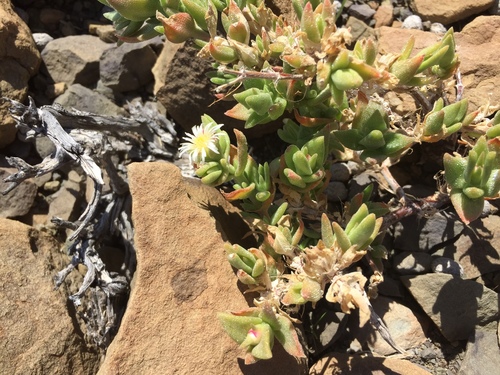
iNaturalist· cc-by-sa
(c) Tony Rebelo, some rights reserved (CC BY-SA), uploaded by Tony Rebelo
Summary
Source: WikipediaCarpobrotus acinaciformis (commonly known as Elands sourfig, Elandssuurvy or Sally-my-handsome) is a succulent perennial of the family Aizoaceae, native to South Africa.
Description
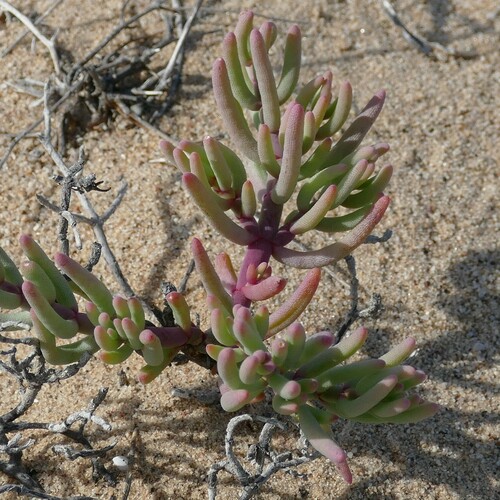
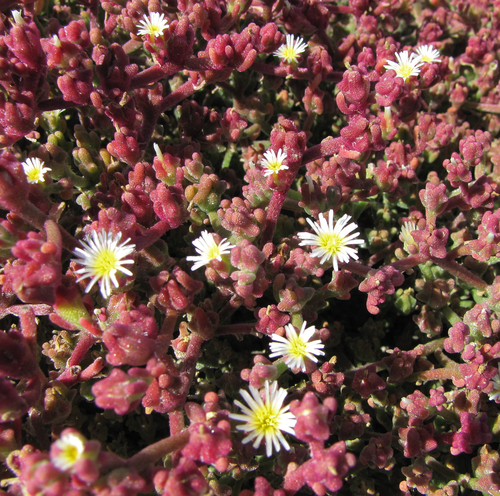
A low succulent shrub which keeps growing from year to year. It is a trailing plant and forms mats. It is woody at the base. The stems are angled and form roots at the nodes. It can be 30 cm high and spread 1 m wide. The leaves are opposite and united at the base. They are 3 angled. They are bluish-green and widest in the middle. The flowers are 11-12 cm across. They are bright purple or purple-red.
Edible Uses
The fruit can be eaten raw, but there is very little flesh and it must be fully ripe — unripe fruit is highly astringent. The flavour is insipid. Leaves can be eaten raw or cooked but are very mucilaginous and difficult to enjoy.
Traditional Uses
The fruit are eaten raw. They are better once dried. They are also used in preserves.
This uses section is brief — help expand it
Medicinal Uses
None known
Distribution
It is a Mediterranean climate plant. It grows on rocky cliffs and sandy places. It will grow in most soils. It is best in a sandy soil and a sunny position. It is resistant to drought but damaged by frost.
Where It Grows
Africa, Australia, Britain, Europe, Mediterranean, North America, South Africa*, Southern Africa, USA,
Cultivation
Plants can be grown by cuttings or seeds.
Propagation
Surface sow seed from March to June in a greenhouse, with lower night-time temperatures being beneficial. Seed typically germinates in 7–10 days at 23°C. Prick seedlings out into individual pots once large enough to handle and grow on in a greenhouse for at least their first winter. Plant out into permanent positions in late spring or early summer, after the last expected frosts. Cuttings can be taken at any point during the growing season — allow the cutting to dry in the sun for a day or two, then pot up in a very sandy mix. Very easy to propagate this way.
Other Uses
Planted in maritime areas to stabilise sandy soils and steep banks, the plants form a dense carpet that provides effective ground cover. The plant is moderately fire-resistant and is suitable for use in barrier plantings to slow the spread of forest fires.
Other Information
The fruit are sold.
Notes
There are about 25 Carpobrotus species. Also put in the family Mesembryanthemaceae.
Synonyms
Also Known As
Elandsvy, Goenavy, Sout fig, Suurvye, Vyeranke
References (17)
- Barkhuizen, 1978,
- Beckstrom-Sternberg, Stephen M., and James A. Duke. "The Foodplant Database." http://probe.nalusda.gov:8300/cgi-bin/browse/foodplantdb.(ACEDB version 4.0 - data version July 1994) (As Mesembryanthemum acinaciforme)
- Bircher, A. G. & Bircher, W. H., 2000, Encyclopedia of Fruit Trees and Edible Flowering Plants in Egypt and the Subtropics. AUC Press. p 85
- Blamey, M and Grey-Wilson, C., 2005, Wild flowers of the Mediterranean. A & C Black London. p 42
- Bodkin, F., 1991, Encyclopedia Botanica. Cornstalk publishing, p 217
Show all 17 references Hide references
- De Vynk, J. C., et al, 2016, Indigenous edible plant use by contemporary Khoe-San descendants of South Africa's Cape South Coast. South African Journal of Botany. 102 (2016) 60-69
- Fl. Pl. South Africa 7: t. 247. 1927
- Fox, F. W. & Young, M. E. N., 1982, Food from the Veld. Delta Books. p 266
- Hedrick, U.P., 1919, (Ed.), Sturtevant's edible plants of the world. p 411 (As Mesembryanthemum acinaciforme)
- Heywood, V.H., Brummitt, R.K., Culham, A., and Seberg, O. 2007, Flowering Plant Families of the World. Royal Botanical Gardens, Kew. p 28 (As Mesembryanthemum acinaciforme)
- Heywood, V.H., Brummitt, R.K., Culham, A., and Seberg, O. 2007, Flowering Plant Families of the World. Royal Botanical Gardens, Kew. p 213
- Lyle, S., 2006, Discovering fruit and nuts. Land Links. p 108
- Peters, C. R., O'Brien, E. M., and Drummond, R.B., 1992, Edible Wild plants of Sub-saharan Africa. Kew. p 46
- Petersen, L. M., et al, 2012, Development of a Compendium of Local, Wild-Harvested Species Used in the Informal Economy Trade, Cape Town, South Africa. Ecology and Society 17(2):26
- Plants for a Future database, The Field, Penpol, Lostwithiel, Cornwall, PL22 0NG, UK. http://www.scs.leeds.ac.uk/pfaf/
- Ruiters-Welcome, A. K., 2019, Food plants of southern Africa. Ph.D. thesis. Univ. of Johannesburg p 7
- Welcome, A. K. & Van Wyk, B.-E., 2019, An inventory and analysis of the food plants of southern Africa. South African Journal of Botany 122 (2019) 136–179