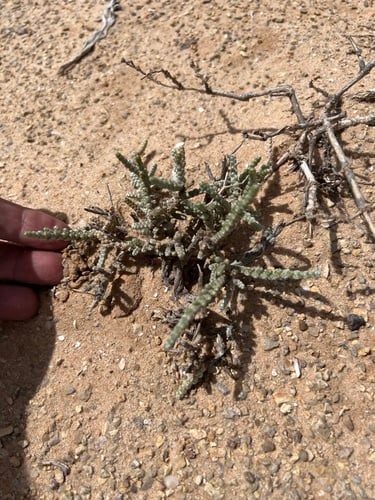
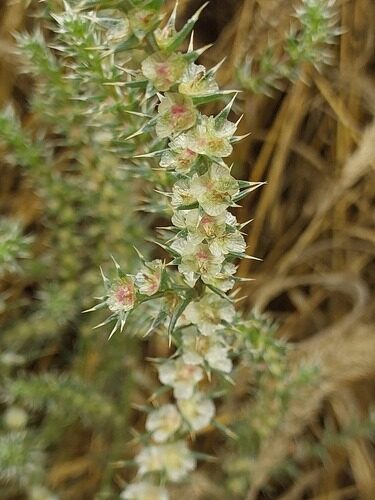
Cyathula orthacantha
(Asch.) Schinz
iNaturalist· cc-by-nc
(c) Dewald du Plessis, some rights reserved (CC BY-NC), uploaded by Dewald du Plessis
iNaturalist· cc0
no rights reserved
Description
An annual herb. It is erect and has many branches but can also lie along the ground. It grows 1.5 m tall. The stems and branches have white hairs when young. They become angular. The leaves are narrowly oval and vary in shape. They can be 1-15 cm long and 5.5 cm wide. The tip is pointed and it narrows to the base. The flowers can be white to pale green or red. They are near the ends of branches. The flowers are in groups forming rounded heads 4-6 cm wide. The fruit is a small one seeded capsule. These form as a burr about 15. cm across.
Edible Uses
The young leaves are used as a vegetable, cut into pieces, washed, cooked, and served with peanut paste.
Traditional Uses
The young leaves are used as a vegetable. They are cut into pieces, washed, cooked and then have peanut paste added.
This uses section is brief — help expand it
Medicinal Uses
The roots are pounded and soaked in warm water and then drunk 2 - 3 times a day to treat stomach-ache. The leaves are dried and pounded, mixed with pounded castor oil seeds and the powder applied on wounds twice a day.
Distribution
It is a tropical plant.
Where It Grows
Africa, Angola, Botswana, Central Africa, East Africa, Ethiopia, Kenya, Mozambique, Namibia, Southern Africa, Sudan, Tanzania, Uganda, Zambia, Zimbabwe,
Cultivation
Plants can be grown from seeds.
Production
Leaves are collected in the rainy season.
Synonyms
Also Known As
Ilamata, Muhuhuoi, Muila-ngoto, Namata, Somwambisi
References (4)
- Grubben, G. J. H. and Denton, O. A. (eds), 2004, Plant Resources of Tropical Africa 2. Vegetables. PROTA, Wageningen, Netherlands. p 560
- Mutie, F. M., et al, 2023, Important Medicinal and Food Taxa (Orders and Families) in Kenya, Based on Three Quantitative Approaches. Plants 2023, 12, 1145
- Ruffo, C. K., Birnie, A. & Tengnas, B., 2002, Edible Wild Plants of Tanzania. RELMA p 248
- World Checklist of Useful Plant Species 2020. Royal Botanic Gardens, Kew