Carissa spinarum
L.
Simple-spined num-num
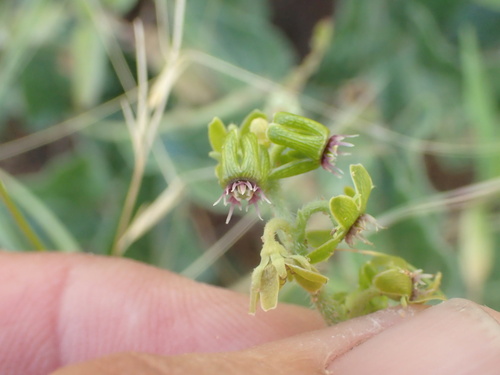
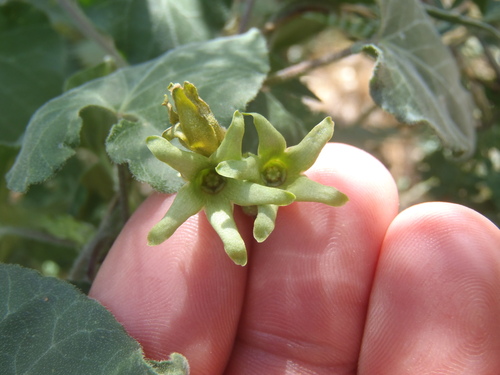
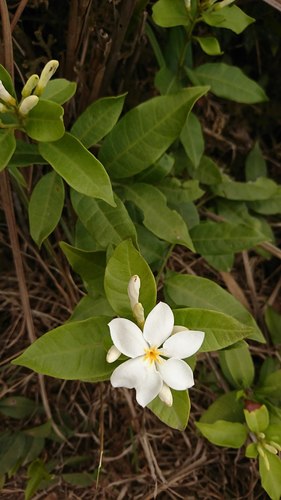
iNaturalist· cc-by-nc
(c) Hans Böckler, some rights reserved (CC BY-NC), uploaded by Hans Böckler
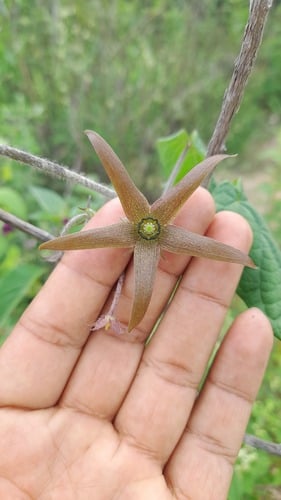
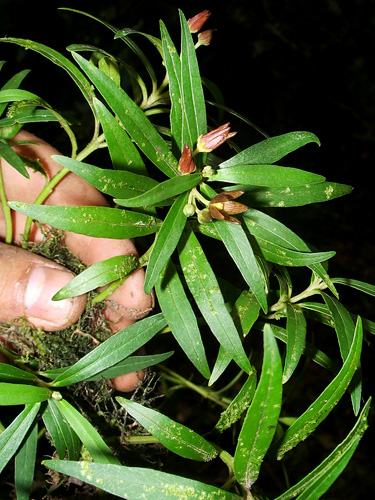
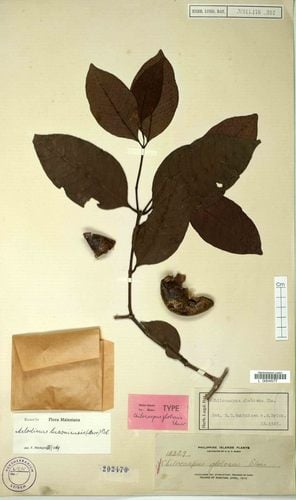
iNaturalist· cc-by
(c) National Geographic Okavango Wilderness Project, some rights reserved (CC BY)
Summary
Source: WikipediaCarissa spinarum, the conkerberry or bush plum, is a large shrub of the dogbane family (Apocynaceae), widely distributed in tropical regions of Africa, Southern Asia, Australia, and various islands of the Indian Ocean. It is most well known in Australia, where it is also called currant bush or, more ambiguously, native currant or even black currant. It is, however, neither closely related to plums (Prunus) nor to true currants (Ribes), which belong to entirely different lineages of eudicots. In India, it is also called wild karanda/wild karavanda, referring to the related karanda (C. carandas). Carissa spinarum is often discussed under its many obsolete synonyms (see below). It grows as a multi-stemmed shrub, 0.5 to 3 m (1.6 to 9.8 ft) in height. The leaves are glossy green, opposite, narrow ovate to lanceolate and 1–5 cm (0.4–2.0 in) in length. The branches bear thorns of 1–3 cm (0.4–1.2 in) length. White, star-shaped flowers about 1 cm (0.4 in) across are followed by ovate green berries, 1–2 cm (0.4–0.8 in) in length, which turn black or dark purple when ripe.
Description
An evergreen shrub. It grows 5 m tall. It is thorny. It can be climbing. The leaves are narrowly oval and leathery and have soft hairs. The flowers are white and have a scent. They are in groups at the ends of branches. The fruit are red berries. They are about 1 cm across.
Edible Uses
Ripe fruit can be eaten raw or used for tarts, juice, and other preparations. Unripe fruit are used in pickles. The fruit is also used as a spice.
Traditional Uses
The ripe fruit can be eaten raw or used for tarts. They are also used for juice, The unripe fruit are used in pickles.
This uses section is brief — help expand it
Medicinal Uses
The plant is well known in Africa for its anthelmintic action in both people and animals and the ground-up root as a remedy for venereal disease. The root is chewed and the saliva swallowed, the root-sap being considered tonic and restorative of virility. The plants are also used as ‘bitters’, macerated in rum, gin, etc. and as an expectorant. The root if crushed emits a strong smell of methyl salicylate and if rubbed onto the fingers produces a prickly sensation. Root-scrapings are used in the treatment of glandular inflammation (adenites). A root-decoction, combined with pimento, is used as an anthelmintic, especially against Taenia. The root is also used for treating chest-complaints, as a cough remedy, tonic and abortifacient. The root-bark is mixed with spices and used as an enema for lumbago and other pains. The leaf decoction is valued in the treatment of intermittent fever, diarrhoea, oral inflammation and earache. The boiled leaves are applied as a poultice to relieve toothache. The unripe fruit is rich in tannins and is used medicinally as an astringent. The ripe fruit is taken as an antiscorbutic and remedy for biliousness. The roots contain an active ingredient, 'carissin', that may prove useful in the treatment of cancer.
Distribution
A tropical plant. It grows in dry regions. It can grow in arid places. It grows in south India. In the Himalayas it grows up to 6,000 m above sea level. It occurs in the Western Ghats in India. Rajasthan. In Sichuan and Yunnan.
Where It Grows
Africa, Asia, Bangladesh, Cambodia, China, Cuba, East Africa, Ethiopia, Himalayas, India, Indochina, Indonesia, Kenya, Madagascar, Mozambique, Myanmar, Northeastern India, NW India, SE Asia, Southern Africa, Sri Lanka, Thailand, Uganda, West Indies,
Cultivation
Plants can be grown from seed or cuttings. It is a good hedge plant.
Propagation
Seed - easy. Cuttings are easy. Air layering.
Other Uses
The bark contains a white latex of no recorded property. The roots are put into water-gourds to impart an agreeable taste to the water, or to disguise a strong smell. A piece of the root is sometimes fixed into a hut-roof as a snake-repellent. A paste of the pounded roots serves as a fly repellant. The fruits are a source of tannins, and have been used in dyeing. The white or yellow wood is hard, smooth and useful for fashioning spoons, combs, household utensils and miscellaneous products of turnery. The wood is used for fuel. The abundant branching habit and the presence of stiff spines to 5 cm long make the plant suitable for planting as a protective hedge.
Production
It flowers throughout the year.
Notes
There about 20-37 Carissa species. All Carissa species bear edible fruit. They grow in the tropics and subtropics. Leeuwenberg has put many Carissa into Carissa spinarum. This is not necessarily accepted.
Nutrition
| Part | Moisture | kJ | kcal | Protein | Vit A | Vit C | Iron | Zinc |
|---|---|---|---|---|---|---|---|---|
| Fruit | 73.2 | — | — | 3.2 | — | — | — | — |
Synonyms
Also Known As
Achuga, Acuga, Agam, Agama, Agasma, Agamisa, Agamsa, Agamta, Agempsa, Akamitta, Almi, Ambelto, Anka, Ankhukoli, Bon-karamcha, Chiru, Chiru-kila, Chothay kalakai, Dudkoli, Emuriel, Emuriet, Gama, Gan, Garaunda, Granda, Hagalcho, Hagamssa, Heen karamba, Jangli-Karaunda, Jugli karonda, Kalakai, Kalive chettu, Kalivi, Karamadika, Karamcha, Karanda, Karaunda, Karonda, Khanzat, Khunti, Kila, Kilatti, Kismis hitam, Kol, Lade, Muchakerech, Mukawa, Mutote, Ngawa, Ndote, Nzunu, Prom banla, Sana karenda, Sirakula, Sirukallakai, Soha, Titita
References (62)
- Addis, G., Asfaw, Z & Woldu, Z., 2013, Ethnobotany of Wild and Semi-wild Edible Plants of Konso Ethnic Community, South Ethiopia. Ethnobotany Research and Applications. 11:121-141
- Addis, G., et al, 2013, The Role of Wild and Semi-wild Edible Plants in Household Food Sovereignty in Hamer and Konso Communities, South Ethiopia. Ethnobotany Research & Applications. 11:251-271
- Alemneh, D., 2020, Ethnobotany of wild edible plants in Yilmana Densa and Quarit Districts of West Gojjam Zone, Amhara Region, Ethiopia. Ethnobotany Research & Applications. 20:47
- Ambasta S.P. (Ed.), 2000, The Useful Plants of India. CSIR India. p 106 (Also as Carissa inermis)
- Ashagre, M., et al, 2016, Ethnobotanical study of wild edible plants in Burji District, Segan Area Zone of Southern Nations, Nationalities and Peoples Region (SNNPR), Ethiopia. Journal of Ethnobiology and Ethnomedicine (2016) 12:32
Show all 62 references Hide references
- Ashton, M. S., et al 1997, A Field Guide to the Common Trees and Shrubs of Sri Lanka. WHT Publications Ltd. p 107
- Assefa, A. & Abebe, T., 2010, Wild Edible Trees and Shrubs in the Semi-arid Lowlands of Southern Ethiopia. Journal of Science and Development 1 (1) 2010
- Balemie, K., & Kebebew, F., 2006, Ethnobotanical study of wild edible plants in Derashe and Kucha Districts, South Ethiopia. Journal of Ethnobiology and Ethnomedicine. p
- Bandyopadhyay, S. et al, 2009, Wild edible plants of Koch Bihar district, West Bengal. Natural Products Radiance 8(1) 64-72
- Bandyopadhyay, S., et al, 2012, A Census of Wild Edible Plants from Howrah District, West Bengal, India. Proceedings of UGC sponsored National Seminar 2012
- Berihun, T., & Molla, E., 2017, Study on the Diversity and Use of Wild Edible Plants in Bullen District Northwest Ethiopia. Hindawi Journal of Botany.Article ID 8383468
- Bhatia, H., et al, 2018, Traditionally used wild edible plants of district Udhampur, J&K, India. Journal of Ethnobiology and Ethnomedicine (2018) 14:73
- Bircher, A. G. & Bircher, W. H., 2000, Encyclopedia of Fruit Trees and Edible Flowering Plants in Egypt and the Subtropics. AUC Press. p 84 (Also as Carissa suavissima)
- Bohra, N., et al, 2017, Ethnobotany of wild edible plants traditionally used by the local people in the Ramnagar regions from Nainital District, Uttarakhand, India. Biolife 5(1): 12-19
- Chowdery, T., et al, 2014, Wild edible plants of Uttar Dinajpur District, West Bengal. Life Science Leaflets. 47:pp 20-36 http://lifesciencesleaflets.ning.com
- Duguma, H. T., 2020, Wild Edible Plant Nutritional Contribution and Consumer Perception in Ethiopia. Hindawi International Journal of Food Science Volume 2020, Article ID 2958623, 16 pages
- Emire, A., et al, 2021, Ethnobotanical Study of Wild Edible Fruit Tree and Shrub Species in Adola Rede and Odo Shakiso Midland Districts of Guji Zone, Southern Ethiopia. Int. J. Adv. Res. Biol. Sci. (2021). 8(12): 96-109
- Feyssa, D. H., et al, 2011, Seasonal availability an consumption of wild edible plants in semiarid Ethiopia; Implications to food security and climate change adaptation. Journal of Horticulture and Forestry 3(5): 138-149
- Fl. ind. 2:524. 1824 (Hort. bengal. 19. 1814, nom. nudum) (As Carissa diffusa)
- GUPTA & KANODIA
- Kala, C. P., 2009, Aboriginal uses and management of ethnobotanical species in deciduous forests of Chhattisgarh state in India. Journal of Ethnobiology and Ethnomedicine. 5:32
- Kebebew, M. & Leta, G., 2016, Wild Edible Plant Bio-diversity and Utilization System in Nech Sar National Park, Ethiopia. International Journal of Bio-resource and Stress Management 2016, 7(4):885-896
- Kidane, B., et al, 2014, Ethnobotany of Wild and Semi-wild Edible Fruit Species used by Maale and Ari Ethnic Communities in South Ethiopia. Ethnobotany Research and Applications. Vol. 12, 1546-3465-12-455
- Kumar, R. & Saikia, P., 2020, Wild edible plants of Jharkhand and their utilitarian perspectives. Indian Journal of Traditional Knowledge Vol 19 (2), April 2020, pp 237-250
- Li Ping-tao; Antony J. M. Leeuwenberg, David J. Middleton, Apocynaceae, Flora of China
- Luizza, M. W., et al., 2013, Local Knowledge of Plants and their uses among Women in the Bale Mountains, Ethiopia. Ethnobotany Research & Applications 11:315-339
- Lulekal, E., et al, 2011, Wild edible plants in Ethiopia: a review on their potential to combat food insecurity. Afrika Focus - Vol. 24, No 2. pp 71-121
- Mant. pl. 2:559. 1771
- Masters, T., 2021, Traditional food plants of the upper Aswa River catchment of northern Uganda—a cultural crossroads. Journal of Ethnobiology and Ethnomedicine (2021) 17:24
- Mengistu, F. & Hager, H., 2008, Wild Edible Fruit Species Cultural Domain, Informant Species Competence and Preference in Three Districts of Amhara Region, Ethiopia. Ethnobotany Research & Applications 6:487-502
- Misra S. & Misra M., 2016, Ethnobotanical and Nutritional Evaluation of Some Edible Fruit Plants of Southern Odisha, India. International Journal of Advances in Agricultural Science and Technology, Vol.3 Issue.1, March- 2016, pg. 1-30
- Misra, S., 2020, Survey of edible plants for human consumption in south Odisha, India. Journal of Emerging Technologies and Innovative Research (JETIR) Vol. 7, Issue 12 p 278
- Ojelel, S., et al, 2019, Wild edible plants used by communities in and around selected forest reserves of Teso-Karamoja region, Uganda. Journal of Ethnobiology and Ethnomedicine (2019) 15:3
- Parmar, C., & Kaushel, M. K., 1982, In Wild Fruits. Kalyani Publishers, New Delhi, India. p 15
- Pasha, M. K. & Uddin, S. B., 2019, Minor Edible Fruits of Bangladesh. Bangladesh J. Plant Taxon. 26(2): 299–313
- Rajapaksha, U., 1998, Traditional Food Plants in Sri Lanka. HARTI, Sri Lanka. p 68
- Ramachandran, V. S., 2007, Wild edible plants of the Anamalais, Coimbatore district, western Ghats, Tamil Nadu. Indian Journal or Traditional Knowledge. 6(1) pp 173-176
- Rashid, A., Anand, V.K. & Serwar, J., 2008, Less Known Wild Plants Used by the Gujjar Tribe of District Rajouri, Jammu and Kashmir State. International Journal of Botany 4(2):219-244
- Rasingam, L., 2012, Ethnobotanical studies on the wild edible plants of Irula tribes of Pillur Valley, Coimbatore district, Tamil Nadu, India. Asian Pacific Journal of Tropical Biomedicine. (2012) S1493-S1497
- Regassa, T., et al, 2014, Ethnobotany of Wild and Semi-Wild Edible Plants of Chelia District, West-Central Ethiopia. Science, Technology and Arts Research Journal. 3(4): 122-134
- Reis, S. V. and Lipp, F. L., 1982, New Plant Sources for Drugs and Foods from the New York Botanical Garden herbarium. Harvard. p 241
- Reitveld, S., 2013, The Animals and Plants of the Zazamalala Forest in Western Madagascar. p 45
- Royal Botanic Gardens, Kew (1999). Survey of Economic Plants for Arid and Semi-Arid Lands (SEPASAL) database. Published on the Internet; http://www.rbgkew.org.uk/ceb/sepasal/internet [Accessed 28th March 2011]
- Ruiters-Welcome, A. K., 2019, Food plants of southern Africa. Ph.D. thesis. Univ. of Johannesburg p 22
- Sasi, R. & Rajendran, A., 2012, Diversity of Wild Fruits in Nilgiri Hills of the Southern Western Ghats - Ethnobotanical Aspects. IJABPT, 3(1) p 82-87 (As Carissa paucinervia)
- Senbeta, F. et al, 2013, Diversity of Useful Plants in the Coffee Forests of Ethiopia. Ethnobotany Research & Applications 11:049-069
- Seyoum, Y., et al, 2015, Edible Wild Fruit Trees and Shrubs and Their Socioeconomic Significance in Central Ethiopia. Ethnobotany Research & Applications. 14:183-197
- SHORTT (As Carissa diffusa)
- Sina, B. & Degu, H. D., 2015, Knowledge and use of Wild Edible Plants in the Hula District of the Sidama Zone. International Journal of Bio-resource and Stress Management 6(3):352-365
- Singh, H.B., Arora R.K.,1978, Wild edible Plants of India. Indian Council of Agricultural Research, New Delhi. p 53 (Also as Carissa paucinervia) and (As Carissa inermis)
- Singh, V. and Singh, P., 1981, Edible Wild Plants of Eastern Rajasthan. J. Econ. Tax. Bot. Vol 2 pp 197-207
- Sukarya, D. G., (Ed.) 2013, 3,500 Plant Species of the Botanic Gardens of Indonesia. LIPI p 910
- Swaminathan, M.S., and Kochnar, S.L., 2007, An Atlas of Major Flowering Trees in India. Macmillan. p 210 (Also as Carissa paucinervia)
- Tamil herbs, 2007, Edible Plants of the Tropical Dry Evergreen Forest.
- Tebkew, M. et al, 2014, Underutilized wild edible plants in the Chilga District, northwestern Ethiopia: focus on wild woody plants. Agriculture & Food Security 3:12
- Teklehaymanot, T., 2017, An ethnobotanical survey of medicinal and edible plants of Yalo Woreda in Afar regional state, Ethiopia. Journal of Ethnobiology and Ethnomedicine 13:40
- Ulian, T., et al, 2020, Unlocking plant resources to support food security and promote sustainable agriculture. Plants, People, Planet. 2020;2:421–445.
- Welcome, A. K. & Van Wyk, B.-E., 2019, An inventory and analysis of the food plants of southern Africa. South African Journal of Botany 122 (2019) 136–179
- Wiersema, J. H. & Leon, B., 2013, World Economic Plants. A Standard Reference CRC Press. 2nd Ed. p 145
- Wild edible plants of Himachal Pradesh
- World Checklist of Useful Plant Species 2020. Royal Botanic Gardens, Kew
- Yimer, A., et al, 2021, Ethnobotanical study of wild edible plants used by Meinit Ethnic Community at Bench-Maji Zone, Southwest Ethiopia. Research Square. p 5