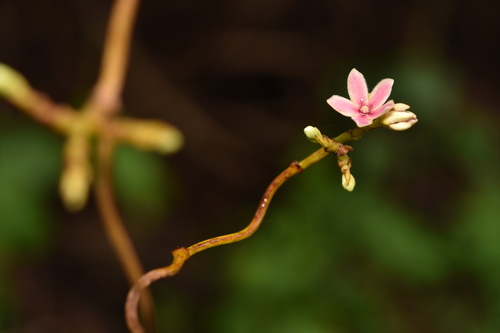
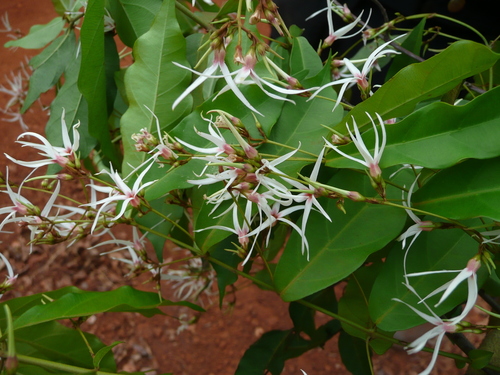
Brachystelma foetidum
Schltr.
iNaturalist· cc-by-nc
(c) georgfritz, some rights reserved (CC BY-NC)
iNaturalist· cc-by-nc
(c) juddkirkel, some rights reserved (CC BY-NC)
Description
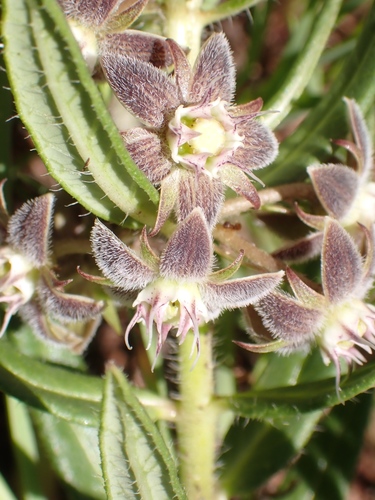
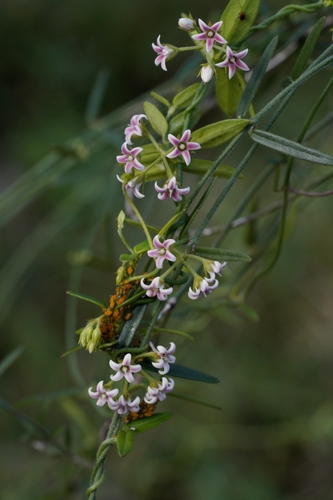
A herb that keeps growing from year to year. It has short annual stems growing from a tuber. The leaves vary. The flowers are in clusters in the axils of leaves. They are in clusters of 2-6. The flowers are bell shaped and the lobes are purple brown with yellow spots near the base. They have a bad smell. The fruit is a hairy follicle.
Edible Uses
The root and tubers are eaten raw or roasted.
Traditional Uses
The root is eaten raw or roasted.
This uses section is brief — help expand it
Distribution
It is a subtropical plant. It grows in open woodland.
Where It Grows
Africa, Botswana, Central Africa, Congo, East Africa, South Africa, Southern Africa, Zimbabwe,
Notes
Also put in the family Asclepiadaceae.
Synonyms
Also Known As
Seru, T'kalcuni
References (6)
- Fox, F. W. & Young, M. E. N., 1982, Food from the Veld. Delta Books. p 106
- Gillarmod, J., 1971,
- Malaisse, F., 1997, Se nourrir en floret claire africaine. Approche ecologique et nutritionnelle. CTA., p 91.
- Peters, C. R., O'Brien, E. M., and Drummond, R.B., 1992, Edible Wild plants of Sub-saharan Africa. Kew. p 62
- Ruiters-Welcome, A. K., 2019, Food plants of southern Africa. Ph.D. thesis. Univ. of Johannesburg p 22
Show all 6 references Hide references
- Welcome, A. K. & Van Wyk, B.-E., 2019, An inventory and analysis of the food plants of southern Africa. South African Journal of Botany 122 (2019) 136–179