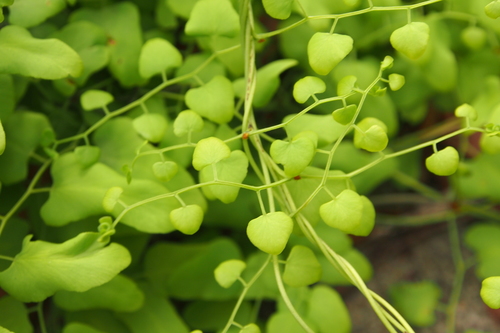
Lygodium flexuosum
(L.) Sw.
Climbing maidenhair
iNaturalist· cc-by
(c) naturewatchwidow, some rights reserved (CC BY), uploaded by naturewatchwidow
iNaturalist· cc-by-nc
(c) abhilare, some rights reserved (CC BY-NC)
iNaturalist· cc-by-nc-sa
(c) 106611639464075912591, some rights reserved (CC BY-NC-SA), uploaded by 106611639464075912591
Summary
Source: WikipediaLygodium flexuosum, also known as the flexuose climbing fern, is a rhizomatous perennial climbing fern native to tropical and subtropical Asia and northern Australia. It produces thin, wiry fronds that twine and climb, arising from horizontal rhizomes and stolons on or beneath the ground. The pinnae are oppositely arranged, triangular in shape, with fertile pinnae margins forming finger-like projections that bear sporangia for spore production. Unlike flowering plants, this species reproduces by spores and often forms dense vine growth in wet tropical habitats.
Description
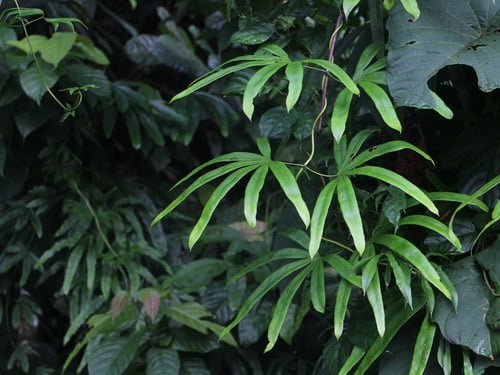
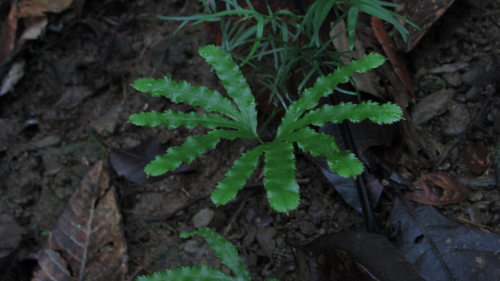
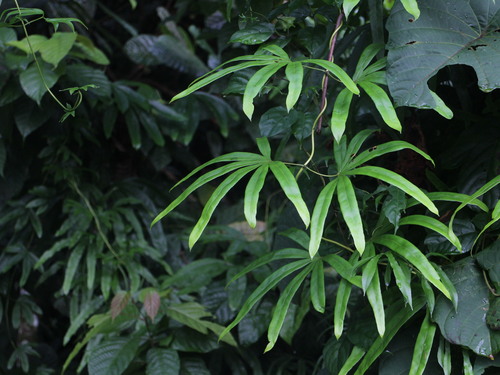
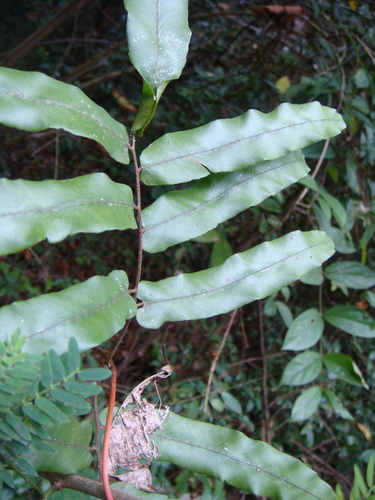
A large fern. It has a short creeping rhizome. It is a climber. It grows 2 m tall. There are 2 kinds of leaves, Sterile leaves are narrow to sword shaped. The fertile leaflets are smaller and have frills around the edge.
Edible Uses
The leaves and fronds are eaten as a vegetable. The roots are dried, powdered, and used as a flavoring in local fermented drinks.
Traditional Uses
The leaves are eaten as a vegetable. The roots are dried, powdered and used to flavour local fermented drinks.
This uses section is brief — help expand it
Medicinal Uses
The roots are used to flavor traditional fermented drinks.
Known Hazards
Although we have found no reports of toxicity for this species, a number of ferns contain carcinogens so some caution is advisable. Many ferns also contain thiaminase, an enzyme that robs the body of its vitamin B complex. In small quantities this enzyme will do no harm to people eating an adequate diet that is rich in vitamin B, though large quantities can cause severe health problems. The enzyme is destroyed by heat or thorough drying, so cooking the plant will remove the thiaminase.
Distribution
It is a tropical plant. In India it grows up to 1,500 m above sea level. It grows on the edge of the rainforest.
Where It Grows
Asia, Australia, Cambodia, Himalayas, India, Indochina, Laos, Nepal, SE Asia, Thailand,
Cultivation
The roots can be planted in a shady position, allowing the plant to climb up into the sun. Prefers a neutral to slightly acid soil.
Propagation
Spores. Division. Serpentine layering. An actively growing frond is pinned down onto the soil surface at each node, where it may root and shoot out as a new plant.
Other Uses
The stem is used for tying rice sheaves. Splints prepared from the stems are used in the manufacture of baskets, hats, and fancy boxes. The splints can be combined with buri (Corypha spp.) or some other fibre to make various fancy articles such as cigarette cases or pocketbooks. The effect is very pleasing, particularly when the plant stem is black.
Notes
Also put in the family Schizaeaceae.
Also Known As
Janai laharo, Kalitulia, Lahare unyu, Namjam rehet, Parandi sag, Parewapoti, Phak kud noy, Thu-kaing-khu-du
References (9)
- Anderson, E. F., 1993, Plants and people of the Golden Triangle. Dioscorides Press. p 214
- Dangol, D. R., 2002, Economic uses of forest plant resources in western Chitwan, Nepal. Banko Janakari, 12(2): 56-64
- Dangol, D. R. et al, 2017, Wild Edible Plants in Nepal. Proceedings of 2nd National Workshop on CUAOGR, 2017.
- Kachenchart, B., et al, 2008, Phenology of Edible Plants at Sakaerat Forest. In Proceedings of the FORTROP II: Tropical Forestry Change in a Changing World. Bangkok, Thailand.
- Kuhnlein, H. V., et al, 2009, Indigenous Peoples' food systems. FAO Rome p 171
Show all 9 references Hide references
- Luczaj, L., et al, 2021, Wild food plants and fungi sold in the markets of Luang Prabang, Lao PDR. Journal of Ethnobiology and Ethnomedicine (2021) 17:6
- Misra, R. C., et al, 2013, Genetic resources of wild tuberous food plants traditionally used in Similipal Biosphere Reserve, Odisha, India. Genetic Resources and Crop Evolution. Vol. 60 No. 2. Springer
- Ojha, R. & Devkota, H. P., 2021, Edible and Medicinal Pteridophytes of Nepal: A Review. Ethnobotany Research & Applications 22:16
- Pearson, S. & A., 1992, Rainforest Plants of Eastern Australia. Kangaroo Press p 138