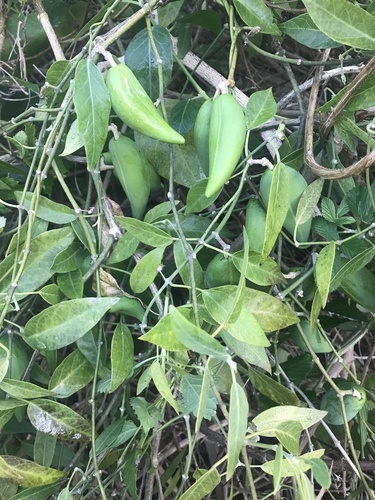
Carissa bispinosa
(L.) Desf. ex Brenan
Fork-spined carissa
iNaturalist· cc-by
(c) Henry de Lange, some rights reserved (CC BY), uploaded by Henry de Lange
iNaturalist· cc-by-nc
(c) fayne, some rights reserved (CC BY-NC), uploaded by fayne
iNaturalist· cc-by-nc
(c) Ann, some rights reserved (CC BY-NC), uploaded by Ann
Summary
Source: WikipediaCarissa bispinosa grows as a shrub or small tree up to 5 metres (16 ft) tall. Its fragrant flowers feature a white corolla. The fruit is red when ripe. Its habitat is woodland and forest from 1,080 m (3,540 ft) to 1,630 m (5,350 ft) elevation. Vernacular names for the plant include forest num-num and Y-thorned carissa. Carissa bispinosa is native an area from Uganda to South Africa.
Description
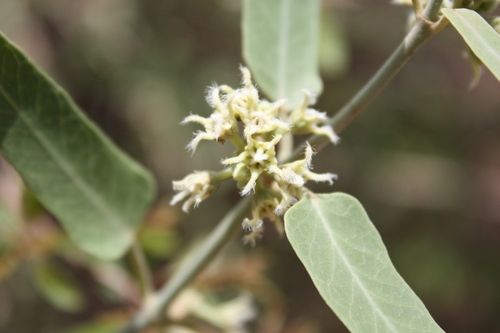
Normally a shrub. It can be partly a climber. It grows 3 m tall. It is evergreen, and spiny. The spines can have one or two forks. The leaves vary but are often egg shaped. They are 1-7 cm long by 0.8-3.5 cm wide. The tip has a small thorn-like point. Leaves are dark green above and paler underneath. The flowers are small and white. They have long tubes which flare out. They have a scent. They occur in clusters at the ends of twigs. The fruit are berries which are 1.6 cm long. They are purple-red. They contain 1-2 seeds. The fruit are bright red and edible.
Edible Uses
The fruit are eaten fresh, particularly by children, and are also used for drinks, as a flavouring, and as a preservative.
Traditional Uses
The fruit are eaten fresh. They are also used for drinks, as a flavouring and preservative.
This uses section is brief — help expand it
Distribution
A tropical plant. It occurs at medium to low altitude in dry woodland and coastal scrub. It is also at the edges of evergreen forest. It is damaged by drought and frost. In Malawi the variety grows from 1,250-2,150 m altitude. It can grow in arid places. It suits hardiness zones 10-11.
Where It Grows
Africa, Australia, Botswana, Cuba, East Africa, Eswatini, Kenya, Malawi, Mozambique, Namibia, South Africa*, Southern Africa, Swaziland, Tanzania, West Indies, Zimbabwe,
Cultivation
Plants can be grown from seed or cuttings. It can be grown as a hedge.
Propagation
Seed - best sown fresh, but can also be stored for a while. Half-ripe cuttings with a heel.
Other Uses
Very amenable to trimming, the plant is often grown as a hedge.
Other Information
The fruit are eaten especially by children.
Notes
There about 20 Carissa species. All Carissa species bear edible fruit. They grow in the tropics and subtropics.
Nutrition
| Part | Moisture | kJ | kcal | Protein | Vit A | Vit C | Iron | Zinc |
|---|---|---|---|---|---|---|---|---|
| Fruit | 81.6 | 292 | 70 | 0.7 | — | 10.6 | 0.8 | 0.4 |
Synonyms
Also Known As
Amatungula, Dithokolo, Hedge Thorn, Isibetankunzi, Isincum'ncum', Lucondvo, Mfumba, Mfumbeli, Morokolo, Mulu, Murabamungu, Murayangombe, Murungulu, Mutogwe, Natal Plum, Noem noem, Num-num, Olyamliyak, Red numnum, Serokolo, Simboka, Umbethankunzi, Umbethamtunzu, Umvusankunzi, Voatsikopika, Y-thorned carissa, Yum-yum
References (40)
- Akinola, R., et al, 2020, A Review of Indigenous Food Crops in Africa and the Implications for more Sustainable and Healthy Food Systems. Sustainability 2020, 12, 3493;
- Bircher, A. G. & Bircher, W. H., 2000, Encyclopedia of Fruit Trees and Edible Flowering Plants in Egypt and the Subtropics. AUC Press. p 84 (As Carissa arduina)
- Bodkin, F., 1991, Encyclopedia Botanica. Cornstalk publishing, p 215
- Burkill, I.H., 1966, A Dictionary of the Economic Products of the Malay Peninsula. Ministry of Agriculture and Cooperatives, Kuala Lumpur, Malaysia. Vol 1 (A-H) p 469 (As Carissa arduina)
- Cundall, P., (ed.), 2004, Gardening Australia: flora: the gardener's bible. ABC Books. p 331
Show all 40 references Hide references
- Cunningham 1985,
- Dale, I. R. and Greenway, P. J., 1961, Kenya Trees and Shrubs. Nairobi. p 44
- De Vynk, J. C., et al, 2016, Indigenous edible plant use by contemporary Khoe-San descendants of South Africa's Cape South Coast. South African Journal of Botany. 102 (2016) 60-69
- Etherington, K., & Imwold, D., (Eds), 2001, Botanica's Trees & Shrubs. The illustrated A-Z of over 8500 trees and shrubs. Random House, Australia. p 181
- Facciola, S., 1998, Cornucopia 2: a Source Book of Edible Plants. Kampong Publications, p 22
- Fox, F. W. & Young, M. E. N., 1982, Food from the Veld. Delta Books. p 88
- INFOODS:FAO/INFOODS Databases
- Jardin, C., 1970, List of Foods Used In Africa, FAO Nutrition Information Document Series No 2.p 125
- Joffe, P., 2007, Creative Gardening with Indigenous Plants. A South African Guide. Briza. p 216
- Long, C., 2005, Swaziland's Flora - siSwati names and Uses http://www.sntc.org.sz/flora/
- Lord, E.E., & Willis, J.H., 1999, Shrubs and Trees for Australian gardens. Lothian. p 211
- Magwede, K., van Wyk, B.-E., & van Wyk, A. E., 2019, An inventory of Vhavenḓa useful plants. South African Journal of Botany 122 (2019) 57–89
- Mannheimer, C. A. & Curtis. B.A. (eds), 2009, Le Roux and Muller's Field Guide to the Trees and Shrubs of Namibia. Windhoek: Macmillan Education Namibia. p 406
- Mem. New York Bot. Gard. 8:502. 1954 (R. L. Desfontaines, Tabl. Ecole bot. ed. 1:78. 1804, nom. nudum)
- Maroyi, A., 2011, The Gathering and Consumption of Wild Edible Plants in Nhema Communal Area, Midlands Province, Zimbabwe. Ecology of Food and Nutrition 50:6, 506-525
- Maroyi, A. & Cheikhyoussef, A., 2017, Traditional knowledge of wild edible fruit in southern Africa: A comparative use patterns in Namibia and Zimbabwe. Indian Journal of Traditional Knowledge. 16(3): 385-392
- Miguel, E., et al, 1989, A checklist of the cultivated plants of Cuba. Kulturpflanze 37. 1989, 211-357 (As Carissa arduina)
- Mokganya, M. G. et al, 2018, An evaluation of additional uses of some wild edible fruit plants of the Vhembe District Municipality in the Limpopo Province, South Africa. Indian Journal of Traditional Knowledge. Vol 17(2) April 2018, pp 276-281
- Mutie, F. M., et al, 2023, Important Medicinal and Food Taxa (Orders and Families) in Kenya, Based on Three Quantitative Approaches. Plants 2023, 12, 1145
- Palgrave, K.C., 1996, Trees of Southern Africa. Struik Publishers. p 782
- Palmer, E and Pitman, N., 1972, Trees of Southern Africa. Vol. 2. A.A. Balkema, Cape Town p1904
- Peters, C. R., O'Brien, E. M., and Drummond, R.B., 1992, Edible Wild plants of Sub-saharan Africa. Kew. p 57
- Royal Botanic Gardens, Kew (1999). Survey of Economic Plants for Arid and Semi-Arid Lands (SEPASAL) database. Published on the Internet; http://www.rbgkew.org.uk/ceb/sepasal/internet [Accessed 28th March 2011]
- Ruiters-Welcome, A. K., 2019, Food plants of southern Africa. Ph.D. thesis. Univ. of Johannesburg p 22
- Ruffo, C. K., Birnie, A. & Tengnas, B., 2002, Edible Wild Plants of Tanzania. RELMA p 186
- Schmidt, E., Lotter, M., & McCleland, W., 2007, Trees and shrubs of Mpumalanga and Kruger National Park. Jacana Media p 558
- Shava, S., 2000, The Use of Indigenous Plants as Food by a Rural Community in the Eastern Cape: an Educational Exploration. Masters Thesis Rhodes University. p 63
- Styger, E., et al, 1999, Indigenous fruit trees of Madagascar: potential components of agroforestry systems to improve human nutrition and restore biological diversity. Agroforestry Systems 46: 289-310 (As Carissa sessiliflora)
- Swaziland's Flora Database http://www.sntc.org.sz/flora
- van Wyk, Be, & Gericke, N., 2007, People's plants. A Guide to Useful Plants of Southern Africa. Briza. p 36
- Welcome, A. K. & Van Wyk, B.-E., 2019, An inventory and analysis of the food plants of southern Africa. South African Journal of Botany 122 (2019) 136–179
- White, F., Dowsett-Lemaire, F. and Chapman, J. D., 2001, Evergreen Forest Flora of Malawi. Kew. p 137
- World Checklist of Useful Plant Species 2020. Royal Botanic Gardens, Kew
- www.tradewindsfruit.com
- Young, J., (Ed.), 2001, Botanica's Pocket Trees and Shrubs. Random House. p 196