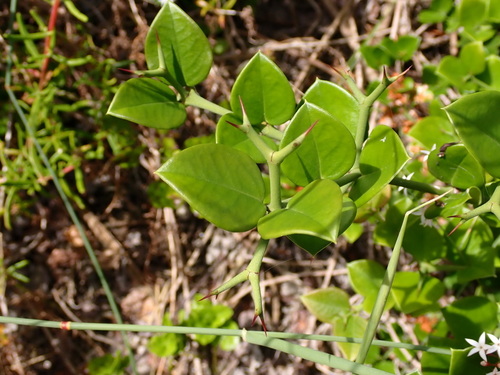
Asclepias curassavica
L.
Butterweed
iNaturalist· cc-by
(c) Ricard Busquets Reverte, some rights reserved (CC BY), uploaded by Ricard Busquets Reverte
iNaturalist· cc-by
(c) Tomás Carranza Perales, some rights reserved (CC BY), uploaded by Tomás Carranza Perales
iNaturalist· cc-by-sa
(c) Douglas Goldman, some rights reserved (CC BY-SA), uploaded by Douglas Goldman
Summary
Source: WikipediaAsclepias curassavica, commonly known as tropical milkweed, is a flowering plant species of the milkweed genus, Asclepias. It is native to the American tropics and has a pantropical distribution as an introduced species. Other common names include bloodflower or blood flower, cotton bush, hierba de la cucaracha, Mexican butterfly weed, redhead, scarlet milkweed, and wild ipecacuanha.
Description
An erect small shrub. It grows 60-90 cm high. The leaves are 13 cm long. They are narrowly oval and taper at both ends. The flowers are in clusters at the ends of branches. These are 5-10 cm across. They are orange and red. The fruit are spindle shaped pods.
Edible Uses
The plant is used to flavour tortillas in Mexico.
Traditional Uses
Caution: The plant is poisonous. It is used to flavour tortillas in Mexico.
This uses section is brief — help expand it
Medicinal Uses
The latex of the plant as well as the roots, leaves, and flowers are used medicinally. The root is febrifuge. A decoction is used in the treatment of dysentery and as an eyewash for infected eyes. The root contains a glycoside, asclepiadin, which is used as an emetic and purgative. It has been used as a substitute for ipecacuanha. A paste made of the crushed leaves, combined with salt, vegetable oil and bread, is used for treating skin ulcers. The plant contains an abundant white latex which is applied to warts and corns in order to kill them. The juice of the whole plant is used to treat ringworm, sores, rashes, dermatitis etc. The plant is considered cicatrizant (healing cuts etc by encouraging the formation of scars). The aerial parts of plant are sometimes used in the treatment of dysentery and as an eyewash for infected eyes. The root contains cardenolides with aglycones such as asclepogenine and curassavogenine. The latex contains cardenolides and esterified triterpenes. Extracts stimulate the central nervous system. The latex also contains quercetin, caffeic acid, sterols, flavonoids, carbohydrates, fatty acids and acidic mucilage. The plant contains beta-sitosterol, which is antihypercholesterolemic (reduces cholesterol), anti-prostatic, and oestrogenic.
Known Hazards
The root contains a glycoside, asclepiadin, which is emetic and purgative - in large doses it can cause death. The plant is suspected to be poisonous to grazing animals.
Distribution
It needs subtropical climates. It suits hardiness zones 8-11. In XTBG Yunnan. In Sichuan.
Where It Grows
Africa, Andaman Is., Argentina, Asia, Australia, Bahamas, Belize, Bolivia, Brazil, British Indian Ocean Terr., BIOT, Burkina Faso, Caribbean, Caroline Islands, Central America, Chile, China, Colombia, Comoros, Congo DR, Congo R., Cook Is., Costa Rica, Cuba, Cyprus, Dominica, Dominican Republic, East Africa, East Timor, Ecuador, El Salvador, Fiji, Grenada, French Guatemala, Guiana, Guianas, Guyana, Haiti, Hawaii, Honduras, India, Indochina, Indonesia, Iraq, Jamaica, Japan, Kenya, Kiribati, Laos, Madagascar, Marquesas, Mexico, Mozambique, Myanmar, Nepal, New Caledonia, Nicaragua, North America, Northeastern India, Pacific, Pakistan, Panama, Papua New Guinea, PNG, Paraguay, Peru, Puerto Rico, Rotuma, Samoa, Sao Tome and Principe, SE Asia, Senegal, Seychelles, Sierra Leone, Singapore, Slovenia, Solomon Islands, South America, Spain, Sri Lanka, Suriname, Taiwan, Tanzania, Thailand, Tibet, Timor-Leste, Trinidad-Tobago, Tuvalu, Uruguay, Venezuela, West Africa, West Indies*, Zambia, Zimbabwe,
Cultivation
It can be grown from seed or cuttings.
Propagation
Seed - surface sow and make sure the seeds are kept moist.
Other Uses
The stem fibres are used for spinning, partly in mixture with cotton. The seed hairs are used as a stuffing material for pillows. This is too elastic for spinning unless altered by chemical treatment after which it can be spun admixed with cotton. The stems are used, tied in bundles, as brooms.
Notes
It is used in medicine.
Synonyms
Also Known As
Bloodflower, Fanoromena, Kitseakanalika, Red head cotton bush, Scarlet milkweed, Svilnica, Treniombilahy, Truka-keree
References (14)
- Bodkin, F., 1991, Encyclopedia Botanica. Cornstalk publishing, p 106
- Cowie, I, 2006, A Survey of Flora and vegetation of the proposed Jaco-Tutuala-Lore National Park. Timor-Lests (East Timor) www.territorystories.nt/gov.au p 43
- Ekman Herbarium records Haiti
- Fowler, D. G., 2007, Zambian Plants: Their Vernacular Names and Uses. Kew. p 76
- Kew Plants of the World Online
Show all 14 references Hide references
- Parham, B. E. V., 1972, Plants of Samoa. New Zealand Department of Scientific and Industrial Research. Information Series. No. 85 p 100
- Plants of Haiti Smithsonian Institute http://botany.si.edu
- Franklin, J., Keppel, G., & Whistler, W., 2008, The vegetation and flora of Lakeba, Nayau and Aiwa Islands, Central Lau Group, Fiji. Micronesica 40(1/2): 169–225, 2008
- McLaughlin, J., Woody and Herbaceus Plants Native to Haiti. University of Florida. p 3
- Sp. pl. 1:215. 1753
- Thaman, R. R, 2016, The flora of Tuvalu. Atoll Research Bulletin No. 611. Smithsonian Institute p 66
- Topp, J. M. W., 1988, An Annotated Check List of the Flora of Diego Garcia, British Ocean Territory. Atoll Research Bulletin No. 313
- World Checklist of Useful Plant Species 2020. Royal Botanic Gardens, Kew
- Zuchowski W., 2007, Tropical Plants of Costa Rica. A Zona Tropical Publication, Comstock Publishing. p 81