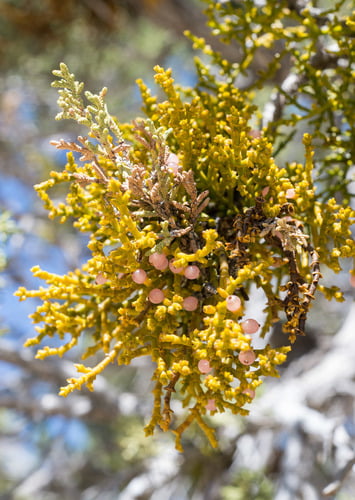
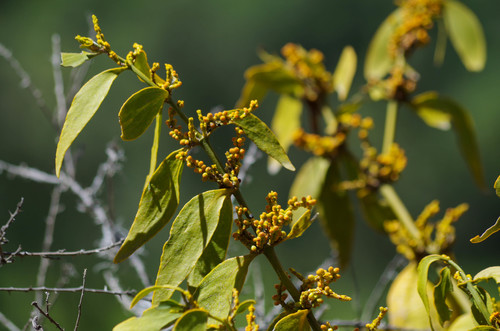
Viscum rotundifolium
L. f.
Red-berried mistletoe, Round-leaved mistletoe
iNaturalist· cc-by
(c) Marianne Le Roux, some rights reserved (CC BY), uploaded by Marianne Le Roux
iNaturalist· cc-by-nc
(c) fayne, some rights reserved (CC BY-NC), uploaded by fayne
iNaturalist· cc-by-nc
(c) Dewald du Plessis, some rights reserved (CC BY-NC), uploaded by Dewald du Plessis
Summary
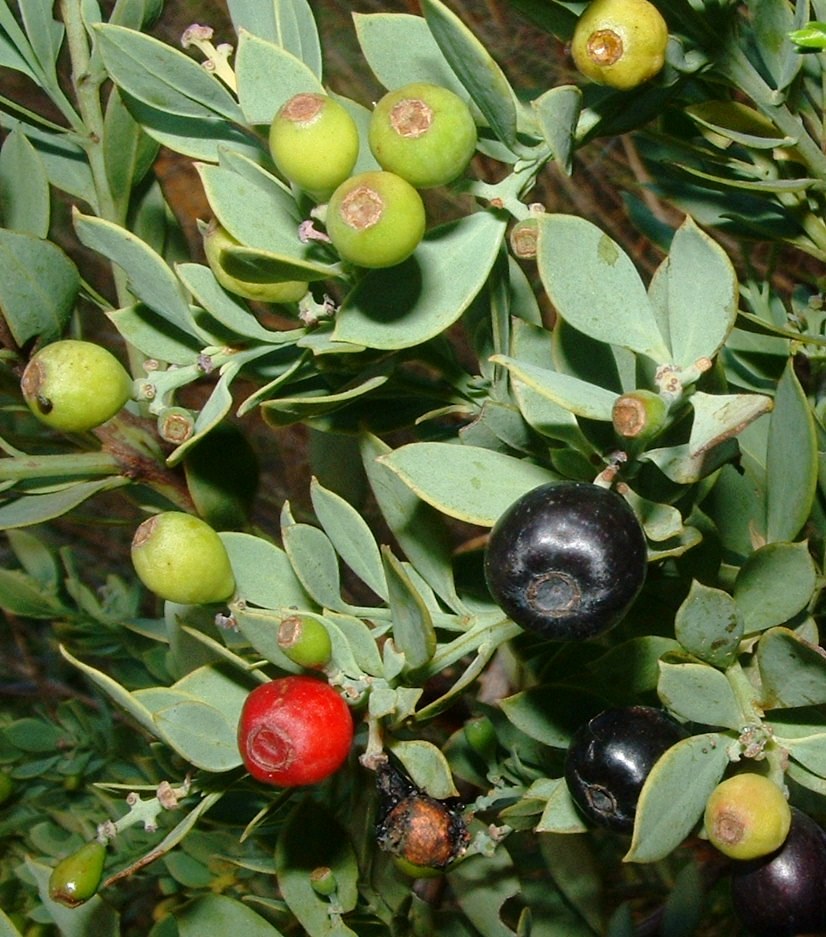
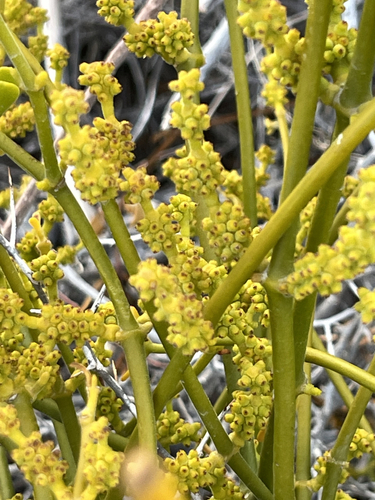
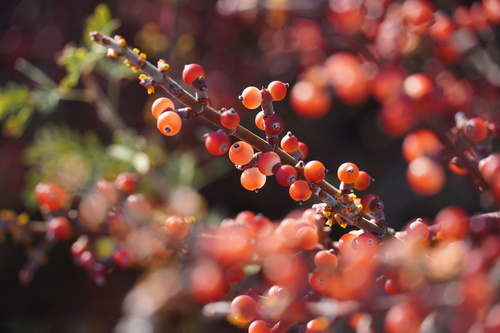
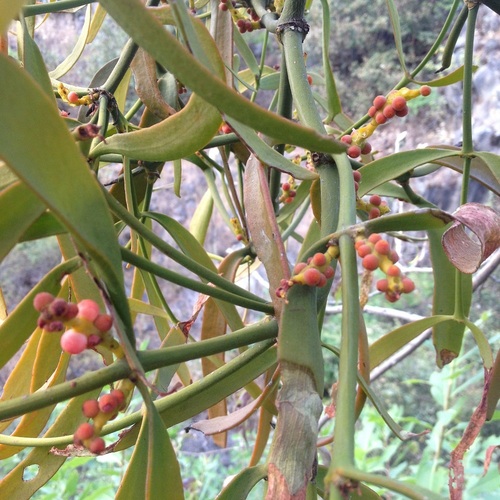
Source: WikipediaViscum rotundifolium, the red-berry mistletoe, is a variable, wide-ranging and monoecious mistletoe of southern Africa. It is a hardy, evergreen hemiparasite with a catholic variety of host plants, including other mistletoes. It may be found from near sea level to 1,950 m. Its fleshy, leathery leaves are dark or pale green and variable in shape, though usually broadly ovate to elliptic. While its creamy-green flowers are small and inconspicuous, the fruit are a brilliant, shiny orange-red colour when ripe. It is similar to V. schaeferi Engl. & K.Krause and V. pauciflorum L.f. with which it may be confused.
Description
An evergreen shrub that grows attached to other plants. It grows 50 cm high. It is a leafy plant often forming small round clusters. The leaves vary in shape from almost round to narrowly oval. They are 8-12 mm long by 4-8 mm wide. The fruit are bright red berries with a sticky pulp. They are 4-5 mm long.
Edible Uses
The bright red berries are eaten raw, particularly by children. The stems are used to make tea.
Traditional Uses
The fruit are eaten raw. The stems are used for tea.
This uses section is brief — help expand it
Medicinal Uses
The stems are used for tea.
Distribution
It is a subtropical plant. It grows in hot arid places with a marked dry season. It grows between 10-1,950 m above sea level.
Where It Grows
Africa, Angola, Botswana, Central Africa, East Africa, Eswatini, Lesotho, Namibia, South Africa, Southern Africa, Swaziland, Zimbabwe,
Other Information
The fruit are eaten especially by children.
Notes
It has also been put in the family Viscaceae.
Synonyms
Also Known As
Haires, Maias, Martak, Oviraura, Veolent
References (4)
- De Vynk, J. C., et al, 2016, Indigenous edible plant use by contemporary Khoe-San descendants of South Africa's Cape South Coast. South African Journal of Botany. 102 (2016) 60-69
- Ruiters-Welcome, A. K., 2019, Food plants of southern Africa. Ph.D. thesis. Univ. of Johannesburg p 100
- World Checklist of Useful Plant Species 2020. Royal Botanic Gardens, Kew
- Welcome, A. K. & Van Wyk, B.-E., 2019, An inventory and analysis of the food plants of southern Africa. South African Journal of Botany 122 (2019) 136–179