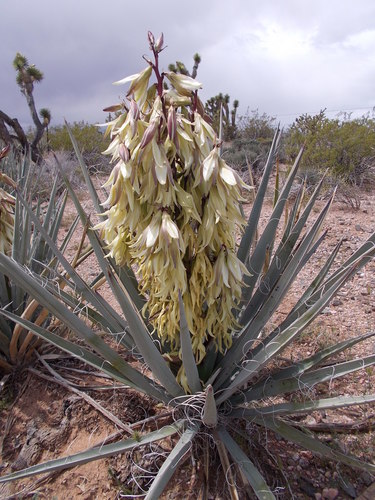
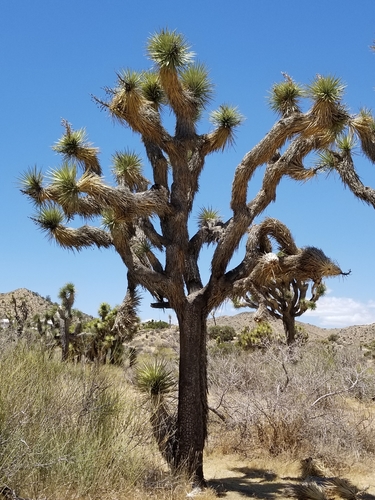
Dracaena pearsonii
(N. E. Br.) Byng & Christenh.
Spiky mother-in-law's tongue
wikimedia· cc0
Wikimedia Commons - Andrew Deacon
wikimedia· cc-by-sa
Wikimedia Commons - Tony Rebelo
Summary
Source: WikipediaDracaena pearsonii is a species of succulent plant native to Southern Africa. This species is in a complex of plants including Dracaena stuckyi and Dracaena angolensis that are characterized by their cylindrical leaves that grow upright in a spear-like habit. It grows in desert or dry shrubland, has thick rhizomes that produce offsets.
Description
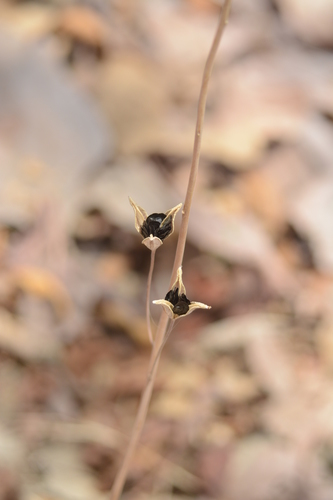
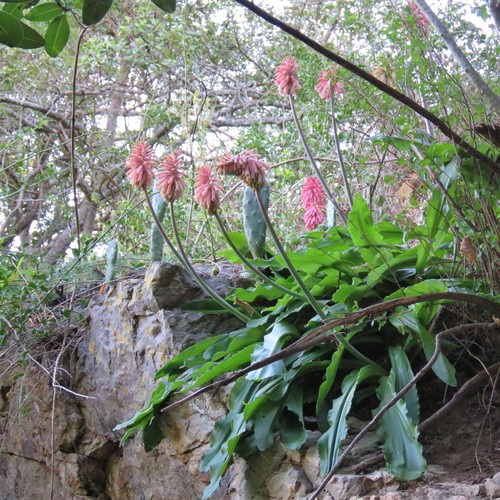
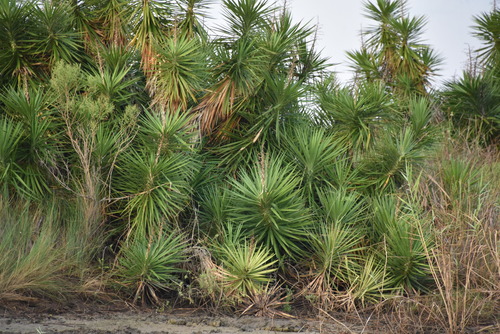
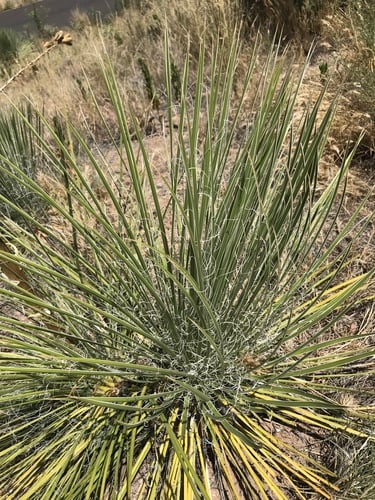
An evergreen shrub. It does not have an above ground stem but has underground stems or rhizomes. It keeps growing from year to year. It grows 1.2 m high. The leaves are succulent. They are erect and fleshy with a sharp spine at the end. They form a ring. They are 3 cm across. The flowers are white or light red. They are in clusters of up to 6. The fruit are bright orange berries on an erect flower stalk. The flower stalk can be 50-60 cm long.
Edible Uses
The roots are sucked for their moisture content.
Traditional Uses
The roots are sucked for their moisture.
This uses section is brief — help expand it
Distribution
It is a subtropical plant. It grows in hot arid places. It grows in loamy sands. It grows between 315-1,565 m above sea level. It can grow in arid places.
Where It Grows
Africa, Angola, Botswana, Central Africa, East Africa, Eswatini, Mozambique, Namibia, South Africa, Southern Africa, Swaziland, Tanzania, USA, Zambia, Zimbabwe,
Notes
Also put in the family Dracaenaceae.
Nutrition
| Part | Moisture | kJ | kcal | Protein | Vit A | Vit C | Iron | Zinc |
|---|---|---|---|---|---|---|---|---|
| Roots | 89.1 | 105 | 25 | 0.8 | — | 3.1 | 2.3 | 0.4 |
Synonyms
Also Known As
Gui, Mfughu-fughu, Ongushe
References (2)
- Royal Botanic Gardens, Kew (1999). Survey of Economic Plants for Arid and Semi-Arid Lands (SEPASAL) database. Published on the Internet; http://www.rbgkew.org.uk/ceb/sepasal/internet [Accessed 16th April 2011] (As Sansevieria pearsonii)
- World Checklist of Useful Plant Species 2020. Royal Botanic Gardens, Kew