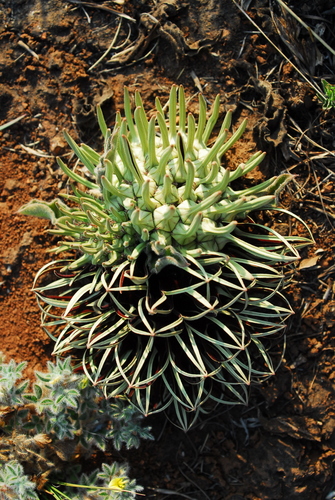
Caralluma adscendens var. fimbriata
(Roxb.) Haw., (Wall.) Grav. & Mayur.
iNaturalist· cc0
no rights reserved
iNaturalist· cc-by-nc
(c) Mayuresh Kulkarni, some rights reserved (CC BY-NC), uploaded by Mayuresh Kulkarni
iNaturalist· cc-by
(c) Shaunak Modi, some rights reserved (CC BY), uploaded by Shaunak Modi
Summary
Source: WikipediaCaralluma adscendens is a succulent plant in the family Apocynaceae. Its distribution ranges from India and Sri Lanka through the Arabian peninsula to North Africa and the Sahel.
Description
An erect branched herb. It is succulent. It grows 20-30 cm tall. The stems are leafless. They are 4 angled and fleshy. They are green and taper to a point. The leaves are very small and only on young branches. The flowers are at the ends of branches. They can occur singly or at 2-3 together. The flowers are like wheels and are 2 cm across. The petals are purple with yellow markings.
Edible Uses
Caralluma adscendens (Chong) has been eaten in rural India for centuries, raw, as a vegetable with spices, or preserved in chutneys and pickles, and is often found as a roadside shrub or boundary marker.
Traditional Uses
The whole plant is boiled in water then eaten with salt and chilli. It is used as a vegetable. It is used as a thirst quencher and is supposed to suppress hunger.
Distribution
A tropical plant. It grows in Rajasthan on the Deccan. It grows at aAn erect succulent plant. It looks like a small cactus. n altitude of 600-900 metres.
Where It Grows
Asia, India, Pakistan,
Other Information
It is a famine food.
Notes
There are about 56-100 Caralluma species. These are sometimes put in the Asclepiadaceae.
Synonyms
Also Known As
Kaarallamu, Kallimudayan, Kullee mooliyan, Kundelu kommulu, Maakada singi, Makaadsing, Makad shenguli, Makadsinghi, Makedshingi, Mangana kodu, Pamankey, Ranshabar, Shindamakad, Shindala makadi, Shingoli, Vajra che baji, Yugmaphallottama
References (13)
- Ambasta S.P. (Ed.), 2000, The Useful Plants of India. CSIR India. p 104 (As Caralluma fimbriata)
- Barkatullah & Ibrar, M., 2011, Plants profile of Malakand Pass Hills, District Malakand, Pakistan. African Journal of Biotechnology Vol. 10(73) pp. 16521-16535 (As Caralluma fimbriata)
- Barkatullah and Ibrar, M., 2011, Plants profile of Malakand Pass Hills, District Malakand, Pakistan. African Journal of Biotechnology Vol. 10 (73) pp. 16521-16535 (As Caralluma fimbriata)
- Datar, M. N. & Upadhye, A. S., 2015, Forest foods of Northern Western Ghats: Mode of Consumption, Nutrition, and Availability. Asian Agri-History Vol. 19, No. 4, 2015 (293–316)
- Dobriyal, M. J. R. & Dobriyal, R., 2014, Non Wood Forest Produce an Option for Ethnic Food and Nutritional Security in India. Int. J. of Usuf. Mngt. 15(1):17-37 (As Caralluma fimbriata)
Show all 13 references Hide references
- GAMMIE,
- Jadhav, R., et al, 2015, Forest Foods of Northern Western Ghats: Mode of Consumption, Nutrition and Availability. Asian Agri-History Vol. 19, No. 4: 293-317
- Sharma, B.D., & Lakshminarasimhan, P., 1986, Ethnobotanical Studies on the Tribals of Nasik District (Maharashtra). J. Econ. Tax. Bot. Vol. 8 No. 2 pp 439-446
- Singh, H.B., Arora R.K.,1978, Wild edible Plants of India. Indian Council of Agricultural Research, New Delhi. p18, 78 (As Caralluma fimbriata)
- SWARUPANANDAN,
- Vartak, V.D. and Kulkarni, D.K., 1987, Monsoon wild leafy vegetables from hilly regions of Pune and neighbouring districts, Maharashtra state. J. Econ. Tax. Bot. Vol. 11 No. 2 pp 331-335 (As Caralluma fimbriata)
- WATT.
- www.theplantlist.org