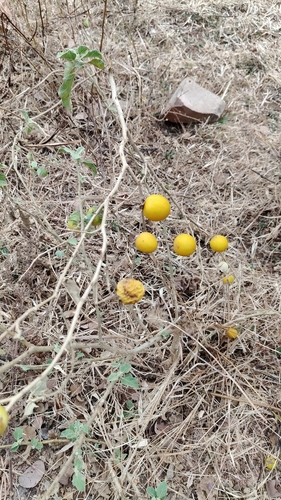
Capsicum baccatum var. pendulum
(Willdenow) Eshbaugh
Brown's pepper, Peruvian pepper
gbif· cc-by-nc
Maria Luiza Bohnemberger
gbif· cc-by-nc
Maria Luiza Bohnemberger
gbif· cc-by-nc
Andres Castro Palmer
Summary
Source: WikipediaCapsicum baccatum, also simply referred to as ají (Spanish: [aˈxi]), is a member of the genus Capsicum, and is one of the five domesticated chili pepper species. The fruit tends to be very pungent and registers 30,000 to 50,000 on the Scoville heat unit scale.
Description
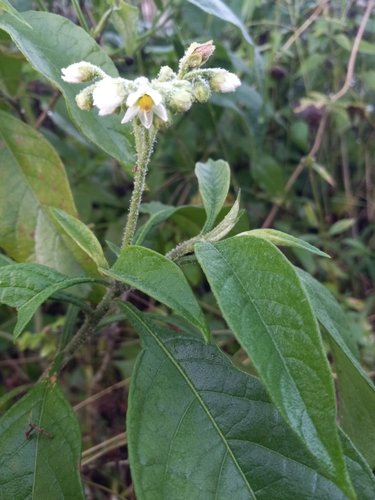
A shrub. It grows 1-1.2 m high. The leaves have 3 leaflets. The leaflets are 6-7 cm long by 4-5 cm wide. The base is unequal and it tapers to the tip. The flowers are in the axils of leaves. They are white. The fruit is 10-15 cm long by 3-4 cm wide. There are many seeds.
Edible Uses
The C. baccatum species, notably the ají amarillo chili, has its origins in ancient Peru and across the Andean region of South America. It is typically associated with Peruvian cuisine, and is considered part of its condiment trinity together with red onion and coriander. Ají amarillo literally means "yellow chili"; however, the yellow color appears only when cooked, as the mature pods are bright orange. Ají amarillo is one of the ingredients of Peruvian and Bolivian cuisines. It is used as a condiment, especially in many dishes and sauces. In Peru, the chilis are mostly used fresh, and in Bolivia, dried and ground. Common dishes with ají amarillo are the Peruvian stew ají de gallina ("hen chili"), Papa a la Huancaína, and the Bolivian fricasé Paceño, among others. In Ecuadorian cuisine, ají amarillo, onion, and lemon juice (amongst others) are served in a separate bowl with many meals as an optional condiment. In Colombian, Peruvian, and Ecuadorian cuisines, ají sauce is also a common condiment. The Ají Amarillo pepper has been named the "Flavor of the Year" for 2025 by McCormick & Company, a prominent spice company. This pepper is expected to see a 59% increase in menu appearances over the next four years. Capsicum baccatum var. pendulum, popularly known as dedo-de-moça (lady-finger) is specially used on Brazilian cuisine, specially in the South and Southeast regions.
Distribution
A tropical plant. It can tolerate cooler conditions.
Where It Grows
Argentina, Asia, Bolivia, Brazil, Central America, Chile, Colombia, Costa Rica, Ecuador, Europe, Hawaii, India, Japan, North America, Pacific, Peru, South America, USA,
Notes
There are 10 Capsicum species.
Synonyms
Also Known As
Aji colla
References (9)
- Brown, D., 2002, The Royal Horticultural Society encyclopedia of Herbs and their uses. DK Books. p 155
- Purseglove, J.W., 1968, Tropical Crops Dicotyledons, Longmans. p 526
- Samuels, J., 2015, Biodiversity of Food Species of the Solonaceae Family: A Preliminary Taxonomic Inventory of Subfamily Solanoideae. Resources 2015, 4. 277-322
- Seidemann J., 2005, World Spice Plants. Economic Usage, Botany, Taxonomy. Springer. p 83
- Small, E., 2009, Top 100 Food Plants. The world's most important culinary crops. NRC Research Press. p 177
Show all 9 references Hide references
- Staples, G.W. and Herbst, D.R., 2005, A tropical Garden Flora. Bishop Museum Press, Honolulu, Hawaii. p 532
- Vasquez, Roberto Ch. & Coimbra, German S., 1996, Frutas Silvestres Comestibles de Santa Cruz. p 222
- Taxon 17:51-52. 1968
- Wiersema, J. H. & Leon, B., 2013, World Economic Plants. A Standard Reference CRC Press. 2nd Ed. p 141