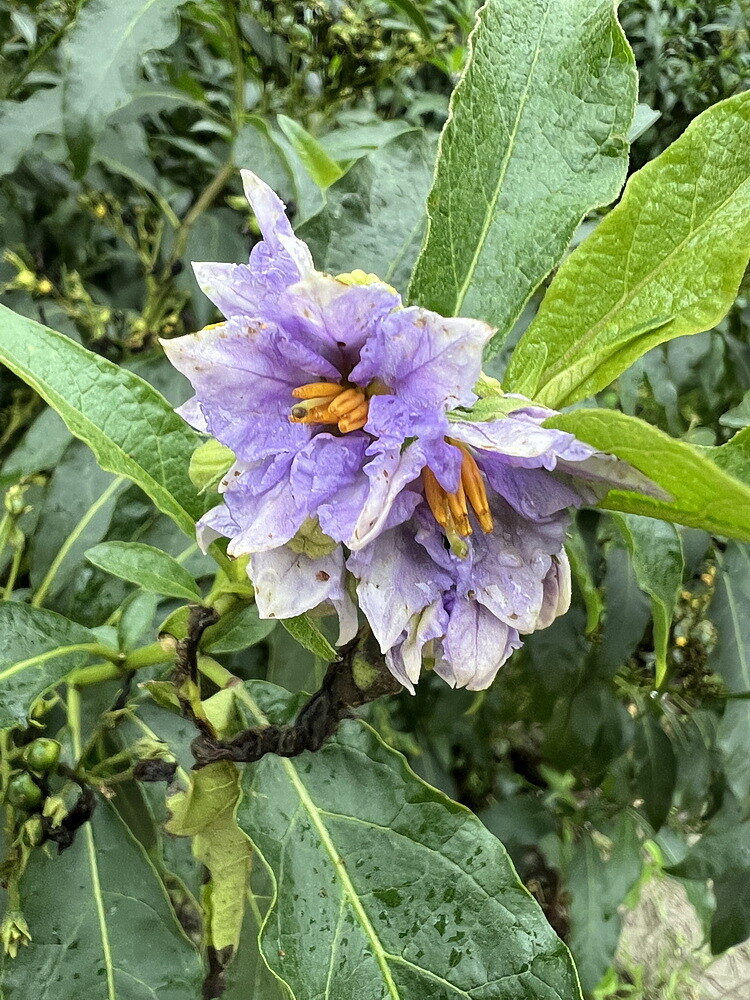
Solanum betaceum
Cav.
iNaturalist· cc-by-nc
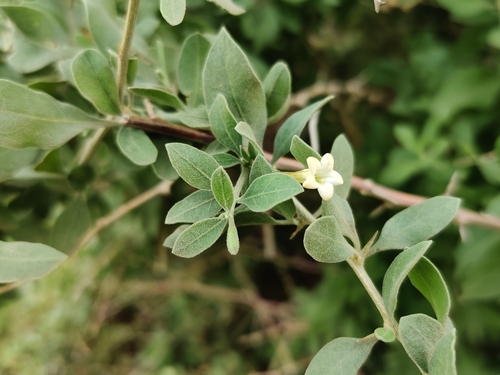
(c) Juan Peña, some rights reserved (CC BY-NC), uploaded by Juan Peña
iNaturalist· cc-by
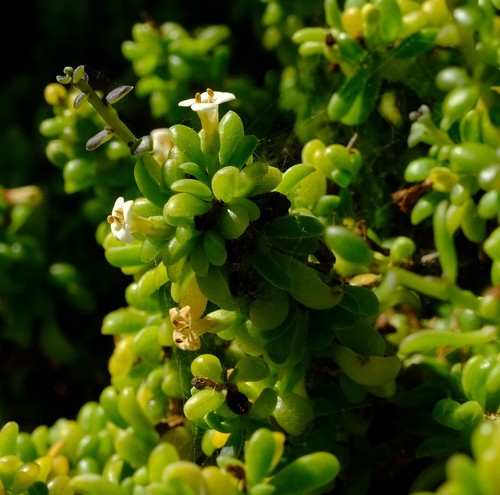
(c) Abril Bastons, some rights reserved (CC BY)
iNaturalist· cc-by
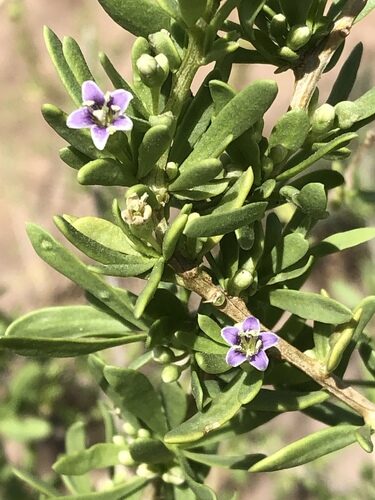
(c) Abril Bastons, some rights reserved (CC BY)
Description
A shrub. The commonly used same is Cyphomandra betacea. See under that name.
This description is brief — help expand it
Edible Uses
The fruit is eaten by scooping the flesh from a halved fruit. When lightly sugared and chilled, the flesh is used for a breakfast dish. Some people in New Zealand cut the fruit in half, scoop out the pulpy flesh and spread it on toast. Yellow-fruited cultivars have a sweeter flavor, occasionally compared to mango or apricot. The red-fruited variety, which is much more widely cultivated, is more tart, and the savory aftertaste is far more pronounced. In the Northern Hemisphere, tamarillos are most frequently available from July until November, and fruits early in the season tend to be sweeter and less astringent. In the highlands of Ecuador, yellow tamarillos are used in ceviche and condiments, and the red varieties for desserts. The hydroethanolic extract of the purple variety seeds has been found to be genotoxic, so macerations should only be done with the pulp. They can be made into compotes, or added to hollandaise, chutneys and curries. Desserts using this fruit include bavarois and, combined with apples, a strudel. In Colombia, Ecuador, Panama, Venezuela, and parts of Indonesia (including Sumatra and Sulawesi), fresh tamarillos are frequently blended together with water and sugar to make a juice. It is also available as a commercially pasteurized purée. In Nepal, a version of the South American fruit is very popular. It is typically consumed as a chutney or a pickle during the autumn and winter months. It is known as Tyamtar and Ram Bheda. The fruit is boiled or roasted in open fire till the skin breaks and then mashed with chillies, timur, garlic and other spices of choice. Similar to Nepal, the Indian regions of Ooty, Darjeeling and Sikkim also consume Tamarillo. In Northeast India, it is roasted and chutneys are made with it by blending roasted or fried dried or fermented fish, chillies and garlic. In Ecuador, the tamarillo, known as tomate de árbol, is blended with chili peppers to make a hot sauce commonly consumed with local dishes of the Andean region. The sauce is simply referred to as ají and is present at a wide variety of meals in Ecuador. In Rwanda, tree tomatoes are often served alongside other tropical fruits, such as mango and pineapple. In Yunnan, China, the Dai people make a tamarillo nanpie, a sauce like dish made with roasted tamarillo, sawtooth coriander, chillies and garlic. The flesh of the tamarillo is tangy and variably sweet, with a bold and complex flavor, and may be compared to kiwifruit, tomato, guava, or passion fruit. The skin and the flesh near it have a bitter taste and are not usually eaten raw. The tamarillo has been described as having a taste similar to that of a passion fruit and a piquant tomato combined. The red and purple types of fruits are preferred in import countries of Europe: Even though they taste more acidic, their color is favoured by consumers.
Traditional Uses
The fruit are cooked as a vegetable or used to make chutney.
This uses section is brief — help expand it
Medicinal Uses
The leaves are used to treat inflammation of the liver[1783[. The leaves are warmed then wrapped around the neck as a remedy for sore throat. The juice is used to treat anaemia and tonsillitis. The fruit pulp, after having been cooked in embers, is used as a poultice for inflamed tonsils. The plant was known as 'vegetable mercury' in Jamaica because of its presumed therapeutic value to the liver.
Known Hazards
The unripe fruit is slightly toxic. Although providing many well-known foods for people, including the potato, tomato, pepper and aubergine, most species in this genus also contain toxic alkaloids. Whilst these alkaloids can make the plant useful in treaing a range of medical conditions, they can also cause problems such as nausea, vomiting, salivation, drowsiness, abdominal pain, diarrhoea, weakness and respiratory depression. Unless there are specific entries with information on edible uses, it would be unwise to ingest any part of this plant.
Distribution
It is a subtropical plant.
Where It Grows
Africa, Andes, Argentina, Asia, Bolivia, Brazil, Britain, Cape Verde, Central America, Colombia, Ecuador, Europe, France, India, Indonesia, Mediterranean, Mexico, Myanmar, New Zealand, Northeastern India, Peru, Portugal, SE Asia, South Africa, Southern Africa, South America, Spain, West Indies,
Cultivation
Plants grow best at low elevations in the subtropics and medium to higher elevations in the tropics, where they can succeed at elevations up to 2,800 metres. They grow best in areas where annual daytime temperatures are within the range 16 - 22°c, but can tolerate 10 - 30°c. They can be killed by temperatures of -2°c or lower. They prefer a mean annual rainfall in the range 2,000 - 2,600mm, but tolerate 600 - 4,000mm. Plants are probably insensitive to day-length. Succeeds in a sunny position in any well-drained soil. Prefers a light, mildly acid, fertile soil. Prefers a pH in the range 6.3 - 7, tolerating 5.8 - 7.5. Dislikes drought. Plants are very prone to wind damage. Plants have a shallow spreading root system and resent surface hoeing, they are best given a good mulch. A very fast growing plant, it starts to fruit within two years from seed and reaches peak production in 3 - 4 years. Trees are, however, short-lived - the life of a commercial plantation is about 8 years. Plants grow, flower and fruit best in areas where there is a distinct cooling of a night time - the fruit also develop a better flavour. Plants usually ripen their fruit over a period of time, though pruning methods can be used to produce a peak time of fruiting. Trees can flower and fruit all year round. Yields of about 20 kilos of fruit per tree per year, equating to 15 - 17 tonnes per hectare, are achieved in New Zealand. There are some named varieties. This species does not hybridize easily with other members of the genus. The leaves are large and have a pungent smell. Plants are subject to attacks by red spider mites.
Propagation
Seed - usually germinates within 4 weeks at 15°c, within 2 weeks at 25°c. When they are large enough to handle, prick the seedlings out into individual pots and grow them on until large enough to plant out. Cuttings of greenwood.
Other Uses
The unripe fruits contain tannins. The leaves have been used as a dye. The plant can be grown with crops such as coffee[303. Green manure or cover crops of grass and clover can be grown between rows. New Zealand growers often plant this species as an intercrop in young citrus orchards.
Production
In NE India fruit are available November to January.
Other Information
It is cultivated.
Synonyms
Also Known As
Ookhamen, Tomate de laguna
References (14)
- Duarte, M. C., et al, 2022, Diversity of Useful Plants in Cabo Verde Islands: A Biogeographic and Conservation Perspective. Plants 2022, 11, 1313 p 16
- Grandtner, M. M. & Chevrette, J., 2013, Dictionary of Trees, Volume 2: South America: Nomenclature, Taxonomy and Ecology. Academic Press p 614
- INFOODSUpdatedFGU-list.xls
- INFOODS:FAO/INFOODS Databases
- Konsam, S., et al, 2016, Assessment of wild leafy vegetables traditionally consumed by the ethnic communities of Manipur, northeast India. Journal of Ethnobiology and Ethnomedicine, 12:9
Show all 14 references Hide references
- Roa, J. A. G. & Boada, D. S. G., 2018, Fundación para el Fortalecimiento de la Fruticultura y Plantas Alimenticias no Convencionales en Colombia.
- Ruiters-Welcome, A. K., 2019, Food plants of southern Africa. Ph.D. thesis. Univ. of Johannesburg p 103
- Samuels, J., 2015, Biodiversity of Food Species of the Solonaceae Family: A Preliminary Taxonomic Inventory of Subfamily Solanoideae. Resources 2015, 4. 277-322
- Segura, S., et al, 2018, The edible fruit species in Mexico. Genet Resour Crop Evol (2018) 65:1767–1793
- Suwardi, A. B., et al, 2020, Wild edible fruits generate substantial income for local people of the Gunung Leuser National Park, Aceh Tamiang Region. Ethnobotany Research & Applications 20:11
- Torre, de la, L., et al, 2008, Enciclopedia de las Plantas Útiles del Ecuador. Herbario QCA. Pontificia Universidad Católica del Ecuador. p 589
- Welcome, A. K. & Van Wyk, B.-E., 2019, An inventory and analysis of the food plants of southern Africa. South African Journal of Botany 122 (2019) 136–179
- Wiersema, J. H. & Leon, B., 2013, World Economic Plants. A Standard Reference CRC Press. 2nd Ed. p 642
- World Checklist of Useful Plant Species 2020. Royal Botanic Gardens, Kew