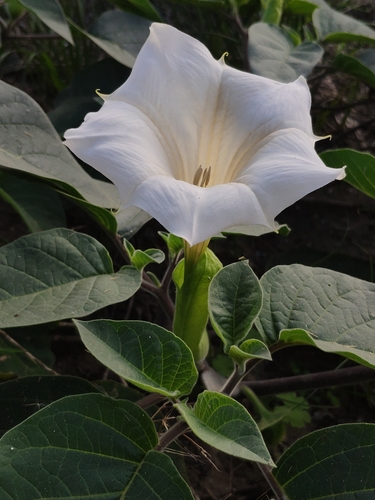
Solanum boreale
(A. Gray) Bitter
Fendler's Horse-nettle
wikimedia· cc0
Wikimedia Commons - Clements, Edith S.; Clements, Edith S.
Summary
A perennial with hermaphroditic insect-pollinated flowers. Grows in well-drained light sandy, medium loamy, or heavy clay soils across mildly acidic to mildly alkaline pH levels. Demands full sun exposure and consistently moist conditions.
Description
A perennial with hermaphroditic insect-pollinated flowers. Grows in well-drained light sandy, medium loamy, or heavy clay soils across mildly acidic to mildly alkaline pH levels. Demands full sun exposure and consistently moist conditions.
Edible Uses
The root is eaten cooked.
Medicinal Uses
None known.
Distribution
It is a temperate plant.
Where It Grows
North America, USA,
Propagation
Seed - sow early spring in a warm greenhouse. Prick out seedlings into a fairly rich compost as soon as they are large enough to handle and grow on quickly. Plant out after the last expected frosts. Division. Harvest tubers in autumn after top-growth has been cut back by frost. Store in a cool, frost-free place over winter and replant in April.
Other Uses
None known.
Notes
There are about 1400 Solanum species.
References (4)
- Beckstrom-Sternberg, Stephen M., and James A. Duke. "The Foodplant Database." http://probe.nalusda.gov:8300/cgi-bin/browse/foodplantdb.(ACEDB version 4.0 - data version July 1994)
- Plants for a Future database, The Field, Penpol, Lostwithiel, Cornwall, PL22 0NG, UK. http://www.scs.leeds.ac.uk/pfaf/
- Repert. Spec. Nov. Regni Veg. 11:459. 1912
- Saunders, C.F., 1948, Edible and Useful Wild Plants. Dover. New York. p 9