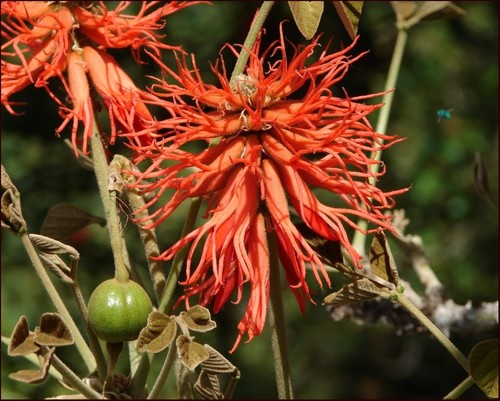
Canavalia gladiata
(Jacq) DC.
Sword bean
iNaturalist· cc-by-sa
(c) Kenpei, some rights reserved (CC BY-SA)
iNaturalist· cc-by
(c) Siddarth Machado, some rights reserved (CC BY), uploaded by Siddarth Machado
iNaturalist· cc-by-sa
(c) Vmenkov, some rights reserved (CC BY-SA)
Summary
Source: WikipediaCanavalia gladiata, the sword bean or scimitar bean, is a domesticated plant species in the legume family Fabaceae. It is used as a vegetable in interior central and south central India, though not commercially farmed. The unripe pods are also eaten as a vegetable in Africa and Asia. The term "sword bean" is also used for other legumes, notably the common jack bean Canavalia ensiformis.
Description
A climbing or sometimes bushy and upright bean plant. Mostly it is a climber. It can be 4 m long. The leaves have 3 large leaflets. The leaflets are oval and 7.5-20 cm long by 5-12 cm wide. The top of the leaf can narrow abruptly to a tip while the base can be rounded or broadly wedge shaped. The leaves are slightly hairy on both surfaces. The leaf stalk is 5-12 cm long. The flowers are in groups and are white. The flower cluster is 7-12 cm long and the flower cluster stalk 4-20 cm long. The individual flower stalks are 2 mm long. The pods are long (20-40 cm) and curved. Seeds are coloured red or pink. The hilum is dark brown and almost as long as the seed.
Edible Uses
Young seedpods can be eaten raw but are more commonly cooked as a vegetable. Each pod is 20–30cm long and 2cm wide. The seeds must be thoroughly boiled to destroy a toxic alkaloid; the seedcoats are often removed first, and the seeds are then cooked in two or three changes of water. Large pods, 30–45cm long, are produced toward the end of summer, and the seeds swell gradually over several weeks — they fatten much more slowly than peas. It takes practice to judge when they are fully matured, otherwise little food is obtained from each pod. They make a useful haricot bean alternative.
Traditional Uses
Young pods are cooked and eaten. Seeds can be cooked and eaten, but the water should be changed and they should be well boiled. They are also fermented. The seeds can be toasted and ground and used as a coffee substitute. The leaves are blanched and eaten. CAUTION The seeds can be poisonous due to hydrocyanic acid and saponin. Cooking will remove these.
Medicinal Uses
Urease is extracted from the seed for use in clinical laboratories for the in-vitro determination of urea in human blood. In Korea, the plant is used to treat vomiting, abdominal dropsy, kidney-related lumbago, asthma, obesity, stomach-ache, dysentery, coughs, headache, intercostal neuralgia, epilepsy, schizophrenia, inflammatory diseases, and swellings. A soap based on sword bean extracts is marketed there for treating athlete's foot and acne. In Japan, the plant is used to treat ozena, haemorrhoids, pyorrhoea, otitis media, boils, cancers, all kinds of inflammatory diseases, and atopic dermatitis.
Known Hazards
Despite nutritional potential in terms of protein content sword beans are not used as food. This is partly due to the presence of harmful factors such as haemagglutinis (concanavalin A), protease inhibitors, hydrocyanic acid, tannins, phytates and canavanine. Canavanine is contained in the seeds of the plants (the content is 10–13%). It interferes with protein synthesis and has a nutrition-inhibiting effect on animals and humans. Soaking overnight and boiling in excess water followed by decanting resulted in the greatest reduction in canavanine content (approx. 50%), followed by boiling and decanting in excess water (34%).
Distribution
A tropical plant. It requires a tropical climate. Temperatures of 20-30°C suit it well and it grows from sea level to about 1000 m altitude in equatorial zones. They are drought and salt resistant. They can grow on lowland tropical nutrient depleted soils. They can grow on soils with pH from 4.5-7.0. They can tolerate some shade. In Yunnan.
Where It Grows
Africa, Angola, Argentina, Asia, Australia, Bangladesh, Benin, Brazil, Burundi, Cambodia, Central Africa, Central America, China, Congo DR, Cuba, East Africa, Fiji, Ghana, Guadeloupe, Guatemala, Guianas, Haiti, Hawaii, Honduras, India, Indochina, Indonesia, Jamaica, Japan, Korea, Laos, Madagascar, Malaysia, Mauritius, Mexico, Mozambique, Myanmar, Nigeria, North America, Northeastern India, Pacific, Panama, Papua New Guinea, PNG, Paraguay, Philippines, SE Asia, Seychelles, Singapore, Solomon Islands, South Africa, Southern Africa, South America, Sri Lanka, Suriname, Taiwan, Tanzania, Thailand, USA, Vietnam, West Africa, West Indies, Zambia, Zimbabwe,
Cultivation
They are grown from seeds. Seeds germinate readily and the plant is relatively fast growing. Seeds can be sown 5 cm deep. Plants should be 60-70 cm apart. Climbing types need support. Often natural supports such as trees, walls and fences are used in backyard production. For large scale production 25-40 kg/ha of seed are needed.
Propagation
Sow seed in situ, placing seeds 2–3cm deep in the soil. Germination occurs in approximately 72 hours.
Other Uses
The plant is sometimes grown as a green manure crop or temporary ground cover, and is also used as an ornamental climber on fences and houses, though it is short-lived. It is believed to repel snakes. The seed is used as feed for cattle and chickens, but dry seeds consumed in considerable quantity may cause poisoning.
Production
Green seeds/pods are produced in 3-4 months and mature seeds in 5-10 months. Seed yields of 700-900 kg/ha are possible. Green pods are hand picked when 10-15 cm long before they swell and become fibrous.
Other Information
It is a commercially cultivated vegetable. Pods are sold in local markets. Only occasionally grown in Papua New Guinea.
Notes
There are about 50 Canavalia species.
Nutrition
| Part | Moisture | kJ | kcal | Protein | Vit A | Vit C | Iron | Zinc |
|---|---|---|---|---|---|---|---|---|
| Seeds | 15 | 1335 | 319 | 27.1 | — | — | — | — |
| Fresh Pods | 89 | 142 | 34 | 2.8 | — | — | — | — |
| Leaves | — | — | — | — | — | — | — | — |
Synonyms
Also Known As
Abai, Abbo, Alad, Baikang, Baikng, Bara sem, Bo ba ji noe, Bon shim, Carabanz, Chemma kaaya, Dau-rua, Frijol cafe, Frijol de machete, Ghevada, Habas, Jangli Sem, Jungli abhui, Kacang parasman, Kacang polong, Kachang hantu, Kachang nyonya, Kachang parang, Kaos parasman, Kara pedang, Kara wedung, Koas bakol, Lal kadsumbal, Madezo, Magtambokau, Makhan shim, Moushim, Naga sem, Nam-nawbaw, Namtaipee, Nkasa, Pe-dalet, Pe-dama, Pe-damouk, Pe-det, Pe-gale, Pe-naung-ni, Rar bu-shot kwen-e, Sanndaek triehs, Scimitar-bean, Segapu thambattai, Sem, Shembi avare, Tarvardi, Thampattai, Thua phraa, Tioeuhs, Tua pra, Tumbekai, Yerra tamma
References (67)
- Sword bean references Canavalia gladiata
- Ambasta S.P. (Ed.), 2000, The Useful Plants of India. CSIR India. p 101
- Arinathan, V., et al, 2007, Wild edibles used by Palliyars of the western Ghats, Tamil Nadu. Indian Journal of Traditional Knowledge. 6(1) pp 163-168
- BARC, 2016, State of Biodiversity for Food and Agriculture in Bangladesh. Bangladesh Agricultural Research Council.
- Bircher, A. G. & Bircher, W. H., 2000, Encyclopedia of Fruit Trees and Edible Flowering Plants in Egypt and the Subtropics. AUC Press. p 80
Show all 67 references Hide references
- Biswas, S. C., et al, 2018, Diversity of wild edible minor fruits used by the ethnic communities of Tripura, India. Indian Journal of Traditional Knowledge. Vol 17(2), April 2018, pp 282-289
- Bosch, C.H., 2004. Canavalia gladiata (Jacq.) DC. [Internet] Record from Protabase. Grubben, G.J.H. & Denton, O.A. (Editors). PROTA (Plant Resources of Tropical Africa), Wageningen, Netherlands. < http://database.prota.org/search.htm>. Accessed 14 October 2009.
- Brown,
- Burkill, H. M., 1985, The useful plants of west tropical Africa, Vol. 3. Kew.
- Burkill, I.H., 1966, A Dictionary of the Economic Products of the Malay Peninsula. Ministry of Agriculture and Cooperatives, Kuala Lumpur, Malaysia. Vol 1 (A-H) p 438.
- Cobley, L.S. (rev. Steele, W.M.) 2nd Ed., 1976, An Introduction to the Botany of Tropical Crops. Longmans. p 102
- Deb, D., et al, 2013, Wild Edible Plants and Their Utilization in Traditional Recipes of Tripura, Northeast India. Advances in Biological Research 7(5):203-211
- Duke, J. A., 1981. Handbook of legumes of world economic importance. Plenum Press, New York. 345pp
- Facciola, S., 1998, Cornucopia 2: a Source Book of Edible Plants. Kampong Publications, p 103
- Fowler, D. G., 2007, Zambian Plants: Their Vernacular Names and Uses. Kew. p 36
- French, B.R., 1986, Food Plants of Papua New Guinea, A Compendium. Asia Pacific Science Foundation p 44
- French, B.R., 2010, Food Plants of Solomon Islands. A Compendium. Food Plants International Inc. p 58
- Grubben, G. J. H. and Denton, O. A. (eds), 2004, Plant Resources of Tropical Africa 2. Vegetables. PROTA, Wageningen, Netherlands. p 151
- Hani Medicine of Xishuangbanna, 1999, p 511
- Henty, E.E., 1980, Harmful Plants in Papua New Guinea. Botany Bulletin No 12. Division Botany, Lae, Papua New Guinea. p 79
- Hossain, U. & Rahman, A., 2018, Study and quantitative analysis of wild vegetable floral diversity available in Barisal district, Bangladesh. Asian J. Med. Biol. Res. 2018, 4 (4), 362-371
- Hu, Shiu-ying, 2005, Food Plants of China. The Chinese University Press. p 469
- ILDIS Legumes of the World http:www:ildis.org/Legume/Web
- Jacquat, C., 1990, Plants from the Markets of Thailand. D.K. Book House p 47
- Jadhav, R., et al, 2015, Forest Foods of Northern Western Ghats: Mode of Consumption, Nutrition and Availability. Asian Agri-History Vol. 19, No. 4: 293-317
- Japanese International Research Centre for Agricultural Science www.jircas.affrc.go.jp/project/value_addition/Vegetables
- Jardin, C., 1970, List of Foods Used In Africa, FAO Nutrition Information Document Series No 2.p 25, 62
- Kays, S. J., and Dias, J. C. S., 1995, Common Names of Commercially Cultivated Vegetables of the World in 15 languages. Economic Botany, Vol. 49, No. 2, pp. 115-152
- Kiple, K.F. & Ornelas, K.C., (eds), 2000, The Cambridge World History of Food. CUP p 1864
- Kiran, K. C., et al, 2019, Diversity and Seasonal Availability of Potential Wild Edible Plants from Vidarbha Region of Maharashtra State, India. Int.J.Curr.Microbiol.App.Sci (2019) 8(2): 1434-1446
- Kuvar, S. D. & Shinde, R. D., 2019, Wild Edible Plants used by Kokni Tribe of Nasik District, Maharashtra. Journal of Global Biosciences. Volume 8, Number 2, 2019, pp. 5936-5945
- Latham, P., 2004, Useful Plants of Bas-Congo province. Salvation Army & DFID p 67
- Lautenschläger, T., et al, 2018, First large-scale ethnobotanical survey in the province of Uíge, northern Angola. Journal of Ethnobiology and Ethnomedicine (2018) 14:51
- Lazarides, M. & Hince, B., 1993, Handbook of Economic Plants of Australia, CSIRO. p 46
- Macmillan, H.F. (Revised Barlow, H.S., et al) 1991, Tropical Planting and Gardening. Sixth edition. Malayan Nature Society. Kuala Lumpur. p 322
- Medhi, P. & Borthakur, S. K., 2012, Phytoresources from North Cachur Hills of Assam -3: Edible plants sold at Hflong market. Indian Journal or Natural Products and Resources. 3(1) pp 84-109
- Medhi, P. & Borthakur, S. K., 2013, Wild edible plants sold by the Zeme Nagas at the makeshift market of Mahur, Dima Hasao district of Assam. Pleione 7(1): 84 - 93. 2013
- Medhi, P., Sarma, A and Borthakur, S. K., 2014, Wild edible plants from the Dima Hasao district of Assam, India. Pleione 8(1): 133-148
- Miguel, E., et al, 1989, A checklist of the cultivated plants of Cuba. Kulturpflanze 37. 1989, 211-357
- Nyadanu, D., et al, 2015, Agro-biodiversity and challenges of on-farm conservation: the case of plant genetic resources of neglected and underutilized crop species in Ghana. Genet. Resourc. Crop Evol. 62(7):
- Pham-Hoang Ho, 1999, An Illustrated Flora of Vietnam. Nha Xuat Ban Tre. p 944
- Phon, P., 2000, Plants used in Cambodia. © Pauline Dy Phon, Phnom Penh, Cambodia. p 128
- Plants of Haiti Smithsonian Institute http://botany.si.edu/antilles/West Indies
- Prodr. 2:404. 1825
- PROSEA handbook Volume 13 Spices. p 275
- Purseglove, J.W., 1968, Tropical Crops:Dicotyledons, Longmans. p 245
- Reddy, B. M., 2012, Wild edible plants of Chandrapur district, Maharashtra, India. Indian Journal of Natural Products and Resources. 3(1) pp 110-117
- Reis, S. V. and Lipp, F. L., 1982, New Plant Sources for Drugs and Foods from the New York Botanical Garden herbarium. Harvard. p 130
- Ruiters-Welcome, A. K., 2019, Food plants of southern Africa. Ph.D. thesis. Univ. of Johannesburg p 56
- Sarvalingam, A., et al, 2014, Wild edible plant resources used by the Irulas of the Maruthamalai Hills, Southern Western Ghats, Coimbatore, Tamil Nadu. Indian Journal of Natural Products and Resources 5(2):198-201
- Shah, G.L. et al, 1981, An account of the Ethnobotany of Saurashtra in Gujarat State (India). J. Econ. Tax. Bot. Vol 2 pp 173-182
- Siemonsma, J. S. and Piluek, K. (Eds), 1994, Plant Resources of South-East Asia No. 8 Vegetables. Prosea Foundation, Bogor, Indonesia, p 134
- Singh, V. and Singh, P., 1981, Edible Wild Plants of Eastern Rajasthan. J. Econ. Tax. Bot. Vol 2 pp 197-207
- Sutjaritjai, N., et al, 2019, Traditional Uses of Leguminosae among the Karen in Thailand. Plants 2019, 8, 600 p 5
- Terra, G.J.A., 1973, Tropical Vegetables. Communication 54e Royal Tropical Institute, Amsterdam, p 34
- Terrell et al. 1986. Agric. Handb. no. 505.
- Tindall, H.D., & Williams, J.T., 1977, Tropical Vegetables and their Genetic Resources, International Board for Plant Genetic Resources, Rome, p 76
- Tindall, H.D., 1983, Vegetables in the Tropics, Macmillan p 259
- USDA, ARS, National Genetic Resources Program. Germplasm Resources Information Network - (GRIN). [Online Database] National Germplasm Resources Laboratory, Beltsville, Maryland. Available: www.ars-grin.gov/cgi-bin/npgs/html/econ.pl (10 April 2000)
- van Wyk, B., 2005, Food Plants of the World. An illustrated guide. Timber press. p 113
- van Wyk, Ben-Erik, 2019, The diversity and multiple uses of southern African legumes. Australian Systematic Botany, 2019, 32, 519–546
- Verdcourt, B., 1979, Manual of New Guinea Legumes. Botany Bulletin No 11, Division of Botany, Lae, Papua New Guinea. p 474
- Welcome, A. K. & Van Wyk, B.-E., 2019, An inventory and analysis of the food plants of southern Africa. South African Journal of Botany 122 (2019) 136–179
- Wiersema, J. H. & Leon, B., 2013, World Economic Plants. A Standard Reference CRC Press. 2nd Ed. p 138
- Wilson, J.M. & Witcombe, J.R., Crops for Arid lands, in Wickens, G.E., Goodin, J.R., and Field, D.V.,(Eds.) 1985, Plants for Arid Lands. Unwin Hyman, London, p 45
- World Checklist of Useful Plant Species 2020. Royal Botanic Gardens, Kew
- Zeven, A. C. & de West, J. M. J., 1982, Dictionary of cultivated plants and their regions of diversity. Wageningen. p 40, 57