Bauhinia variegata
L.
Pink Orchid Tree
iNaturalist· cc-by-nc
(c) Sune Holt, some rights reserved (CC BY-NC), uploaded by Sune Holt
iNaturalist· cc0
no rights reserved, uploaded by Hugo Hulsberg
iNaturalist· cc-by-nc
(c) claudia-delcid, some rights reserved (CC BY-NC)
Summary
Source: WikipediaBauhinia variegata is a species of flowering plant in the legume family, Fabaceae. It is native to an area from China through Southeast Asia to the Indian subcontinent. Common names include orchid tree (though not belonging to the family Orchidaceae) and mountain ebony.In Cambodia, it is known as Deum Cheung Ko (ដើមជើងគោ).
Description
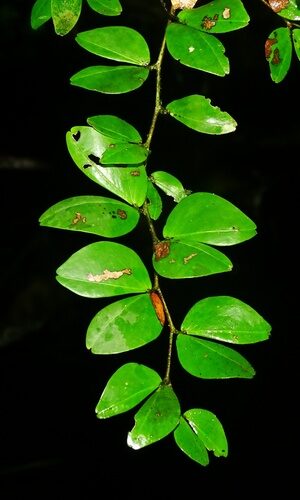
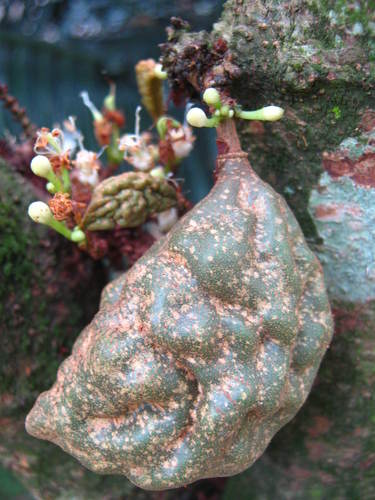
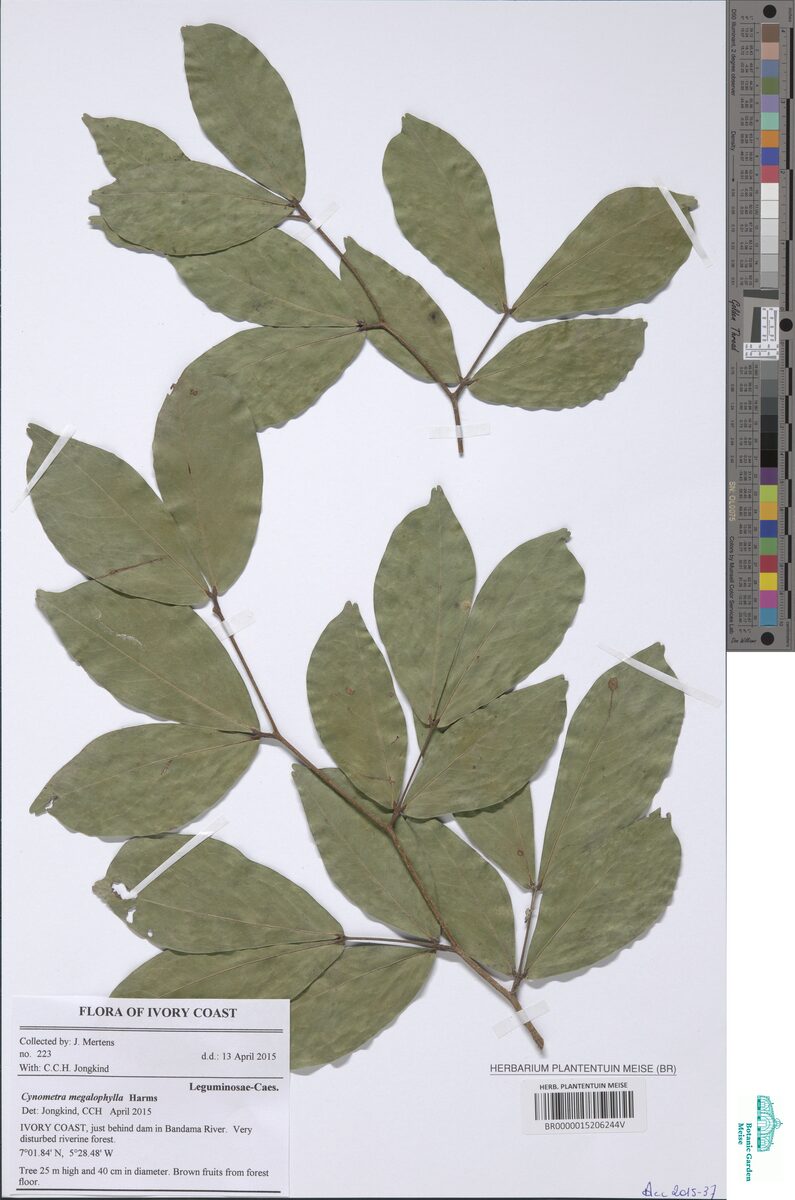
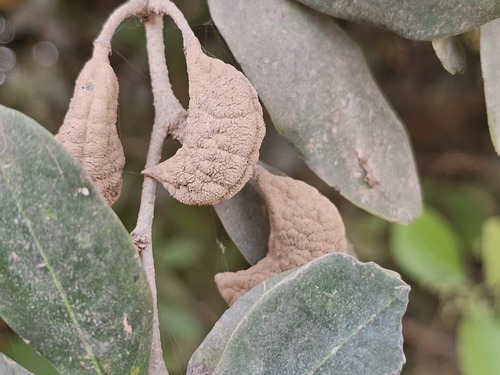
A tree. It loses its leaves during the dry season of the year. It grows to a height of 8-12 m tall and spreads to 5 m across. The stem is erect and straight. The leaves are entire to the midpoint, then divided into 2 lobes. The leaves are 10-20 cm long and 10-15 cm across. The base of the leaves is heart shaped. They are dull blue-green. The veins radiate from the base of the leaf. The leaf stalk is 2-3 cm long. The flowers are pink to purple with 5 club-shaped petals. One petal is a different shape and colour. They are produced on stalks around a flowering stalk at the end of branches. The flowers are 8-12 cm across. The fruit are pods. They are 20-30 cm long and 1.5-2.5 cm wide. They are flat and brown and twist as they open. There are 10-15 seeds. The seeds are round and flat and 1 cm across.
Edible Uses
Edible Parts: Leaves Edible Uses: The young leaves, flowers and fruits are boiled and eaten as a vegetable, or are pickled.
Traditional Uses
The flowers are used in pickles and curry. They are dried. They are edible when fried. The young leaves, flowers and fruit (pods) are boiled and cooked as a vegetable. They are also used in relish and chutney. The seeds are eaten after roasting.
Medicinal Uses
Alterative Anthelmintic Astringent Dysentery Tonic The bark is alterative, anthelmintic, astringent and tonic. The juice of the bark is used in the treatment of amoebic dysentery, diarrhoea and other stomach disrders. A paste of the bark is useful in the treatment of cuts and wounds, skin diseases, scrofula and ulcers. The dried buds are used in the treatment of piles, dysentery, diarrhoea and worms. The juice of the flowers is used to treat diarrhoea, dysentery and other stomach disorders. The root is used as an antidote to snake poison. A decoction of the root is used to treat dyspepsia.
Distribution
A tropical plant. The minimum temperature is 7°C. They cannot tolerate salt spray. It grows naturally in deciduous forest between 500 and 1500 m altitude. It can grow in arid places. It suits hardiness zones 9-10. In Yunnan.
Where It Grows
Africa, Andamans, Asia, Australia, Bahamas, Bangladesh, Bhutan, Brazil, Cambodia, Caribbean, Central Africa, Central America, China, Colombia, Congo, Costa Rica, Cyprus, Dominican Republic, East Africa, Egypt, El Salvador, Eswatini, Ethiopia, Fiji, Ghana, Grenada, Haiti, Hawaii, Himalayas, India, Indochina, Indonesia, Iraq, Israel, Jamaica, Kenya, Laos, Lebanon, Malawi, Malaysia, Mauritius, Mediterranean, Mexico, Middle East, Mozambique, Myanmar, Nauru, Nepal, New Caledonia, New Zealand, Nigeria, North Africa, North America, Northeastern India, NW India, Pacific, Pakistan, Panama, Papua New Guinea, PNG, Puerto Rico, SE Asia, Seychelles, Sierra Leone, Sikkim, South Africa, Southern Africa, South America, Sri Lanka, St Lucia, Swaziland, Tanzania, Thailand, Tonga, Uganda, USA, Vanuatu, Vietnam, West Africa, West Indies, Zambia, Zimbabwe,
Cultivation
Plants can be grown from treated seed. Fresh seeds do not need to be treated, but stored seed do. They are put into hot water then left overnight before planting. (There are 4,200-5,700 seed per kg.) Seeds germinate in about 3 weeks. It can be grown by air-layering and grafting.
Propagation
Seed - pre-soak for 12 hours in warm water then sow in mid spring in a greenhouse. When large enough t handle, prick the seedlings out into individual pots and grow them on in the greenhouse for at least their first winter. Plant out in early summer, after the last expected frosts and consider giving some protection from the cold for their first winter or two outdoors. Cuttings of half-ripe wood, with the leaves removed, in moist sand July/August in a frame. Gentle bottom heat is usually required. Layering.
Other Uses
Dye Fodder Tannin Wood The bark is a source of tannins. It is used for dyeing. Wood - used for house construction and making household implements. A very popular ornamental tree in subtropical and tropical climates, grown for its scented flowers. The leaves, shoots and pods of B. variegata are used as fodder for livestock, including sheep, goats and cattle. Average leaf yield from a mature tree is about 20-22 kg fresh weight per annum. Erosion control or dune stabilization, Shade and shelter, Windbreak. Fuels:Charcoal, Fuelwood. Special Uses
Production
Trees are fairly fast growing. Trees produce flowers when 3 years old.
Other Information
The flowers are mainly used in India and Nepal. It is not known if it is used for food in Papua New Guinea. They are sold in markets in Nepal.
Notes
There are about 250-350 Bauhinia species. Most are in the tropics. It can become invasive. Also as Caesalpinaceae.
Nutrition
| Part | Moisture | kJ | kcal | Protein | Vit A | Vit C | Iron | Zinc |
|---|---|---|---|---|---|---|---|---|
| Pods young | 70.5 | 468 | 112 | 4.4 | — | — | — | — |
| Leaves/Flowers | 78.9 | 291 | 70 | 1.8 | — | 9 | 5.3 | — |
| Buds | — | — | — | — | — | — | — | — |
| Flowers | 79 | — | — | 1.8 | — | — | 18.4 | — |
| Seeds | — | — | — | — | — | — | — | — |
Synonyms
Also Known As
Bhosa, Bunga kupu kupu, Butterfly bush, Camel-foot tree, Champa, Chingthrao, Chuvannamandaram, Dhaonro pump, Dork ban, Ger her por, Greainblack, Guiral, Hoa ban, Kachnar, Kalshiya, Kalyar, Kanaraj, Kanchan, Kanchanar, Kanchavala, Kaniar, Karial, Katyalae, Kerale, Kha-la, Khwairal, Kiorala, Koilar, Koilara, Koiralo, Kulyar, Kurial, Kurol, Kutchnar, Mahul, Malungarh, Mandari, Mogar, Mountain ebony, Okjok, Orchid tree, Pacham, Pachem, Padrian, Paj haum tsav, Pawangma, Phar-kung, Phum, Pink bauhinia, Pink camel's-foot, Pohon bauhinia talikancu merah, Raktakanchan, Segapumanchori, Sheep's foot, Sieo-dok-khao, Taki, Tapak kerbau, Variegated bauhinia, Vaube, White bauli, Yangtijia
References (120)
- Acharya K. P. and Acharya, R., 2010, Eating from the Wild: Indigenous knowledge on wild edible plants in Parroha VDC of Rupandehi District, Central Nepal. International Journal of Social Forestry. 3(1):28-48
- Ahmad, K., et al, 2018, Ethnobotanical investigation of wild vegetables used among local communities in northwest Pakistan. Acta Soc Bot Pol. 2019;88(1):3616.
- Ambasta S.P. (Ed.), 2000, The Useful Plants of India. CSIR India. p 69
- Arora, R. K., 2014, Diversity in Underutilized Plant Species - An Asia-Pacific Perspective. Bioversity International. p 100
- Aryal, K. P., et al, 2018, Diversity and use of wild and non-cultivated edible plants in the Western Himalaya. Journal of Ethnobiology and Ethnomedicine (2018) 14:10
Show all 120 references Hide references
- Baishya, S. Kr., et al, 2013, Survey of Wild Edible Fruits of Dhubri District, Assam, India. Plant Archives Vol 13 (1): 155-158
- Balkrishna, A., et al, 2022, Indigenous Uses of Plants among Forest-dependent Communities of Seijosa, Arunachal Pradesh. International Journal of Economic Plants 2022, 9(1):064-080
- Baro, D., Baruah, S. and Borthukar, S. K. 2015, Documentation on wild vegetables of Baksa district, BTAD (Assam). Scholars Research Library. Archives of Applied Science Research, 2015, 7 (9):19-27
- Barwick, M., 2004, Tropical and Subtropical Trees. A Worldwide Encyclopedic Guide. Thames and Hudson p 46
- Behera, K. K. et al, 2008, Wild Edible Plants of Mayurbhanj District, Orissa, India. J. Econ. Taxon. Bot. Vol. 32 (Suppl,) pp 305-314
- Benvenuti, S. & Mazzoncini, M., 2021, The Biodiversity of Edible Flowers: Discovering New Tastes and New Health Benefits. Frontiers in Plant Science Article 569499.
- Bhatia, H., et al, 2018, Traditionally used wild edible plants of district Udhampur, J&K, India. Journal of Ethnobiology and Ethnomedicine (2018) 14:73
- Bircher, A. G. & Bircher, W. H., 2000, Encyclopedia of Fruit Trees and Edible Flowering Plants in Egypt and the Subtropics. AUC Press. p 55
- Bodkin, F., 1991, Encyclopedia Botanica. Cornstalk publishing, p 135
- Bohra, N., et al, 2017, Ethnobotany of wild edible plants traditionally used by the local people in the Ramnagar regions from Nainital District, Uttarakhand, India. Biolife 5(1): 12-19
- Borrell, O.W., 1989, An Annotated Checklist of the Flora of Kairiru Island, New Guinea. Marcellin College, Victoria Australia. p 93
- Brickell, C. (Ed.), 1999, The Royal Horticultural Society A-Z Encyclopedia of Garden Plants. Convent Garden Books. p 161
- Burkill, H. M., 1985, The useful plants of west tropical Africa, Vol. 3. Kew.
- Burkill, I.H., 1966, A Dictionary of the Economic Products of the Malay Peninsula. Ministry of Agriculture and Cooperatives, Kuala Lumpur, Malaysia. Vol 1 (A-H) p 315
- Chettri, N. & Sharma, E., Non-timber Forest Produce: Utilization, Distribution and Status in the Khangchendzonga Biosphere Reserve, Sikkim, India.
- Cronin, L., 1989, The Concise Australian Flora. Reed. p 153
- Cundall, P., (ed.), 2004, Gardening Australia: flora: the gardener's bible. ABC Books. p 221
- Dangol, D. R. et al, 2017, Wild Edible Plants in Nepal. Proceedings of 2nd National Workshop on CUAOGR, 2017.
- DARLINGTON & AMMAL,
- Dharani, N., 2002, Field Guide to common Trees & Shrubs of East Africa. Struik. p 57
- Dobriyal, M. J. R. & Dobriyal, R., 2014, Non Wood Forest Produce an Option for Ethnic Food and Nutritional Security in India. Int. J. of Usuf. Mngt. 15(1):17-37
- Dutta, U., 2012, Wild Vegetables collected by the local communities from the Churang reserve of BTD, Assam. International Journal of Science and Advanced Technology. Vol. 2(4) p 119
- Engel, D.H., & Phummai, S., 2000, A Field Guide to Tropical Plants of Asia. Timber Press. p 45
- Etherington, K., & Imwold, D., (Eds), 2001, Botanica's Trees & Shrubs. The illustrated A-Z of over 8500 trees and shrubs. Random House, Australia. p 122
- Facciola, S., 1998, Cornucopia 2: a Source Book of Edible Plants. Kampong Publications, p 66
- Flora Zambesiaca. http://apps.kew.org/efloras
- Food Composition Tables for the Near East. http://www/fao.org/docrep No. 366
- Fowler, D. G., 2007, Zambian Plants: Their Vernacular Names and Uses. Kew. p 28
- Gardner, S., et al, 2000, A Field Guide to Forest Trees of Northern Thailand, Kobfai Publishing Project. p 168
- Ghorbani, A., et al, 2012, A comparison of the wild food plant use knowledge of ethnic minorities in Naban River Watershed Nature Reserve, Yunnan, SW China. Journal of Ethnobiology and Ethnomedicine; 8:17
- GUPTA
- Hamayun, M., Ethnobotanical Studies of some Useful Shrubs and Trees of District Buner, NWFP, Pakistan
- Hearne, D.A., & Rance, S.J., 1975, Trees for Darwin and Northern Australia. AGPS, Canberra p 31, Pl 9
- Hibbert, M., 2002, The Aussie Plant Finder 2002, Florilegium. p 39
- http://cypruswildflowers.com
- Hu, Shiu-ying, 2005, Food Plants of China. The Chinese University Press. p 467
- ILDIS Legumes of the World http:www;ildis.org/Legume/Web
- Jabeen, A., et al, 2009, Indigenous uses of economically important flora of Margallah Hills National Park, Islamabad, Pakistan. African Journal of Biotechnology Vol. 8 (5), pp. 763-784
- Johnson, N., 2002, Environmental Change in northern Thailand: Impact on Wild Edible Plant Availability. Ecology of Food and Nutrition, 41: 5, 373-399
- Joshi, N., et al, 2007, Traditional neglected vegetables of Nepal: Their sustainable utilization for meeting human needs. Tropentag 2007. Conference on International Agricultural Research for Development.
- Kar, A., et al, 2013, Wild Edible Plant Resources used by the Mizos of Mizoram, India. Kathmandu University Journal of Science, Engineering and Technology. Vol. 9, No. 1, July, 2013, 106-126
- Katende, A.B., Birnie, A & Tengnas B., 1995, Useful Trees and Shrubs for Uganda. Identification, Propagation and Management for Agricultural and Pastoral Communities. Technical handbook No 10. Regional Soil Conservation Unit, Nairobi, Kenya. p 126
- Khan, M. & Hussain, S., 2014, Diversity of wild edible plants and flowering phenology of district Poonch (J & K) in the northwest Himalaya. Indian Journal of Sci, Res. 9(1): 032-038
- Khodram,S. D., et al, 2019, Local knowledge of edible flowers used in Mizoram. Indian Journal of Traditional Knowledge Vol 18(40 pp 715-723
- Kiran, K. C., et al, 2019, Diversity and Seasonal Availability of Potential Wild Edible Plants from Vidarbha Region of Maharashtra State, India. Int.J.Curr.Microbiol.App.Sci (2019) 8(2): 1434-1446
- Krishen P., 2006, Trees of Delhi, A Field Guide. DK Books. p 192
- Kumar, A., 2013, Ethnobotanical study of wild vegetables used by rural communities of Kannauj district, Uttar Pradesh, India. Emir. J. Food Agric. 2013. 25 (10): 760-766
- Kumar, P. D., et al, 2015, Ethnobotanical Knowledge and Usage of Wild Plants in Theog Forest Division, Himachal Pradesh, North Western Himalaya. The Journal of Ethnobiology and Traditional Medicine. Photon 124(2015) 922-935
- Kumar, R., et al, 2013, Ethnoboptany of Tharus or Dudhwa National Park, India. Mintage journal of Pharmaceutical & Medical Science 6-11
- Liu, Yi-tao, & Long, Chun-Lin, 2002, Studies on Edible Flowers Consumed by Ethnic Groups in Yunnan. Acta Botanica Yunnanica. 24(1):41-56
- Llamas, K.A., 2003, Tropical Flowering Plants. Timber Press. p 199
- Lord, E.E., & Willis, J.H., 1999, Shrubs and Trees for Australian gardens. Lothian. p 48
- Maheshwari, J.K., & Singh, J.P., 1984, Contribution to the Ethnobotany of Bhoxa Tribe of Bijnor and Pauri Garhwal Districts, U.P. J. Econ. Tax. Bot. Vol.5. No.2 pp 253- (As Perlebia variegata)
- Manandhar, N.P., 2002, Plants and People of Nepal. Timber Press. Portland, Oregon. p 107
- Manju, S., and Sundriyal, R. C., 2001, Wild Edible Plants of the Sikkim Himalaya: Nutritive Values of Selected Species. Economic Botany 55(3): 377-390
- Marandi, R. R. & Britto, S. J., 2015, Medicinal Properties of Edible Weeds of Crop Fields and Wild plants Eaten by Oraon Tribals of Latehar District, Jharkhand. International Journal of Life Science and Pharma Research. Vo. 5. (2) April 2015
- Marinelli, J. (Ed), 2004, Plant. DK. p 445
- Martin, F.W. & Ruberte, R.M., 1979, Edible Leaves of the Tropics. Antillian College Press, Mayaguez, Puerto Rico. p 87, 198
- Masoodi, H. U. R. & Sundriyal, R. C., 2020, Richness of non-timber forest products in Himalayan communities—diversity, distribution, use pattern and conservation status. Journal of Ethnobiology and Ethnomedicine 16:56
- Mbuya, L.P., Msanga, H.P., Ruffo, C.K., Birnie, A & Tengnas, B., 1994, Useful Trees and Shrubs for Tanzania. Regional Soil Conservation Unit. Technical Handbook No 6. p 120
- Mehta, P. S. et al, 2010, Native plant genetic resources and traditional foods of Uttarakhand Himalaya for sustainable food security and livelihood. Indian Journal or Natural products and Resources. Vol 1(1), March 2010 pp 89-96
- Meitei, L. R., et al, 2022, An ethnobotanical study on the wild edible plants used by forest dwellers in Yangoupokpi Lokchao Wildlife Sanctuary, Manipur, India. Ethnobotany Research and Application 23:15
- Mukhia, P.K., et al, 2013, Wild plants as Non Wood Forest Products used by the rural community of Dagana, a southern foothill district of Bhutan, SAARC Journal, 27 pages
- Murtem, G. & Chaudhrey, P., 2016, An ethnobotanical note on wild edible plants of Upper Eastern Himalaya, India. Brazilian Journal of Biological Sciences, 2016, v. 3, no. 5, p. 63-81.
- Pandey, K. C. & Pande, N., 2016, Ethnobotanical Documentation of Wild Edible Plants used by Gujjar Community of Tarai West Forest Division Ramnagar, Nainital, India, Current World Environment. Vol. 11(3), 808-818
- Patiri, B. & Borah, A., 2007, Wild Edible Plants of Assam. Geethaki Publishers. p 43
- Pham-Hoang Ho, 1999, An Illustrated Flora of Vietnam. Nha Xuat Ban Tre. p 854
- Phangchopi, U., et al, 2015, Diversity of wild edible plants in Marat Longri Wildlife Sanctuary, Assam. Indian Journal of Natural Products and Resources Vol. 6(4), December 2015 pp. 305-313
- Phon, P., 2000, Plants used in Cambodia. © Pauline Dy Phon, Phnom Penh, Cambodia. p 92
- Plants of Haiti Smithsonian Institute http://botany.si.edu/antilles/West Indies
- Plowes, N. J. & Taylor, F. W., 1997, The Processing of Indigenous Fruits and other Wildfoods of Southern Africa. in Smartt, L. & Haq. (Eds) Domestication, Production and Utilization of New Crops. ICUC p 186
- Prabha, Y. P., et al, 2010, Documentation of Wild Edible Plants of Melghat Forest, Dist. Amravati, Maharashtra State, India. Ethnobotanical Leaflets 14: 751-58, 2010.
- Prachi, K., et al, 2012, Underutilized wild fruits of North Maharashtra. Journal of Research in Plant Sciences. (2012) 1:071-076
- Pradheep, K., et al, 2016, Wild edible plants used by Konyak tribe in Mon district of Nagaland: Survey and inventorisation. Indian Journal of Natural Products and Resources. Vol 7(1) pp 74-81
- Prashanth Kumar, G.M. and Shiddamallayya, N., 2015, Ethnobotanical Study of Less Known Wild Edible Plants of Hakki Pikki Tribes of Angadihalli, Hassan District, Karnataka. Journal or Medicinal Plants Studies 3(5):80-85
- Rana, D., et al, 2019, Ethnobotanical knowledge among the semi-pastoral Gujjar tribe in the high altitude (Adhwari’s) of Churah subdivision, district Chamba, Western Himalaya. Journal of Ethnobiology and Ethnomedicine (2019) 15:10
- Roa, J. A. G. & Boada, D. S. G., 2018, Fundación para el Fortalecimiento de la Fruticultura y Plantas Alimenticias no Convencionales en Colombia.
- Royal Botanic Gardens, Kew (1999). Survey of Economic Plants for Arid and Semi-Arid Lands (SEPASAL) database. Published on the Internet; http://www.rbgkew.org.uk/ceb/sepasal/internet [Accessed 21st April 2011]
- Sahni, K.C., 2000, The Book of Indian Trees. Bombay Natural History Society. Oxford. p 84
- Sarma, H., et al, 2010, Updated Estimates of Wild Edible and Threatened Plants of Assam: A Meta-analysis. International Journal of Botany 6(4): 414-423
- Savita, et al, 2006, Studies on wild edible plants of ethnic people in east Sikkim. Asian J. of Bio Sci. (2006) Vol. 1 No. 2 : 117-125
- Sawian, J. T., et al, 2007, Wild edible plants of Meghalaya, North-east India. Natural Product Radiance Vol. 6(5): p 413
- Sharma, P., et al, 2013, Wild edibles of Murari Devi and surrounding areas in Mandi district of Himachal Pradesh, India. International Journal of Biodiversity and Conservation. Vol. 5(9), pp. 580-592, September 2013
- Sher, Z., Hussain, F., & Ibrar, M., 2014, Traditional knowledge on plant resources of Ashezai and Salarzai Valleys, District Buner, Pakistan. African Journal of Plant Science. Vol. 8(1), pp. 42-53, January 2014
- Shin, T., et al, 2018, Traditional knowledge of wild edible plants with special emphasis on medicinal uses in Southern Shan State, Myanmar. Journal of Ethnobiology and Ethnomedicine (2018) 14:48
- Shrestha, S., 2021, Wild Edible Plants of Dhankuta, Eastern Nepal. Rupantaran : A Multidisciplinary Journal Vol. V : pp 100-109, September, 2021 p 102
- Singh, A. G., Panthi, M. P., & Tewari, D. D., 2012, Wild Plants Used as Vegetable in Rupandehi District of Nepal and their Ethnomedicinal Importance. J. Nat. Hist. Mus. Vol. 26, 2012, 111-125
- Slik, F., www.asianplant.net
- Sp. pl. 1:375. 1753
- Srivastava, R. C., 2009, Traditional knowledge of Adi tribe of Arunachal Pradesh on plants. Indian Journal of Traditional Knowledge. 8(2): 146-153
- Staples, G.W. and Herbst, D.R., 2005, A tropical Garden Flora. Bishop Museum Press, Honolulu, Hawaii. p 306
- Sukarya, D. G., (Ed.) 2013, 3,500 Plant Species of the Botanic Gardens of Indonesia. LIPI p 154
- Sundriyal, M., et al, 1998, Wild edibles and other useful plants from the Sikkim Himalaya, India. Oecologia Montana 7:43-54
- Sundriyal, M., et al, 2004, Dietary Use of Wild Plant Resources in the Sikkim Himalaya, India. Economic Botany 58(4) pp 626-638
- Sundriyal, M. & Sundriyal, R. C., 2004, Structure, Phenology, Fruit Yield, and Future Prospects of some Prominent Wild Edible Plant Species of the Sikkim Himalaya, India. Journal of Ethnobiology 24(1): 113-138
- Sutjaritjai, N., et al, 2019, Traditional Uses of Leguminosae among the Karen in Thailand. Plants 2019, 8, 600 p 5
- Swaminathan, M.S., and Kochnar, S.L., 2007, An Atlas of Major Flowering Trees in India. Macmillan. p 118
- Taram, M., et al, 2018, Wild Food Plant Resources of Komkar Adi Tribe of Upper Siang District in Arunachal Pradesh, India. Bulletin of Arunachal Forest Research, Vol. 33(2), 27-35
- Terra, G.J.A., 1973, Tropical Vegetables. Communication 54e Royal Tropical Institute, Amsterdam, p 29
- Thapa, L. B., et al, 2014, Wild Edible Plants used by endangered and Indigenous Raji Tribe in Western Nepal. International Journal of Applied Sciences and Biotechnology. Vol 2(3):243-252
- Thitiprasert, W., et al, 2007, Country report on the State of Plant Genetic Resources for Food and Agriculture in Thailand (1997-2004). FAO p 95
- Tiwari, J. K., et al, 2010, Some Promising Wild Edible Plants of Srinagar and its Adjacent Area in Alaknanda Valley of Garhwal Himalaya, India. Journal of American Science 6(4) p 167ff
- Toppo, P. et al, 2016, Wild edible plants of Dhamtari district of Chhattisgarh, India. Van Sangyan Vol. 3, No. 4
- Tsering, J., et al, 2017, Ethnobotanical appraisal on wild edible plants used by the Monpa community of Arunchal Pradesh. Indian Journal of Traditional Knowledge. Vol 16(4), October 2017, pp 626-637
- Uprety, Y., et al, 2011, Plant biodiversity and ethnobotany inside the projected impact area of the Upper Seti Hydropower Project, Western Nepal. Environ. Dev. Sustain. (2011) 13:463-492
- Uprety, Y., et al, 2012, Diversity of use and local knowledge of wild edible plant resources in Nepal. Journal of Ethnobotany and Ethnomedicine 8:16
- Valder, P., 1999, The Garden Plants of China. Florilegium. p 267
- Verdcourt, B., 1979, Manual of New Guinea Legumes. Botany Bulletin No 11, Division of Botany, Lae, Papua New Guinea. p 119
- Whitney, C. W., et al, 2014, Conservation and Ethnobotanical Knowledge of a Hmong Community in Long Lan, Luang Prabang, Lao People’s Democratic Republic. Ethnobotany Research and Applications 12:643-658
- World Checklist of Useful Plant Species 2020. Royal Botanic Gardens, Kew
- www.mekonginfo.org/assets/midocs/0001714-environment-forests-and-trees-of-the-central-highlands-of-xieng-khouang-lao
- www.worldagroforestrycentre.org/treedb/
- Xu, Z., Tao, G. & Tan, J., 1988, Tropical Wild Flowers and Plants in Xishuangbanna, Agricultural Publishing House. photo 11
- Young, J., (Ed.), 2001, Botanica's Pocket Trees and Shrubs. Random House. p 131
- Zuchowski W., 2007, Tropical Plants of Costa Rica. A Zona Tropical Publication, Comstock Publishing. p 135