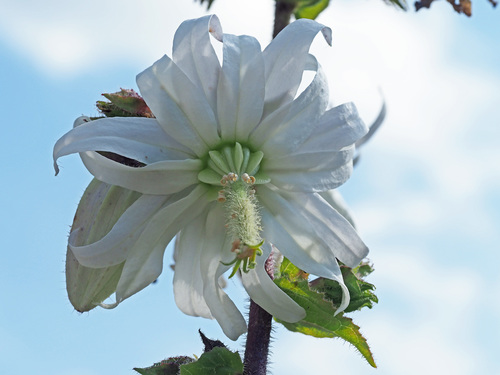
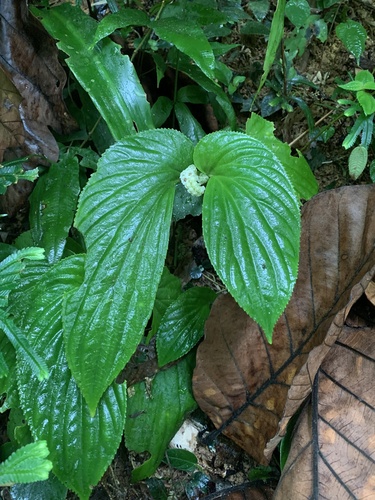
Campanula punctata
Lam.
Chinese rampion
iNaturalist· cc-by-nc
(c) Svetlana Nesterova, some rights reserved (CC BY-NC), uploaded by Svetlana Nesterova
iNaturalist· cc-by-nc
(c) Svetlana Nesterova, some rights reserved (CC BY-NC), uploaded by Svetlana Nesterova
Summary
Source: WikipediaCampanula punctata, the spotted bellflower, is a species of flowering plant in the bellflower family Campanulaceae. This ornamental herbaceous perennial is native to Japan, Korea, China and Siberia, and is widely cultivated for its attractive bell-shaped flowers. The Latin specific epithet punctata means "spotted".
Description
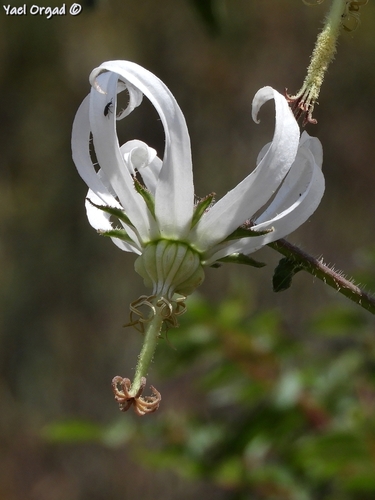
A small plant. It grows 30 cm high and spreads 45 cm wide. It keeps growing from year to year and forms clumps. The leaves are pointed and heart shaped. The flowers are tube shaped and hang down. They are cream with red spots inside. They are 8 cm long.
Edible Uses
Both the flowers and leaves can be used as potherbs. The leaves are slightly hairy but have a very pleasant raw taste with a notable sweetness, and they make a highly acceptable salad green. The flowers are a decorative and tasty addition to the salad bowl.
Traditional Uses
The young leaves are eaten with oil and salt. The flowers and leaves are used as potherbs.
This uses section is brief — help expand it
Medicinal Uses
None known.
Distribution
It is a temperate plant. It grows well in composted soils in a protected sunny position. It is resistant to frost but sensitive to drought. It suits hardiness zones 6-9. In Sichuan.
Where It Grows
Asia, Australia, China, Europe*, Japan, Korea, Mongolia, Russia, Siberia, Tasmania,
Cultivation
Succeeds in most fertile well-drained soils, though it prefers a moist but well-drained rich sandy loam and a neutral or alkaline soil in sun or partial shade. Plants are hardy in most parts of Britain but are best grown in pots in a cold greenhouse. Another report says that it is very well suited to the ornamental garden. This species has proved to be difficult of cultivation in many gardens, though it spreads freely in others and can become invasive. It probably requires a very light soil, and is more inclined to die out when growing in clay. Where successful, the plants usually produce an abundance of seed and sometimes self-sow. Closely related to C. takesimana. The species in this genus do not often hybridize and so seed can generally be relied upon to come true. The plants are self-fertile. There are several named forms selected for their ornamental value. Members of this genus are rarely if ever troubled by browsing deer.
Propagation
Sow seed on the surface in a cold frame in spring; germination typically occurs in 2–4 weeks at 18°C and is easy. Once large enough to handle, prick seedlings out into individual pots and grow on in a cold frame for at least the first winter, then plant out in late spring or early summer after the last expected frosts. Take basal cuttings in spring by harvesting shoots around 10–15cm long with plenty of underground stem; pot individually and keep in light shade in a cold frame or greenhouse until rooting well, then plant out in summer. Divide in spring or autumn — larger clumps can go directly into permanent positions, though smaller clumps are better potted up and grown on in a cold frame until rooting well, then planted out in summer or the following spring.
Other Uses
None known.
Notes
There are about 300 Campanula species.
References (12)
- Bodkin, F., 1991, Encyclopedia Botanica. Cornstalk publishing, p 208
- Brickell, C. (Ed.), 1999, The Royal Horticultural Society A-Z Encyclopedia of Garden Plants. Convent Garden Books. p 222
- Chen, B. & Qiu, Z., Consumer's Attitudes towards Edible Wild Plants, Ishikawa Prefecture, Japan. p 22 www.hindawi.com/journals/ijfr/aip/872413.pdf
- Cundall, P., (ed.), 2004, Gardening Australia: flora: the gardener's bible. ABC Books. p 321
- Encycl. 1:586. 1785
Show all 12 references Hide references
- Facciola, S., 1998, Cornucopia 2: a Source Book of Edible Plants. Kampong Publications, p 69
- Hibbert, M., 2002, The Aussie Plant Finder 2002, Florilegium. p 58
- Kim, H. & Song, M., 2013, Ethnobotanical analysis for traditional knowledge of wild edible plants in North Jeolla Province (Korea). Genetic. Resour. Crop Evol. (2013) 60:1571-1585
- Kunkel,
- Plants for a Future database, The Field, Penpol, Lostwithiel, Cornwall, PL22 0NG, UK. http://www.scs.leeds.ac.uk/pfaf/
- READ,
- Tanaka,