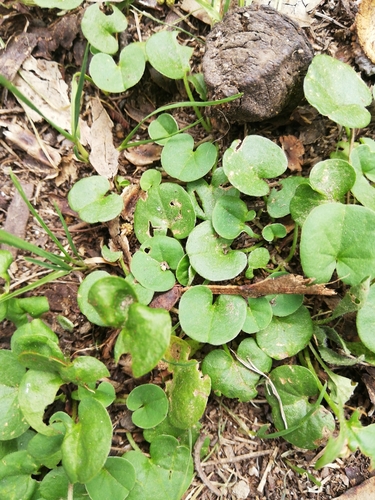
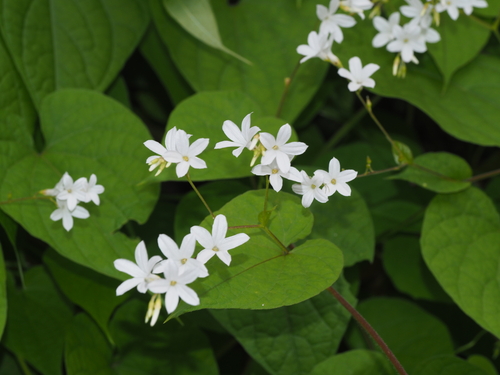
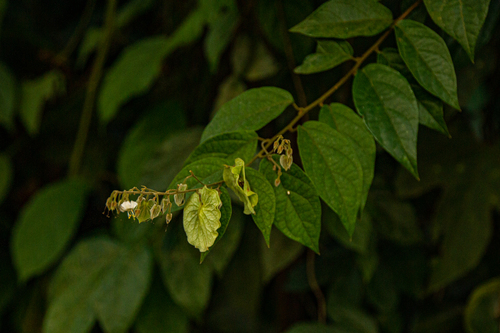
Hewittia malabarica
(L.) Suresh
iNaturalist· cc-by-nc
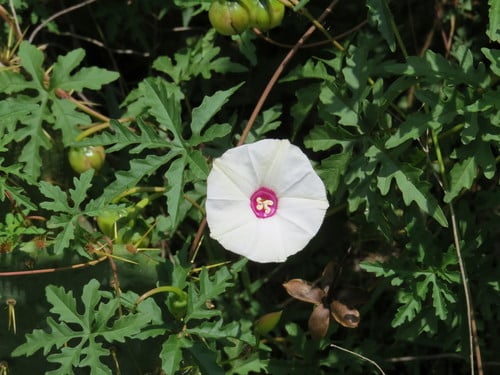
(c) Roddy CJ Ward, some rights reserved (CC BY-NC), uploaded by Roddy CJ Ward
iNaturalist· cc-by-nc
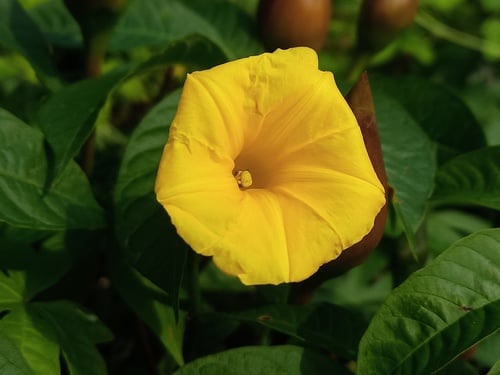
(c) Felix Riegel, some rights reserved (CC BY-NC)
iNaturalist· cc-by-nc
(c) eric_wilmot, some rights reserved (CC BY-NC)
Summary
Source: WikipediaHewittia malabarica is a flowering plant in the monotypic genus Hewittia Wight & Arn., belonging to the family Convolvulaceae and widespread throughout tropical Africa, Asia, and Polynesia. It is a climbing or prostrate perennial herb with slender stems and flowers that are pale yellow, cream, or white with a purple center, and large leaves that can be used as a cooked vegetable or used in folk medicine with the roots. The stems can be used to make ropes.
Description
A slender herb. It lies along the ground and keeps growing from year to year. It can be twining to a height of 3 m. It can form roots at the nodes. The leaves are alternate and simple. The leaf stalks are 9 cm long. The leaf blade is oval and 2-14 cm long by 1-10 cm wide. There can be teeth along the edge. The flowers are in the axils of the leaves. The ring of flower petals is yellow with a purple throat. The fruit is a rounded capsule. It is 1 cm across. There are 4 valves and 2-4 seeds.
Edible Uses
The leaves are cooked and eaten as a vegetable, often in mixtures with other vegetables. It is a minor vegetable popular in some regions.
Traditional Uses
The leaves are cooked and eaten as a vegetable. It can be cooked with other vegetables.
This uses section is brief — help expand it
Medicinal Uses
It has various uses; as well as being an edible plant, it has medicinal uses, is used in rope making, and is also an ornamental garden plant. It is used in folk medicine, where the leaves are rubbed on sores. In the China, the leaf is used in an oral decoction and in baths. A root decoction is drunk to rid the body of Oxyuris or 'threadworms'. The leaves are used as a cooked vegetable, they are collected from the wild and then cooked. It is often available when other vegetables are scarce. They are chopped up, boiled, the water is then drained and the vegetable is mixed with pounded groundnuts or coconut milk and eaten with ugali or rice. Alternatively, the leaf is cooked with other vegetables such as Amaranthus or bidens, coconut milk or groundnut paste is then added and the whole mixture is served with a staple such as rice. In Uganda, they are popular with the Langi people, who use it for a traditional dish called 'onyebe'. It is also occasionally grown as an ornamental plant and also as a ground cover in plantations. In Madagascar, it is used as a cover-plant in plantations of 'ylang-ylang' (Cananga odorata (Lam.) Hook f. & Thomson) and it is also grazed by cattle. It is used as cattle fodder in Benin with a wide range of other plants. The fiber from the inner bark is also used to make ropes.
Distribution
It is a tropical plant. It grows in forest re-growth. In Malawi it grows between 480-1,200 m altitude. It can grow from sea level to 1,800 m above sea level. It grows in areas with a rainfall of 1,100-2,100 mm. In Yunnan.
Where It Grows
Africa, Asia, Cambodia, Cameroon, Central Africa, Côte d'Ivoire, East Africa, Gambia, India, Indochina, Indonesia, Ivory Coast, Jamaica, Kenya, Laos, Malawi, Malaysia, Mozambique, Myanmar, New Guinea, Nigeria, Pacific, Philippines, Polynesia, SE Asia, Sierra Leone, Sri Lanka, Taiwan, Tanzania, Thailand, Uganda, Vietnam, West Africa, West Indies, West Timor,
Cultivation
Plants can be grown by seeds or cuttings.
Propagation
Seed - Cuttings.
Other Uses
The fibre from the inner bark is used for making ropes. The plant is sometimes grown as a cover plant in plantations of ylang-ylang (Cananga odorata).
Production
Leaves are collected in the rainy season.
Other Information
A minor vegetable popular in some places.
Notes
There may only be one Hewittia species.
Synonyms
Also Known As
Mafumanheca, Nhembeatata
References (5)
- Burkill, H. M., 1985, The useful plants of west tropical Africa, Vol. 1. Kew.
- Grubben, G. J. H. and Denton, O. A. (eds), 2004, Plant Resources of Tropical Africa 2. Vegetables. PROTA, Wageningen, Netherlands. p 310
- Ruffo, C. K., Birnie, A. & Tengnas, B., 2002, Edible Wild Plants of Tanzania. RELMA p 366 (As Hewittia sublobata)
- White, F., Dowsett-Lemaire, F. and Chapman, J. D., 2001, Evergreen Forest Flora of Malawi. Kew. p 211
- World Checklist of Useful Plant Species 2020. Royal Botanic Gardens, Kew