Cercestis mirabilis
(N. E. Br.) Bogner
iNaturalist· cc-by-nc
(c) awajikeem, some rights reserved (CC BY-NC), uploaded by awajikeem
iNaturalist· cc-by-nc
(c) OTTO ITOUA Bernard De Sebastien, some rights reserved (CC BY-NC)
Summary
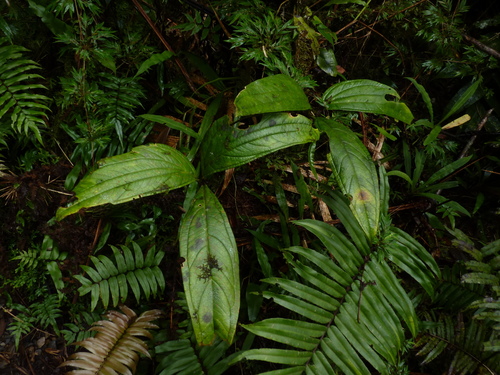
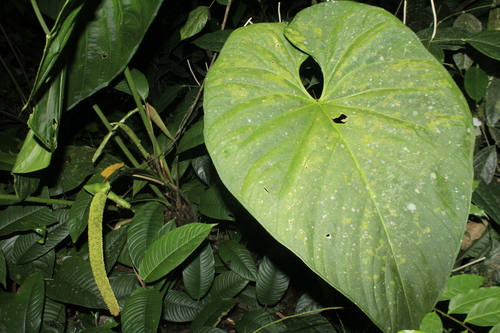
Source: WikipediaCercestis mirabilis is a perennial herb that can grow up to 3.3 m (11 ft) tall. It is an obligate climber, which means that it requires support to grow. The stem is about 2.5 cm (0.98 in) thick and can climb up to a height of 9 m (30 ft), rooting as it climbs. The juvenile leaves are saggitate with white markings. The adult leaves are about 60 cm (24 in) long, simple, broad, and glabrous, with a terete petiole that is 25–60 cm (9.8–23.6 in) long and grooved at the base in the adult plant. It is native to tropical Africa.
Description
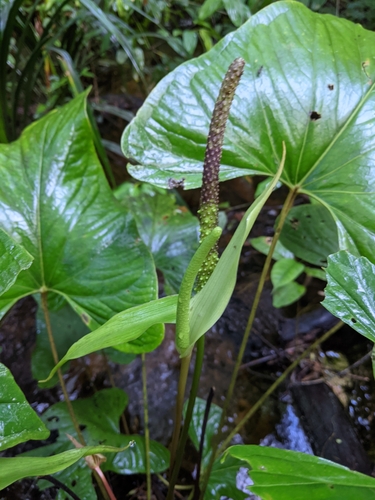
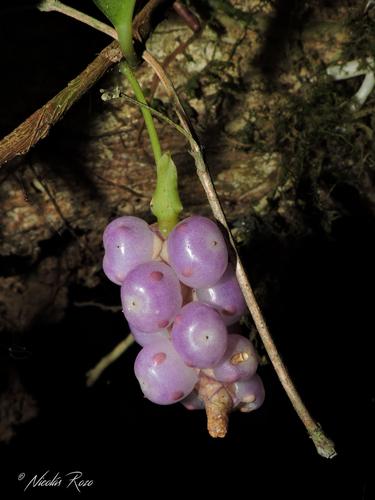
A stout climber. It has long roots that hang down. There are also roots that clasp trees. It grows 3 m tall. The stem can be 5 cm across. The leaves are alternate and simple. The leaf stalk can be 1 m long. The leaves are a spear head shape and 100 cm long by 60 cm wide. It has deep irregular lobes along it. The flowering spadix is 7-17 cm long by 1-2 cm wide. It has a spathe around it that is green on the outside and paler inside. The flowers are of separate sexes with male flowers on the upper part of the spadix. The fruit is a pyramid shaped berry.
Edible Uses
The leaf stalks and leaves are cooked in special preparations and used as a vegetable, though it is considered a very minor vegetable.
Traditional Uses
The leaves are cooked in special preparations.
This uses section is brief — help expand it
Medicinal Uses
The leaves are cooked in butter made from moabi nuts (Baillonella toxisperma), together with an unspecified fungus, and eaten to treat liver complaints and stitch. The leaves may also be combined with the bark of various trees, the rhizome of Sarcophrynium species and seeds of chilli to treat the same ailments. The leaf sap is taken in draught with kaolin, melegueta pepper (Aframomum melegueta) and rock salt to treat heart troubles and to stop vomiting.
Distribution
It is a tropical plant It grows in the forest. It grows in lowland humid forests up to 400 m above sea level. Brisbane Botanical Gardens.
Where It Grows
Africa, Angola, Asia, Australia, Benin, Cameroon, Central Africa, Central African Republic, CAR, Congo, East Africa, Equatorial Guinea, Gabon, Myanmar, Nigeria, SE Asia, Uganda, West Africa,
Cultivation
Cercestis mirabilis is a plant of the lowland, humid tropics, where it can be found at elevations up to 400 metres. The plant can be cut back quite severely when harvesting it. New shoots are soon produced from the lower stem
Other Uses
The long pendulous roots are used as ties for yams. The central fibrous core of the roots is used as a fishing line.
Other Information
It is a very minor vegetable.
Synonyms
Also Known As
Bou odu, Eko, Kpakpari
References (4)
- Burkill, H. M., 1985, The useful plants of west tropical Africa, Vol. 1. Kew.
- Chapman, J. D. & Chapman, H. M., 2001, The Forest Flora of Taraba and Andamawa States, Nigeria. WWF & University of Canterbury. p 208
- Grubben, G. J. H. and Denton, O. A. (eds), 2004, Plant Resources of Tropical Africa 2. Vegetables. PROTA, Wageningen, Netherlands. p 177
- World Checklist of Useful Plant Species 2020. Royal Botanic Gardens, Kew